Home > Press > Tension in axons is essential for synaptic signaling, researchers report
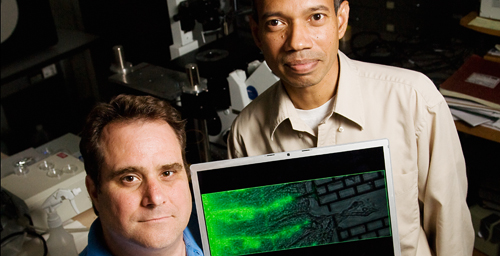 |
| Photo by L. Brian Stauffer Doctoral student Scott Siechen, left, and mechanical science and engineering professor Taher Saif and their colleagues found that tension in axons is required for proper neuron signaling. |
Abstract:
Every time a neuron sends a signal - to move a muscle or form a memory, for example - tiny membrane-bound compartments, called vesicles, dump neurotransmitters into the synapse between the cells. Researchers report that this process, which is fundamental to the workings of the nervous system, relies on a simple mechanical reality: Tension in the axon of the presynaptic neuron is required.
Tension in axons is essential for synaptic signaling, researchers report
Champaign, IL | Posted on July 20th, 2009Without this tension, the researchers found, the vesicles that must haul their chemical cargo to the synapse for neuronal signaling would instead disperse.
The new findings appear this week in the Proceedings of the National Academy of Sciences.
"There is no controversy here," said University of Illinois mechanical science and engineering professor Taher Saif, who conducted the study with biology professor Akira Chiba, now at the University of Miami. Chiba's former doctoral student Scott Siechen and Saif's former doctoral student Shengyuan Yang also contributed significantly to the study. "We're not saying that you don't need chemical or electrical signals for the neurons to fire. All we're saying is that you also need tension in the axons."
The discovery was made almost by accident, Saif said. In a study of fruit fly embryos, Siechen wanted to know whether severing the growing end of an axon would prevent it from reaching its target, a nearby muscle cell.
After severing the axon, he watched the growing tip of the axon, called the growth cone, continue to grow toward and touch the muscle cell. But when he stained it, he noticed that the vesicles in the axon tip were dispersed, not clustered together near the synapse as they normally are.
He then repeated the experiment, but used a micropipette to pull on the severed end of the axon before staining it. This time the vesicles appeared at high density near the synapse.
This indicated that tension in the severed axon was somehow directing the vesicles to collect near the synapse, Saif said.
"The axon is physically cut off, chemically cut off, electrically cut off from the rest of the cell," he said. "So it appears that tension is all that was needed to keep the vesicles in place. But the question is, what keeps the vesicles there?"
Saif hypothesized that the axons in the embryo must be under tension. Otherwise - like a guitar string that is too loose to tune - it would not readily respond to changes in tension.
Using nanoscale probes developed in Saif's laboratory to gently deform an intact axon, the researchers found that the resting tension in a typical axon is about 1 nanonewton. (One newton has been described as the force required to hold a standard-sized apple against the pull of gravity; a nanonewton is 1-billionth of that force.) Saif's hypothesis was thus proved true.
The researchers next turned their attention to the structure of the axon terminal, the region that lies closest to the synapse. This region contains many proteins, including actin, which is found in virtually all cell types and is known for maintaining cell shape and generating tension. Under the right conditions, individual actin molecules link together into ropelike filaments. Another protein, myosin, acts as a motor that connects the fibers and causes them to slide in relation to one another. This sliding can increase or decrease tension in the cell.
Other researchers have suggested that actin in axon terminals acts as a kind of scaffold that holds the vesicles near the synapse, Saif said. If that is true, he said, then tension also plays a significant role in the process. It appears that actin cannot properly scaffold the vesicles without sufficient tension in the axon terminal. Further research is needed to identify the exact mechanism that allows this to work, he said.
"This study shows that tension in neurons might be one of the parameters so far overlooked in the quest for understanding learning and memory," Saif said. "We know from studies done elsewhere that tension in neurons creates folds in the brain, and it may be that a lack of tension in the neuron or a lack of the neuron's ability to generate tension is linked with memory loss or other neurological disorders."
####
About University of Illinois
We serve the state, the nation, and the world by creating knowledge, preparing students for lives of impact, and addressing critical societal needs through the transfer and application of knowledge.
For more information, please click here
Contacts:
Diana Yates
Life Sciences Editor
217-333-5802
Issuers of news releases, not 7th Wave, Inc. or Nanotechnology Now, are solely responsible for the accuracy of the content.
Bookmark:


| Related News Press |
News and information
 Quantum computer improves AI predictions April 17th, 2026
Flexible sensor gains sensitivity under pressure April 17th, 2026
A reusable chip for particulate matter sensing April 17th, 2026
Detecting vibrational quantum beating in the predissociation dynamics of SF6 using time-resolved photoelectron spectroscopy April 17th, 2026
Possible Futures
A fundamentally new therapeutic approach to cystic fibrosis: Nanobody repairs cellular defect April 17th, 2026
UC Irvine physicists discover method to reverse ‘quantum scrambling’ : The work addresses the problem of information loss in quantum computing system April 17th, 2026
Nanomedicine
A fundamentally new therapeutic approach to cystic fibrosis: Nanobody repairs cellular defect April 17th, 2026
New molecular technology targets tumors and simultaneously silences two ‘undruggable’ cancer genes August 8th, 2025
New imaging approach transforms study of bacterial biofilms August 8th, 2025
Electrifying results shed light on graphene foam as a potential material for lab grown cartilage June 6th, 2025
Announcements
A fundamentally new therapeutic approach to cystic fibrosis: Nanobody repairs cellular defect April 17th, 2026
UC Irvine physicists discover method to reverse ‘quantum scrambling’ : The work addresses the problem of information loss in quantum computing system April 17th, 2026
Tools
Metasurfaces smooth light to boost magnetic sensing precision January 30th, 2026
From sensors to smart systems: the rise of AI-driven photonic noses January 30th, 2026
Japan launches fully domestically produced quantum computer: Expo visitors to experience quantum computing firsthand August 8th, 2025
Nanobiotechnology
A fundamentally new therapeutic approach to cystic fibrosis: Nanobody repairs cellular defect April 17th, 2026
New molecular technology targets tumors and simultaneously silences two ‘undruggable’ cancer genes August 8th, 2025
New imaging approach transforms study of bacterial biofilms August 8th, 2025
Electrifying results shed light on graphene foam as a potential material for lab grown cartilage June 6th, 2025
 |
||
 |
||
| The latest news from around the world, FREE | ||
 |
||
|
|
||
| Premium Products | ||
 |
||
|
Only the news you want to read!
Learn More |
||
 |
||
|
Full-service, expert consulting
Learn More |
||
|
|
||