Home > Press > 'Conductive ink' solar panels capture sun power for soldiers
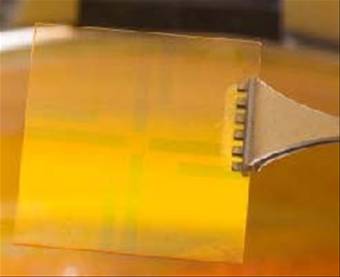 |
| Plexcore® technology, depicted here, allows solar cells to form-fit soldiers’ uniforms to power GPS components and communication devices, and could also be used to “print” solar panels onto thin films incorporated into military tents. Commercial applications include solar energy batteries for cell phones, radios, and other portable devices. (U.S. Air Force photo) |
Abstract:
Scientists at the Air Force Research Laboratory Materials and Manufacturing Directorate (AFRL/RX), in a concerted effort with Plextronics, Inc., and the Pennsylvania NanoMaterials Commercialization Center, both located in Pittsburgh, Pa., developed a ready-to-use, cost-reducing technology that can capture sunlight and store it as energy to power Global Positioning System components, portable communications, and other devices for U.S. soldiers.
'Conductive ink' solar panels capture sun power for soldiers
Wright-Patterson Air Force Base, OH | Posted on July 14th, 2009According to 2nd Lt. Christopher A. Vaiana of the Directorate's Nonmetallic Materials Division, AFRL/RX provided guidance and funding to develop a special "conductive ink" that can be used to make printed organic photovoltaic solar cell panels on very thin, flexible surfaces using ink-jet printing. This new technology, called Plexcore®, developed and manufactured by Plextronics, allows solar cells to form-fit soldiers' uniforms. It can also be used to print solar panels onto thin films in military tents, Lieutenant Vaiana said.
The agreement between AFRL/RX and the Commercialization Center includes the development of a technology roadmap identifying technologies AFRL/RX needs and is interested in funding. The Center is responsible for reporting these needs to industry and requesting proposals. Next, a team of personnel representing both organizations carefully examines the proposals and indentifies those with the most promise to receive funding, Lieutenant Vaiana explained.
The agreement has already resulted in the successful program with Plextronics, whose primary focus is organic solar cell and organic light emitting diodes, and more specifically, the conductive inks and process technologies that enable such applications, he pointed out.
"Solar power and solid-state lighting offer substantial promise as approaches toward the development of practical alternative energy technology," Lieutenant Vaiana stated. "Combined with the low-cost manufacturing methods of printed electronics, solar and solid-state lighting panels could become economical and environmentally compatible solutions to current day and future energy challenges.
"Military and commercial operations demand portable, highly efficient power sources. Using the power provided by natural sunlight via solar cells is an attractive option, yet has thus far been restricted by cost and size," Lieutenant Vaiana continued.
"Plextronics' new technology represents a significant step forward in printing inexpensive solar cells capable of powering a wide range of portable devices such as cell phones and radios. Key outcomes include lower costs and reduced logistical footprints for military operations across the battlefield environment," he added.
Plexcore® has some important advantages over today's silicon-based solar cell panels, including highly substantial cost reduction: approximately $50 per square meter versus $500 per square meter for silicon-based panels, Lieutenant Vaiana explained.
"The technology has won best-in-class recognition for unmatched solar power efficiency. The research and development effort has also helped streamline the manufacturing process for printed OPV devices, resulting in reduced costs and trimmed production times. Compared to other organic photovoltaic materials, Plexcore® offers world-class efficiency," he said.
####
About Air Force Research Laboratory Materials and Manufacturing Directorate
Wright-Patterson Air Force Base (IATA: FFO, ICAO: KFFO, FAA LID: FFO) is a United States Air Force base located in Greene and Montgomery counties, eight miles (13 km) northeast of the central business district of Dayton, Ohio, United States. Part of the base is located along the city limits of Riverside and is also adjacent to Fairborn and Beavercreek. The base is named after the Wright brothers, who used the Huffman Prairie portion of what became Wright-Patterson as their testing ground, and Frank Stuart Patterson, son and nephew of the co-founders of National Cash Register, who was killed on June 19, 1918, in the crash of his Airco DH.4 at Wilbur Wright Field.
From Wikipedia, the free encyclopedia
For more information, please click here
Contacts:
www.wpafb.af.mil/main/contactus.asp
Copyright © AFRL/RX
If you have a comment, please Contact us.Issuers of news releases, not 7th Wave, Inc. or Nanotechnology Now, are solely responsible for the accuracy of the content.
Bookmark:


| Related Links |
| Related News Press |
News and information
 Simulating magnetization in a Heisenberg quantum spin chain April 5th, 2024
NRL charters Navy’s quantum inertial navigation path to reduce drift April 5th, 2024
Discovery points path to flash-like memory for storing qubits: Rice find could hasten development of nonvolatile quantum memory April 5th, 2024
Good as gold - improving infectious disease testing with gold nanoparticles April 5th, 2024
Thin films
Utilizing palladium for addressing contact issues of buried oxide thin film transistors April 5th, 2024
Understanding the mechanism of non-uniform formation of diamond film on tools: Paving the way to a dry process with less environmental impact March 24th, 2023
New study introduces the best graphite films: The work by Distinguished Professor Feng Ding at UNIST has been published in the October 2022 issue of Nature Nanotechnology November 4th, 2022
Possible Futures
Discovery points path to flash-like memory for storing qubits: Rice find could hasten development of nonvolatile quantum memory April 5th, 2024
With VECSELs towards the quantum internet Fraunhofer: IAF achieves record output power with VECSEL for quantum frequency converters April 5th, 2024
Announcements
NRL charters Navy’s quantum inertial navigation path to reduce drift April 5th, 2024
Discovery points path to flash-like memory for storing qubits: Rice find could hasten development of nonvolatile quantum memory April 5th, 2024
Military
NRL charters Navy’s quantum inertial navigation path to reduce drift April 5th, 2024
What heat can tell us about battery chemistry: using the Peltier effect to study lithium-ion cells March 8th, 2024
New chip opens door to AI computing at light speed February 16th, 2024
Environment
Billions of nanoplastics released when microwaving baby food containers: Exposure to plastic particles kills up to 75% of cultured kidney cells July 21st, 2023
Energy
Development of zinc oxide nanopagoda array photoelectrode: photoelectrochemical water-splitting hydrogen production January 12th, 2024
Shedding light on unique conduction mechanisms in a new type of perovskite oxide November 17th, 2023
Inverted perovskite solar cell breaks 25% efficiency record: Researchers improve cell efficiency using a combination of molecules to address different November 17th, 2023
The efficient perovskite cells with a structured anti-reflective layer – another step towards commercialization on a wider scale October 6th, 2023
Aerospace/Space
Under pressure - space exploration in our time: Advancing space exploration through diverse collaborations and ethical policies February 16th, 2024
Bridging light and electrons January 12th, 2024
Manufacturing advances bring material back in vogue January 20th, 2023
Alliances/Trade associations/Partnerships/Distributorships
Chicago Quantum Exchange welcomes six new partners highlighting quantum technology solutions, from Chicago and beyond September 23rd, 2022
University of Illinois Chicago joins Brookhaven Lab's Quantum Center June 10th, 2022
Solar/Photovoltaic
Development of zinc oxide nanopagoda array photoelectrode: photoelectrochemical water-splitting hydrogen production January 12th, 2024
Shedding light on unique conduction mechanisms in a new type of perovskite oxide November 17th, 2023
Inverted perovskite solar cell breaks 25% efficiency record: Researchers improve cell efficiency using a combination of molecules to address different November 17th, 2023
Charged “molecular beasts” the basis for new compounds: Researchers at Leipzig University use “aggressive” fragments of molecular ions for chemical synthesis November 3rd, 2023
 |
||
 |
||
| The latest news from around the world, FREE | ||
 |
||
|
|
||
| Premium Products | ||
 |
||
|
Only the news you want to read!
Learn More |
||
 |
||
|
Full-service, expert consulting
Learn More |
||
|
|
||