Home > Press > Carbon Design Innovations, Inc. Introduces Carbon Nanotube Probe Technology for Atomic Force Microscopy, CNT-Probes Deliver New Level of AFM Imaging Performance
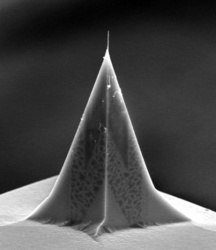 |
| High-aspect Ratio AFM CNT Probe from Carbon Design Innovations |
Abstract:
Carbon Design Innovations, Inc. (C|D|I) today announced the availability of two new atomic force microscope (AFM) probes types with carbon nanotube (CNT) tips. The CCHAR (carbon core high-aspect ratio) and CCHR (carbon core high-resolution) CNT probes offer quantum improvements for AFM imaging, substantially improving results, reducing overall cost of operation and opening new avenues for research.
Carbon Design Innovations, Inc. Introduces Carbon Nanotube Probe Technology for Atomic Force Microscopy, CNT-Probes Deliver New Level of AFM Imaging Performance
Burlingame, CA | Posted on June 16th, 2009Carbon Design Innovations, Inc.(C|D|I) today announced the availability of two new atomic force microscope (AFM) probes types with carbon nanotube (CNT) tips. The CCHAR (carbon core high-aspect ratio) and CCHR (carbon core high-resolution) CNT probes offer quantum improvements for AFM imaging, substantially improving results, reducing overall cost of operation and opening new avenues for research.
"The carbon nanotube AFM probes from C|D|I reveal the most accurate surface morphology, especially for cellular samples such as rat basophilic lymphocytes cells," states Dr. G. Y. Liu, University of California, Davis. "All observations reflect upon the superior geometry of these CCHAR probes, which exhibit little convolution in AFM imaging. We certainly hope to see these advantages among other biological specimens such as, proteins, tissues and biopolymeric materials."
"AFM researchers understand that the next leap in AFM productivity will be based on improved probe technology," said Vance Nau, CEO, Carbon Design Innovations. "They have been looking for reliable CNT probes for many years, however, the inability to consistently manufacture CNT probes that live up to their promise has limited widespread adoption, frustrating users and manufacturers alike."
C|D|I has a patent pending process for the deterministic manufacture of carbon nanotube (CNT) devices. Based on this breakthrough process, the company is able to produce CNT AFM probes that are perfectly straight and precisely aligned, allowing them to be set at desired angles to the surface. The CNT is at the core of the probe structure and the CNT is securely anchored providing for robust and stable imaging with previously unseen levels of performance. C|D|I's CNT probes are more stable and have longer imaging lifetimes than other probe types. In addition, the ability to reinforce longer probes and control taper angle provides users with deep-trench scanning ability not currently available. As a result, C|D|I probes offer customers greater imaging flexibility, performance and reproducibility that will enable them to make significant advances in AFM research. The new CNT AFM probes from C|D|I are compatible with all major AFM systems, giving users an easy path for improving AFM performance without making a substantial investment in new instrumentation.
The CCHAR probe offers high-aspect ratio imaging capability and is designed for materials science, metrology and life science applications. It offers stability and durability in a high-aspect ratio probe designed for difficult to resolve scanning operations such as deep-trench imaging. The nominal CNT total probe length is 1u with the exposed CNT length being 500nm. The CCHAR can be mounted onto any AFM Cantilever.
The CCHR probe family provides high-resolution for material science and life science applications. It offers the durability, stability and high resolution capabilities of a multi-wall CNT tip. The nominal total CNT length is 500 nm, with the exposed CNT tip less than 200 nm. It can be mounted onto any AFM cantilever.
C|D|I probes are now available for order and will begin shipping in the third quarter of 2009.
The Company also today announced that they have secured angel funding from a group of private investors.
####
About Carbon Design Innovations, Inc.
Carbon Design Innovations develops and manufactures carbon nanotube devices based on a patented, deterministic methodology. The company's initial focus is on manufacturing AFM probes.
The company was founded by AFM and CNT industry veteran and company president, Ramsey M. Stevens in January, 2008. Vance Nau, Ph.D. joined the company as CEO in July 2008. Nau has over 25 years experience in management at scientific instrumentation companies and recently led AFM manufacturer Molecular Imaging for five years until its successful acquisition by Agilent Technologies.
For more information, please click here
Contacts:
Phone: +1.650.697.7070
FAX: +1.650.648.0581
Copyright © PRWeb
If you have a comment, please Contact us.Issuers of news releases, not 7th Wave, Inc. or Nanotechnology Now, are solely responsible for the accuracy of the content.
Bookmark:


| Related News Press |
News and information
 Quantum computer improves AI predictions April 17th, 2026
Flexible sensor gains sensitivity under pressure April 17th, 2026
A reusable chip for particulate matter sensing April 17th, 2026
Detecting vibrational quantum beating in the predissociation dynamics of SF6 using time-resolved photoelectron spectroscopy April 17th, 2026
Investments/IPO's/Splits
Daikin Industries becomes OCSiAl shareholder July 27th, 2021
INBRAIN Neuroelectronics raises over €14M to develop smart graphene-based neural implants for personalised therapies in brain disorders March 26th, 2021
180 Degree Capital Corp. Issues Second Open Letter to the Board and Shareholders of Enzo Biochem, Inc. March 26th, 2021
Nanotubes/Buckyballs/Fullerenes/Nanorods/Nanostrings/Nanosheets
Tiny nanosheets, big leap: A new sensor detects ethanol at ultra-low levels January 30th, 2026
Enhancing power factor of p- and n-type single-walled carbon nanotubes April 25th, 2025
Chainmail-like material could be the future of armor: First 2D mechanically interlocked polymer exhibits exceptional flexibility and strength January 17th, 2025
Innovative biomimetic superhydrophobic coating combines repair and buffering properties for superior anti-erosion December 13th, 2024
Nanomedicine
A fundamentally new therapeutic approach to cystic fibrosis: Nanobody repairs cellular defect April 17th, 2026
New molecular technology targets tumors and simultaneously silences two ‘undruggable’ cancer genes August 8th, 2025
New imaging approach transforms study of bacterial biofilms August 8th, 2025
Electrifying results shed light on graphene foam as a potential material for lab grown cartilage June 6th, 2025
Announcements
A fundamentally new therapeutic approach to cystic fibrosis: Nanobody repairs cellular defect April 17th, 2026
UC Irvine physicists discover method to reverse ‘quantum scrambling’ : The work addresses the problem of information loss in quantum computing system April 17th, 2026
Tools
Metasurfaces smooth light to boost magnetic sensing precision January 30th, 2026
From sensors to smart systems: the rise of AI-driven photonic noses January 30th, 2026
Japan launches fully domestically produced quantum computer: Expo visitors to experience quantum computing firsthand August 8th, 2025
Nanobiotechnology
A fundamentally new therapeutic approach to cystic fibrosis: Nanobody repairs cellular defect April 17th, 2026
New molecular technology targets tumors and simultaneously silences two ‘undruggable’ cancer genes August 8th, 2025
New imaging approach transforms study of bacterial biofilms August 8th, 2025
Electrifying results shed light on graphene foam as a potential material for lab grown cartilage June 6th, 2025
 |
||
 |
||
| The latest news from around the world, FREE | ||
 |
||
|
|
||
| Premium Products | ||
 |
||
|
Only the news you want to read!
Learn More |
||
 |
||
|
Full-service, expert consulting
Learn More |
||
|
|
||