Home > Press > Metal sheets with DNA framework could enable future nanocircuits
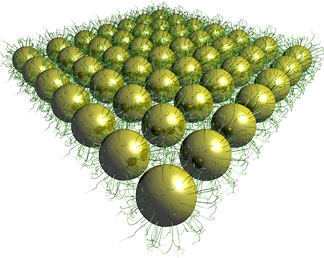 |
| Michael Campolongo/Luo Labs A schematic drawing of gold nanoparticles held together by tangled, hairlike strands of DNA. The thin sheets could prove useful in electronic applications. |
Abstract:
Using DNA not as a genetic material but as a structural support, Cornell researchers have created thin sheets of gold nanoparticles held together by strands of DNA. The work could prove useful for making thin transistors or other electronic devices.
Metal sheets with DNA framework could enable future nanocircuits
Ithaca, NY | Posted on May 20th, 2009The research describing the creation of suspended, free-standing sheets of gold nanoparticles only 20 nanometers thick and held together by tangled, hairlike strands of DNA, is detailed in the May 4 Advance Online Publication of Nature Materials. The work was led by Dan Luo, associate professor of biological engineering, and the team included first author and postdoctoral associate Wenlong Cheng;Christopher Umbach, assistant professor of materials sciences and engineering; and David Muller, associate professor of applied and engineering physics.
To make the thin, ordered sheets, called superlattices, the researchers attached gold nanoparticles to single-stranded DNA and submerged them in a water-based solution. They then deposited droplets of the solution onto a holey silicon substrate and allowed the water to evaporate.
What was left were thin sheets of gold nanoparticles, suspended in place by the DNA strands. What's more, Luo explained, the researchers demonstrated easy control of the sheets' mechanical properties by changing the lengths of the DNA or the distance between nanoparticles.
"We hope this can contribute to development of future nanocircuits," Luo said.
The work was supported by the New York State Office of Science, Technology and Academic Research, the National Science Foundation and Cornell.
####
For more information, please click here
Contacts:
Blaine Friedlander
(607) 254-8093
Cornell Chronicle:
Anne Ju
(607) 255-9735
Copyright © Cornell University
If you have a comment, please Contact us.Issuers of news releases, not 7th Wave, Inc. or Nanotechnology Now, are solely responsible for the accuracy of the content.
Bookmark:


| Related News Press |
News and information
 Quantum computer improves AI predictions April 17th, 2026
Flexible sensor gains sensitivity under pressure April 17th, 2026
A reusable chip for particulate matter sensing April 17th, 2026
Detecting vibrational quantum beating in the predissociation dynamics of SF6 using time-resolved photoelectron spectroscopy April 17th, 2026
Chip Technology
A reusable chip for particulate matter sensing April 17th, 2026
Metasurfaces smooth light to boost magnetic sensing precision January 30th, 2026
Nanoelectronics
Lab to industry: InSe wafer-scale breakthrough for future electronics August 8th, 2025
Interdisciplinary: Rice team tackles the future of semiconductors Multiferroics could be the key to ultralow-energy computing October 6th, 2023
Key element for a scalable quantum computer: Physicists from Forschungszentrum Jülich and RWTH Aachen University demonstrate electron transport on a quantum chip September 23rd, 2022
Reduced power consumption in semiconductor devices September 23rd, 2022
Discoveries
Quantum computer improves AI predictions April 17th, 2026
Flexible sensor gains sensitivity under pressure April 17th, 2026
A reusable chip for particulate matter sensing April 17th, 2026
Detecting vibrational quantum beating in the predissociation dynamics of SF6 using time-resolved photoelectron spectroscopy April 17th, 2026
Announcements
A fundamentally new therapeutic approach to cystic fibrosis: Nanobody repairs cellular defect April 17th, 2026
UC Irvine physicists discover method to reverse ‘quantum scrambling’ : The work addresses the problem of information loss in quantum computing system April 17th, 2026
Nanobiotechnology
A fundamentally new therapeutic approach to cystic fibrosis: Nanobody repairs cellular defect April 17th, 2026
New molecular technology targets tumors and simultaneously silences two ‘undruggable’ cancer genes August 8th, 2025
New imaging approach transforms study of bacterial biofilms August 8th, 2025
Electrifying results shed light on graphene foam as a potential material for lab grown cartilage June 6th, 2025
 |
||
 |
||
| The latest news from around the world, FREE | ||
 |
||
|
|
||
| Premium Products | ||
 |
||
|
Only the news you want to read!
Learn More |
||
 |
||
|
Full-service, expert consulting
Learn More |
||
|
|
||