Home > Press > Bayer builds world's largest production plant for carbon nanotubes in Chempark Leverkusen
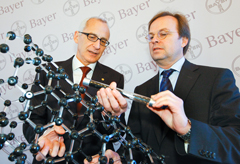 |
| Dr. Wolfgang Plischke, the Board member responsible for research, and Thomas Rachel, Parliamentary State Secretary at the Federal Ministry of Education and Research (BMBF), with a model and a sample of carbon nanotubes. |
Abstract:
20 new jobs to be created after investment of EUR 22 million Bayer builds world's largest production plant for carbon nanotubes in Chempark Leverkusen.
Construction start-up followed by kick-off event of the Innovationsallianz CNT in Leverkusen
Bayer builds world's largest production plant for carbon nanotubes in Chempark Leverkusen
Leverkusen, Germany | Posted on January 26th, 2009Bayer MaterialScience has begun work on the
construction of a new facility for the production of carbon nanotubes
(CNTs) in Chempark Leverkusen. The new plant will have a capacity of 200
tons/year, making it the largest of its kind in the world. The company is
to invest around EUR 22 million in the planning, development and
construction of the plant, which will create 20 new jobs. "We are investing
in a key technology of the future that will open up a broad range of new
applications for us. We intend to utilize this opportunity to the full. At
the same time, the construction of the new CNT facility is a declaration of
faith in Leverkusen and the State of North Rhine-Westphalia as an
industrial location," said Dr. Wolfgang Plischke, the member of the Bayer
AG Board of Management responsible for innovation, technology and the
environment, at a press conference to mark the start of construction.
Current forecasts predict that the global market for carbon nanotubes will
grow by 25 percent a year. In ten years, annual sales of these products are
expected to reach US-Dollar 2 billion.
Following the official start of construction work, representatives of the
Innovationsallianz "CNT - carbon nanomaterials conquer markets" - in brief:
Inno.CNT - met in Chempark Leverkusen for their kick-off event. In this
alliance, which is supported by the German Federal Ministry for Education
and Research (BMBF), more than 70 partners from industry and science have
joined together to develop new technologies and applications for CNT-based
materials.
Bayer MaterialScience is one of the few companies that can produce carbon
nanotubes of consistently high quality on an industrial scale. A pilot
plant with an annual capacity of 60 tons has been in operation in
Laufenburg in southern Germany since 2007. Production involves a catalytic
process in which the carbon nanotubes are obtained from a carbon-containing
gas at elevated temperature in a reactor. "Bayer is investing in this, the
world's largest CNT production plant, because we are convinced of the
technological and economic efficiency of the process," said Plischke.
With the company's know-how, Bayer can now take a product from the research
laboratory and smooth its progress into a broad spectrum of applications
relevant to society, such as energy, the environment, mobility, safety and
construction. Baytubes® - the brand name for Bayer's carbon nanotubes - are
already being used to produce tough, extremely strong, lightweight
materials. This means, for example, that rotor blades for wind turbines are
more energy-efficient, that transport containers weigh less and that sports
equipment can be made more robust.
Innovationsallianz CNT to enhance competitiveness
Plischke also welcomed Thomas Rachel, Parliamentary State Secretary in the
BMBF - the ministry backing the project - to the event. Future developments
in the field of CNT-based materials are to focus on applications involving
energy and the environment, mobility and lightweight construction. A total
of EUR 80 million will be invested in research and development as part of
Inno.CT, of which the BMBF will contribute about EUR 40 million. In
addition, the participating companies want to invest up to EUR 200 million
in the further development of these technologies and applications during
the course of the projects and also after their conclusion.
Rachel pointed out that Germany and the European Union had set themselves
ambitious climate targets. To achieve them, he said, efficient and
responsible energy management was essential. The German government wanted
to significantly reduce energy consumption in Germany by 2020, and new
materials would make a major contribution to this.
Rachel: "Carbon nanotubes will play a particularly important role. They
offer all kinds of benefits, such as improving fuel and battery
technologies and reducing the weight of vehicles. To exploit the enormous
potential of these new materials, the German Federal Ministry for Education
and Research will fund the Innovationsallianz CNT to the tune of around EUR
40 million over a period of four years. This alliance will play a
significant part in implementing the Federal government's high-tech
strategy, through which we aim to strengthen Germany's competitiveness."
The main purpose of the two-day kick-off event in Leverkusen for the
alliance partners was to exchange technical ideas and coordinate further
cooperation on the project.
Note to editors:
Up-to-date photographic material can be found on the Baynews International
press server at www.press.bayer.com
Up-to-the-minute TV footage can be found on the Bayer TV server at:
www.bayer-tv.com
A podcast on this topic can be found at www.podcast.bayer.com
####
About Bayer
Forward-Looking Statements
This release may contain forward-looking statements based on current
assumptions and forecasts made by Bayer Group or subgroup management.
Various known and unknown risks, uncertainties and other factors could lead
to material differences between the actual future results, financial
situation, development or performance of the company and the estimates
given here. These factors include those discussed in Bayer’s public reports
which are available on the Bayer website at www.bayer.com. The
company assumes no liability whatsoever to update these forward-looking
statements or to conform them to future events or developments.
For more information, please click here
Contacts:
Dr. Katharina Jansen
Science/Research
Address: Bayer AG
Building: W 11
Germany-51368 Leverkusen
Telephone: + 49 (0) 214-30-33243
Telefax: + 49 (0) 214-30-58923
Copyright © Bayer
If you have a comment, please Contact us.Issuers of news releases, not 7th Wave, Inc. or Nanotechnology Now, are solely responsible for the accuracy of the content.
Bookmark:


| Related News Press |
News and information
 Quantum computer improves AI predictions April 17th, 2026
Flexible sensor gains sensitivity under pressure April 17th, 2026
A reusable chip for particulate matter sensing April 17th, 2026
Detecting vibrational quantum beating in the predissociation dynamics of SF6 using time-resolved photoelectron spectroscopy April 17th, 2026
Openings/New facilities/Groundbreaking/Expansion
OCSiAl expands its graphene nanotube production capacities to Europe June 17th, 2022
GLOBALFOUNDRIES Moves Corporate Headquarters to its Most Advanced Semiconductor Manufacturing Facility in New York April 27th, 2021
Oxford Instruments Plasma Technology relocates to advanced manufacturing facility: Move driven by exceptional business growth February 12th, 2021
Jobs
Could quantum technology be New Mexico’s next economic boon? Quantum New Mexico Coalition aims to establish state as national hub April 1st, 2022
SEMI Partners with GLOBALFOUNDRIES to Offer Apprenticeship Program Aimed at Building the Electronics Talent Pipeline August 11th, 2020
Arrowhead Pharmaceuticals Reports Inducement Grants under NASDAQ Marketplace Rule 5635(c)(4) March 29th, 2019
Nanotubes/Buckyballs/Fullerenes/Nanorods/Nanostrings/Nanosheets
Tiny nanosheets, big leap: A new sensor detects ethanol at ultra-low levels January 30th, 2026
Enhancing power factor of p- and n-type single-walled carbon nanotubes April 25th, 2025
Chainmail-like material could be the future of armor: First 2D mechanically interlocked polymer exhibits exceptional flexibility and strength January 17th, 2025
Innovative biomimetic superhydrophobic coating combines repair and buffering properties for superior anti-erosion December 13th, 2024
Announcements
A fundamentally new therapeutic approach to cystic fibrosis: Nanobody repairs cellular defect April 17th, 2026
UC Irvine physicists discover method to reverse ‘quantum scrambling’ : The work addresses the problem of information loss in quantum computing system April 17th, 2026
 |
||
 |
||
| The latest news from around the world, FREE | ||
 |
||
|
|
||
| Premium Products | ||
 |
||
|
Only the news you want to read!
Learn More |
||
 |
||
|
Full-service, expert consulting
Learn More |
||
|
|
||