Home > Press > Beyond A.I. -- Creating the Conscience of the Machine
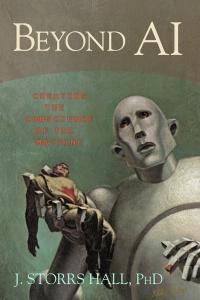 |
| 408 pages, ISBN 978-1-59102-511-5, Hardcover $28, Publication May 2007 Credit: Prometheus Books |
Abstract:
J. Storrs Hall investigates the future implications for artificial intelligence
Beyond A.I. -- Creating the Conscience of the Machine
Amherst, NY | Posted on July 17th, 2007Known as the originator of the Utility Fog concept, Dr. J. Storrs Hall is regarded as one of the most significant thinkers in the field of molecular nanotechnology. In his new book Beyond AI: Creating the Conscience of the Machine (Prometheus Books, $28), Hall explores how artificial intelligence (AI) is now advancing at such a rapid clip that it has the potential to transform our world in ways both exciting and disturbing. Computers have already been designed that are capable of driving cars, playing soccer, and finding and organizing information on the Web in ways that no human could. With each new gain in processing power, will scientists soon be able to create supercomputers that can read a newspaper with understanding, or write a news story, or create novels, or even formulate laws "And if machine intelligence advances beyond human intelligence, will we need to start talking about a computer's intentions"
These are some of the questions discussed by computer scientist J. Storrs Hall in this fascinating layperson's guide to the latest developments in artificial intelligence. Drawing on a thirty-year career in artificial intelligence and computer science, Hall reviews the history of AI, discussing some of the major roadblocks that the field has recently overcome, and predicting the probable achievements in the near future. There is new excitement in the field over the amazing capabilities of the latest robots and renewed optimism that achieving human-level intelligence is a reachable goal.
But what will this mean for society and the relations between technology and human beings" Soon ethical concerns will arise and programmers will need to begin thinking about the computer counterparts of moral codes and how ethical interactions between humans and their machines will eventually affect society as a whole.
According to Dr. Fritz Allhoff, a philosophy professor at Western Michigan University, Dr. Hall combines a strong background in science with a cognizance of its deeper social and ethical issues to present a timely presentation of the past, present and future of artificial intelligence. Dr. Patrick Lin, director of The Nanoethics Group, says, "Hall masterfully traces the history of AI in terms easy to understand for the layperson and sophisticated enough to offer new insights for experts."
Weaving disparate threads together in an enlightening manner from cybernetics, computer science, psychology, philosophy of mind, neurophysiology, game theory, and economics, Hall provides an intriguing glimpse into the astonishing possibilities and dilemmas on the horizon.
J. Storrs Hall, PhD (Laporte, PA), the founding chief scientist of Nanorex, Inc., is a research fellow for the Institute for Molecular Manufacturing and the author of Nanofuture, the "Nanotechnologies" section for The Macmillan Encyclopedia of Energy, and numerous scientific articles. He has designed technology for NASA and was a computer systems architect at the Laboratory for Computer Science Research at Rutgers University from 1985 to 1997.
####
About Prometheus Books
The leading publisher in philosophy, popular science, and critical thinking, Prometheus Books has more than 1,500 books in print, and produces an average of 100 new titles a year.
Founded in 1969, Prometheus Books took its name from the courageous Greek god who gave fire to humans, lighting the way to reason, intelligence, and independence. Prometheus Books established itself immediately as a leading independent publisher, earning the prestigious endorsements of Isaac Asimov and Carl Sagan.
For more information, please click here
Contacts:
Lynn Pasquale
800-853-7545
Copyright © Prometheus Books
If you have a comment, please Contact us.Issuers of news releases, not 7th Wave, Inc. or Nanotechnology Now, are solely responsible for the accuracy of the content.
Bookmark:


| Related News Press |
Ethics
 Artificial Intelligence Centered Cancer Nanomedicine: Diagnostics, Therapeutics and Bioethics June 3rd, 2022
Iran to hold intl. school on application of nanomaterials in medicine September 20th, 2016
Synthetic biology needs robust safety mechanisms before real world application: Ethics and technology hold the key to the success of synthetic biology September 17th, 2015
March 2016; 6th Int'l Conference on Nanostructures in Iran July 29th, 2015
Possible Futures
A fundamentally new therapeutic approach to cystic fibrosis: Nanobody repairs cellular defect April 17th, 2026
UC Irvine physicists discover method to reverse ‘quantum scrambling’ : The work addresses the problem of information loss in quantum computing system April 17th, 2026
Announcements
A fundamentally new therapeutic approach to cystic fibrosis: Nanobody repairs cellular defect April 17th, 2026
UC Irvine physicists discover method to reverse ‘quantum scrambling’ : The work addresses the problem of information loss in quantum computing system April 17th, 2026
Interviews/Book Reviews/Essays/Reports/Podcasts/Journals/White papers/Posters
A fundamentally new therapeutic approach to cystic fibrosis: Nanobody repairs cellular defect April 17th, 2026
UC Irvine physicists discover method to reverse ‘quantum scrambling’ : The work addresses the problem of information loss in quantum computing system April 17th, 2026
Artificial Intelligence
Quantum computer improves AI predictions April 17th, 2026
From sensors to smart systems: the rise of AI-driven photonic noses January 30th, 2026
New quantum encoding methods slash circuit complexity in machine learning November 8th, 2024
 |
||
 |
||
| The latest news from around the world, FREE | ||
 |
||
|
|
||
| Premium Products | ||
 |
||
|
Only the news you want to read!
Learn More |
||
 |
||
|
Full-service, expert consulting
Learn More |
||
|
|
||