Home > Press > Crucial Clue to Nanofiber Fabrication Technique
Fingerprints Provide Crucial Clue to New Nanofiber Fabrication Technique
University Park, PA | Posted on January 26, 2006
Fingerprints are usually used to identify people but, this time, they gave Penn State chemical engineers the crucial clue needed to discover an easy, versatile new method for making nanofibers that have potential uses in advanced filtration as well as wound care, drug delivery, bioassays and other medical applications.
The new technique is based on the way forensic scientists develop fingerprints from a crime scene and is easier and more versatile than either of the current methods, templates or electrospinning, used commercially to make nanofibers.
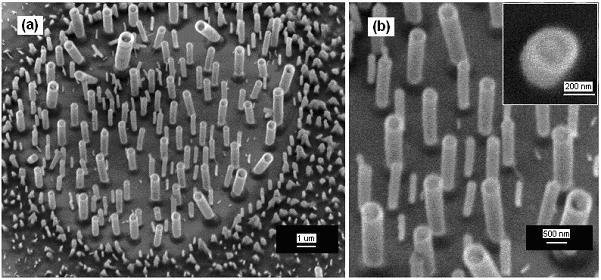
Snapshot of initial polymer fiber (15 min exposure to monomer and high humidity) growth on fingerprint at 30 C and relative humidity >95% (a) Low magnification view (b) Close-up view of the same (inset showing the top view of fiber). Reproduced by permission of The Royal Society of Chemistry
|
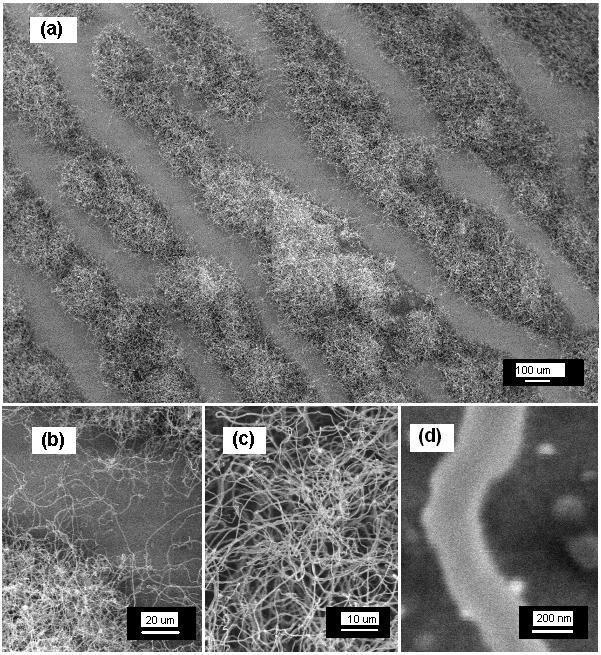
Scanning electron microscope pictures of nanofibers of poly ethyl cyanoacrylate grown on fingerprint ridges at 30 C and relative humidity >95% over a period of 16h (a) Low magnification view (b) Close-up view of the ridge pattern. (c) Close-up view of the nanofibers (d) Magnified view of a single fiber. Reproduced by permission of The Royal Society of Chemistry
|
The first nanofibers generated by the technique are made from the basic ingredient of Super Glue, cyanoacrylate, which is a biologically-compatible material already used in liquid sutures, spheres for drug delivery and in experimental cancer treatment. However, the researchers say that other materials, like cyanoacrylate, that form solid polymers when nudged by a catalyst could potentially also be used in the process.
Dr. Henry C. Foley, professor of chemical engineering who directed the project, says, "The new technique is so versatile that it allows us not only to make nano-scale fibers but also nano-sized flat sheets, spheres and even wrinkled sheets that look tortellini-like."
The researchers can also generate patterned surfaces and say that the process could conceivably be used in an ink jet printer.
The research is detailed in a paper, "Facile Catalytic Growth of Cyanoacrylate Nanofibers," published online today (Jan. 26) in the British journal, The Royal Society of Chemistry, Chemical Communications. The authors are Pratik J. Mankidy, doctoral candidate in chemical engineering; Ramakrishnan Rajagopalan, research associate at Penn State's Materials Research Laboratory, and Foley, who is also associate vice president for research at the University. The journal is available here.
Foley explains that forensic scientists develop latent fingerprints via a process known as cyanoacrylate fuming. Fingerprints left on a surface are exposed to fumes of cyanoacrylate, which form a white polymer residue that makes the ridges of the fingerprint visible.
One of the researchers, Pratik Mankidy, had accidentally left his fingerprints on a piece of research equipment that had been secured with Super Glue and nanofibers appeared. Putting two and two together, the researchers set out to discover what constituents of fingerprints trigger the cyanoacrylate polymerization on the ridges of fingerprints.
They made synthetic fingerprints from a mixture of a known polymer initiator, common table salt in water, and a non-initiator, linoleic acid, found on fingers. Then they exposed the fake prints to cyanoacrylate fuming. Sure enough, they got nanofibers similar to the ones Mankidy’s fingerprints had generated accidentally. They also fumed cyanoacrylate on single initiators and found that sodium hydroxide, potassium hydroxide and potassium acetate produced tortellini-like films of the polymer. When ammonium hydroxide was fumed with cyanoacrylate, it produced nano-sized spheres.
The researchers note that the role played by the presence of the non-initiating components in the fingerprint mixture is not completely understood. They are continuing their experiments to understand the process more completely.
A majority of the fibers produced by the new process have diameters in the 200-250 nanometer range and are hundreds of microns long. Typically, nanofibers that are currently commercially available are in this same range.
Foley notes, "Our findings open up a whole new world of opportunity for control of nanoscale structures through chemistry via catalysis."
The research was supported by a grant from the National Science Foundation.
Barbara Hale
(814) 865-9481
bah@psu.edu
A'ndrea Elyse Messer
Science & Research Information Officer
Penn State
814-865-9481
814-865-9421
aem1@psu.edu
Copyright © Penn State
If you have a comment, please Contact us.
Issuers of news releases, not 7th Wave, Inc. or Nanotechnology Now, are solely responsible for the accuracy of the content.
Bookmark:


| Related News Press |
Possible Futures
 Discovery points path to flash-like memory for storing qubits: Rice find could hasten development of nonvolatile quantum memory April 5th, 2024
With VECSELs towards the quantum internet Fraunhofer: IAF achieves record output power with VECSEL for quantum frequency converters April 5th, 2024
Nanomedicine
New micromaterial releases nanoparticles that selectively destroy cancer cells April 5th, 2024
Good as gold - improving infectious disease testing with gold nanoparticles April 5th, 2024
Researchers develop artificial building blocks of life March 8th, 2024
Materials/Metamaterials/Magnetoresistance
Nanoscale CL thermometry with lanthanide-doped heavy-metal oxide in TEM March 8th, 2024
Focused ion beam technology: A single tool for a wide range of applications January 12th, 2024
Announcements
NRL charters Navy’s quantum inertial navigation path to reduce drift April 5th, 2024
Discovery points path to flash-like memory for storing qubits: Rice find could hasten development of nonvolatile quantum memory April 5th, 2024
 |
||
 |
||
| The latest news from around the world, FREE | ||
 |
||
|
|
||
| Premium Products | ||
 |
||
|
Only the news you want to read!
Learn More |
||
 |
||
|
Full-service, expert consulting
Learn More |
||
|
|
||