Home > Nanotechnology Columns > Kos Galatsis > Turbo-charged Electronics
 |
Kos Galatsis Chief Operating Officer FENA and WIN Centers, UCLA |
Abstract:
Remember the days of the abacus? The abacus was one of the first computational devices ever to exist. Abacus beads represent information (numeric values) based on their physical position along a wire. Today we use electrons to do the exact same thing. Electrons move from various locations (within a circuit), are processed (via logic/memory functions) then used as output signals (such as LEDs, pixels on an LCD monitor or sound via a speaker). However the "electronic" paradigm we are accustomed to could change. New paradigms such as spintronics, phonotics, orbitronics and plasmonics may lead the next nanoelectronic future.
August 21st, 2008
Turbo-charged Electronics
Remember the days of the abacus? The abacus was one of the first computational devices ever to exist. Abacus beads represent information (numeric values) based on their physical position along a wire. Today we use electrons to do the exact same thing. Electrons move from various locations (within a circuit), are processed (via logic/memory functions) then used as output signals (such as LEDs, pixels on an LCD monitor or sound via a speaker). However the "electronic" paradigm we are accustomed to could change. New paradigms such as spintronics, phonotics, orbitronics and plasmonics may lead the next nanoelectronic future.
The digital age of logic began with electromechanical switches known as electromagnetic switches or more commonly referred to as "relays". These very useful and important switches are still used today. Every time your turn on your car's ignition, an array of electromagnetic switches control the vehicle starter, electronic ignition, fuel system and most valves and actuators. Soon after, vacuum tubes were employed to make the ENIAC and Colossus computers in 1944. Vacuum tubes were critical to the development of electronics technology, which drove the expansion and commercialization of radio broadcasting, television, radar, sound reproduction, large telephone networks, analog and digital computers, and industrial process control. Then the silicon age began with the introduction of the bipolar junction transistor (BJT) and then the introduction of Field Effect Transistors (FET) which today is the staple device in nearly all microprocessors and microchips. The FET device is core to the complementary metal oxide semiconductor (CMOS) framework, which quickly became ubiquitous due to its superior (minimal) power consumption advantages. Although we are reaping the benefits of electrons flowing from place to place and providing us with astonishing computing power, digital music, game playing and sound pleasures, one question that plays on my mind is what will electronics look like in the future?
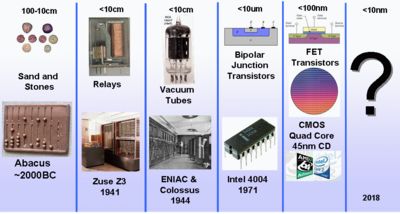 |
| Device and Computer Evolution |
Well for starters, there is a good chance it may not be called electronics, some other possible names that are vying for this lucrative market include spintronics, plasmonics, photonics and orbitronics. To put it simply, these are just some of the various upcoming ways of representing information (just like the abacus beads) that can be easily manipulated to perform information processing. For instance, using the spin of an electron rather than electron movement (charge) will reduce and close to eliminate power dissipation, using photonics can increase the speed of computation and by using plasmonics we can easily couple light with electrons and perform highly functional computation. Below are some of the various alternatives that are being explored to represent information and hence be used for information processing. You may recognize some of them. For instance, single spin domain (magnetism) is being used today in all hard disk drives and MRAM commercialized by Freescale (watch out for other spin based systems such as STT-RAM from Grandis and racetrack memory from IBM), phase change electronics will also soon become commercially viable (watch out for the Intel and STMicroelectronics alliance) and so too will molecular switches used for memory (watch out for ZettaCore and HP).
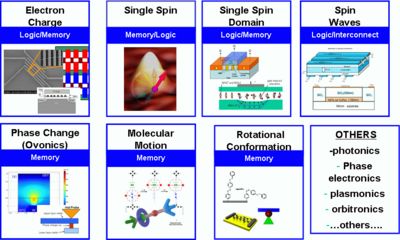 |
| Some different ways of representing information - known as state variables. |
One conceptual view of a future paradigm is shown in the below figure. This is a conceptual view of how a future processor may look like as envisioned by the European Commission - Microelectronics Advanced Research Initiiative. Basically the architecture takes advantages of not just one technology platform, but of various technologies that exploit their unique application specific functionality. For instance, optics for high speed communication, molecules for high density memory and CMOS for robust logic functionality.
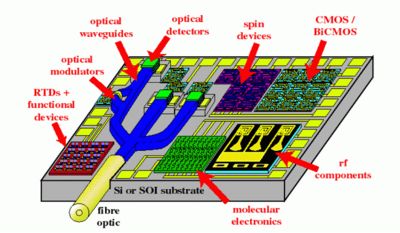 |
| A future look at electronics (European version). |
However, an experienced semiconductor manufacturing guru would quikly identify the challenges both in technical and economic terms in realizing such a dream. The only realistic way forward would require the next "paradigm" to be silicon compatible in order to make use of the existing semiconductor infrastructure, expertise and know-how. Moreover, such a requirement is linked to the economic preprequisite of manufacturing a single device with a cost of less than a nanocent (in order to compete with current CMOS technology). Market forces will ultimately decide on turbo-charging electronics.
Bookmark:


 |
||
 |
||
| The latest news from around the world, FREE | ||
 |
||
|
|
||
| Premium Products | ||
 |
||
|
Only the news you want to read!
Learn More |
||
 |
||
|
Full-service, expert consulting
Learn More |
||
|
|
||