Home > Introduction > Possible Futures > SmartDust & Ubiquitious Computing
Last Updated: Monday, 20-Apr-2015 19:51:36 PDTSmartDust & Ubiquitious Computing
|
Smartdust: "... tiny, bottle-cap-shaped micro-machines fitted with wireless communication devices - that measure light and temperature (among other things - ed.). When clustered together, they automatically create highly flexible, low-power networks with applications ranging from climate-control systems to entertainment devices that interact with handheld computers." Engineers also envision other uses for the Smart Dust project, including:
Source: What 'Smart Dust' Could Do for You Zillah Bahar, June 2001.
In 2010 everything you own that is worth more than a few dollars will know that it's yours, and you'll be able to find it whenever you want it. Stealing cars, furniture, stereos, or other valuables will be unusual, because any of your valuables that leave your house will check in on their way out the door, and scream like a troll's magic purse if removed without permission (they may scream at 2.4 GHz rather than in audio).
It relies on the convergence of three technologies: digital circuitry, laser-driven wireless communications, and something called MEMS (Micro ElectroMechanical Systems) to pack enough equipment into a space no more than one or two cubic millimeters in size. Source: Smart Dust The particles of dust that could be watching you. James Flint, July 1999. The motes can be powered by vibrations in the wall -- a bit like a self-winding wristwatch -- or by solar light or even changes in barometric pressure. This makes smart dust very flexible, which is why Pister envisions it everywhere, doing practically anything -- monitoring how traffic is flowing, say, to determine how to time traffic-lights, or monitoring the vital signs of elderly or sick people. Source: Dust Keeping the Lights Off Farhad Manjoo, May 2001. In the future, there will be hundreds of billions of embedded chips and sensing devices integrated into everything from key chains and swimming pools to your apartment's walls and even your skin. All of these devices will be able to compute, sense and communicate with each other. ... "Computer chips will get smaller, more powerful, connected and 'pervasive.' They'll bring digital intelligence into all kinds of objects and spaces." Source: The Shape of Computer Chips to Come Tim McDonald, May 2002.
The new sensors will be able to detect vibration, chemicals, radiation, biological agents, explosives, footsteps, voices, still images, and even video images and transmit them to a network of fixed and mobile relay collection stations. The significant reduction in size will enable sensors to be deeply embedded in the physical world products or materials and spread throughout our environment like smart grains of sand. Currently, the sensor networks with communications capabilities have been produces that are as small as a penny. In the future NanoTechnology (the capability of building things one molecule at a time) will create miniature sensors so small they could be woven directly into the fabric of a chair or in the layers of plastic in a milk carton or maybe even within the ink on a piece of paper.
Just imagine sensors the size of sand graduals dropped from a plane that detect footsteps in a field or desert. Or sensors of similar size mixed into the asphalt on roads detecting traffic. These devices could be cloaked as bricks and detect footsteps or the movement of vehicles and record then forward the information. Source: GIS, Information Technology, and BioTech Take Center Stage in Supporting Homeland Security Kevin Coleman, April 2003. |
The Generations of Smart Dust Motes
As created by the Berkeley Sensor & Actuator CenterClick images to enlarge
Golem Dust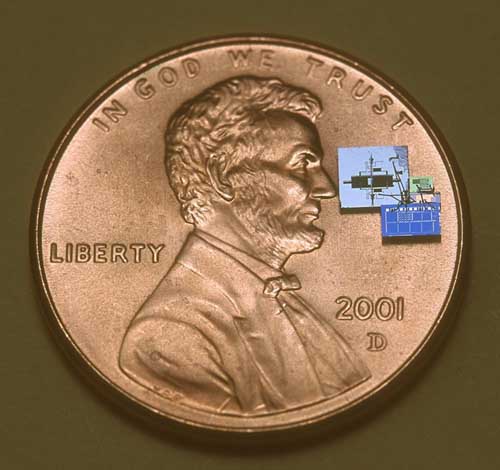
solar powered mote with bi-directional communications and sensing (acceleration and ambient light) 11.7 mm3 total circumscribed volume ~4.8 mm3 total displaced volume |

X25 |
Daft Dust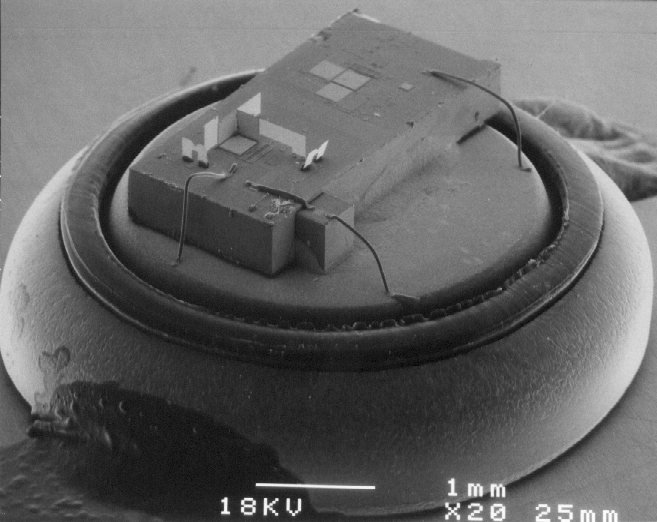
X20 63 mm3 bi-directional communication mote |
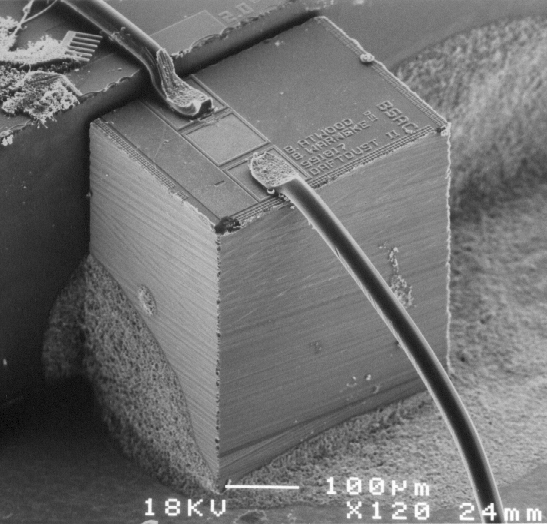
X120 |
Flashy Dust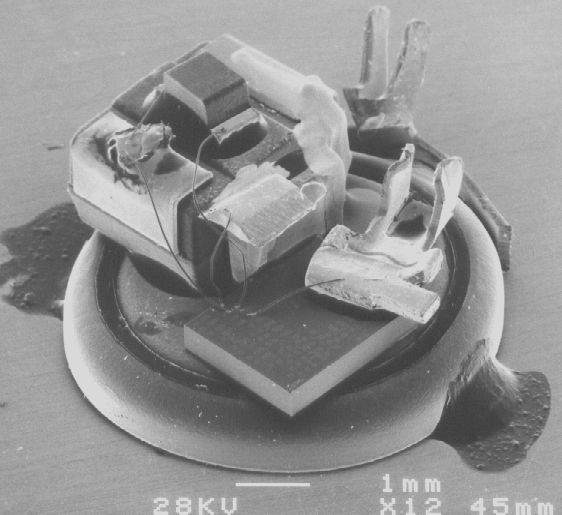
X12 138 mm3 uni-directional communication and sensing (ambient light) mote |
Mobile dust animation Link is at the very bottom of the page. (27MB AVI) |
Penny image Courtesy Joseph M. Kahn and Brett A. Warneke, Univerisity of California at Berkeley. SEMs courtesy Brett A. Warneke and Ron Wilson, UCB. Used with permission.
How they are being used today articles
 Radio Frequency Identification
How they may be used tomorrow
 Global radio network for smart devices
A day at the office in 2013
Global radio network for smart devices
A day at the office in 2013
Other articles referring to smartdust, smart structures, COTS (commercial-off-the-shelf) Dust or "macro motes," ubiquitious computing, and embedded systems:
Smart Dust - Mighty motes for medicine, manufacturing, the military and more "Picture being able to scatter hundreds of tiny sensors around a building to monitor temperature or humidity. Or deploying, like pixie dust, a network of minuscule, remote sensor chips to track enemy movements in a military operation." 2003
Smart Dust Autonomous sensing and communication in a cubic millimeter. Kris Pister, Robotics and Intelligent Machines Laboratory, Department of Electrical Engineering and Computer Sciences
University of California at Berkeley.
Materials That Remotely Monitor Temperature and Stress The same material that makes the theft detectors go off in a department store when the salesperson forgets to remove the anti-theft tag, may make inexpensive, passive temperature and stress sensors for highways, concrete buildings and other applications possible, according to Penn State researchers. June 2002
Low-cost magnetic field sensors " ... large numbers of magnetic field sensors are also required for less obvious technical applications: They measure position, torsion and the number of revolutions of shafts and wheels, as well as monitoring the operational status of robots and machine tools." June 2002
New Center for Embedded Networked Sensing Buildings that "detune" themselves during an earthquake to prevent collapse, and water systems that automatically detect sabotage and isolate the danger are among the possible future breakthroughs to be pioneered by a new UCLA research center intended to create a new generation of wireless sensing technologies. June 2002
Networked Computer Sensors Infiltrate Everything Brian McDonough, June 2002
A new approach may finally make "smart structures" scalable. David F. Salisbury, June 2002
Sensors seen enabling new-age services
EE Times May 2002
Energy Implications of Network Sensor Designs (PDF) Robert Szewczyk and Andras Ferencz. Berkeley Wireless Research Center.
Power evaluation of SmartDust remote sensors (PPT)
Analysis of Wireless Data Transmission Characteristics Rachel Rubin (PDF)
Computing with a pinch of sand April 2002
Brainy Buildings Conserve Energy From "Lab Notes: Research from the Berkeley College of Engineering." September 2001
Wireless wearable digital jewelry and more InfoWorld Editor at Large, Ephraim Schwartz.
Smartdust (PPT) Mohammad H. Rahimi
Mini Airborne Intelligence Smallest Computerized Sensors Designed to Communicate. November 1999
Privacy may be blown away like smart dust in the wind Rosemary Clandos, August 2001
Network in a dust storm Luke Collins, April 2002
'Smart Bandage' Diagnoses Danger Before Infection Takes Hold November 2001
Spies in the Skies Peter Kupfer, November 2000
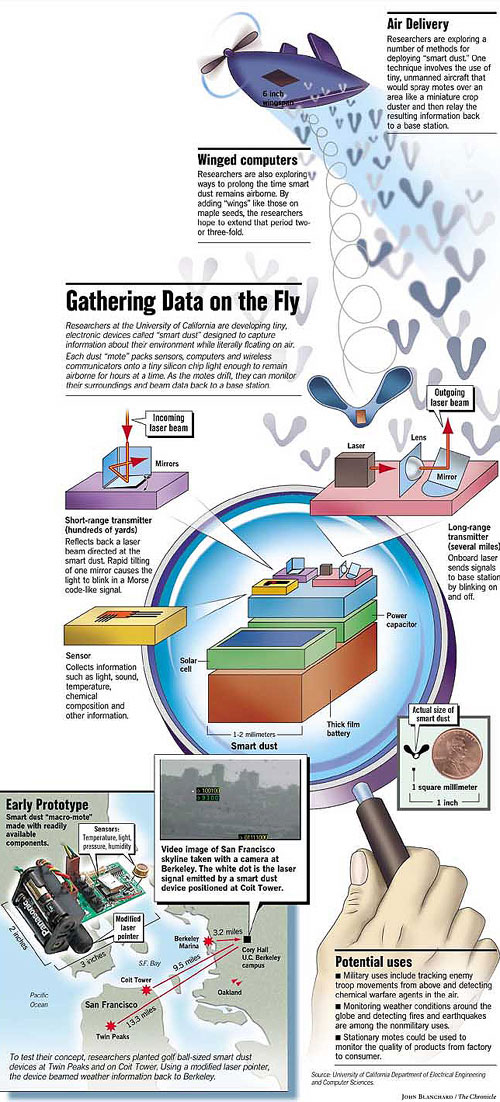
Copyright San Francisco Chronicle. Graphic by John Blanchard. Used with permission.
 |
||
 |
||
| The latest news from around the world, FREE | ||
 |
||
|
|
||
| Premium Products | ||
 |
||
|
Only the news you want to read!
Learn More |
||
 |
||
|
Full-service, expert consulting
Learn More |
||
|
|
||