Home > Press > What a “2D” quantum superfluid feels like to the touch
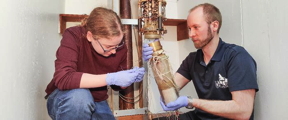 |
| The experiments were carried out at about a 10000th of a degree above absolute zero in a special refrigerator and made use of mechanical resonator the size of a finger to probe the very cold superfluid; Dr Samuli Autti (right) at Lancaster University CREDIT Mike Thompson |
Abstract:
Researchers from Lancaster University in the UK have discovered how superfluid helium 3He would feel if you could put your hand into it.
What a “2D” quantum superfluid feels like to the touch
Lancaster, UK | Posted on November 3rd, 2023The interface between the exotic world of quantum physics and classical physics of the human experience is one of the major open problems in modern physics.
Dr Samuli Autti is the lead author of the research published in Nature Communications.
Dr Autti said: “In practical terms, we don’t know the answer to the question ‘how does it feel to touch quantum physics?’
“These experimental conditions are extreme and the techniques complicated, but I can now tell you how it would feel if you could put your hand into this quantum system.
“Nobody has been able to answer this question during the 100-year history of quantum physics. We now show that, at least in superfluid 3He, this question can be answered.”
The experiments were carried out at about a 10000th of a degree above absolute zero in a special refrigerator and made use of mechanical resonator the size of a finger to probe the very cold superfluid.
When stirred with a rod, superfluid 3He carries the generated heat away along the surfaces of the container. The bulk of the superfluid behaves like a vacuum and remains entirely passive.
Dr Autti said: “This liquid would feel two-dimensional if you could stick your finger into it. The bulk of the superfluid feels empty, while heat flows in a two-dimensional subsystem along the edges of the bulk - in other words, along your finger.”
The researchers conclude that the bulk of superfluid 3He is wrapped by an independent two-dimensional superfluid that interacts with mechanical probes instead of the bulk superfluid, only providing access to the bulk superfluid if given a sudden burst of energy.
That is, superfluid 3He at the lowest temperatures and applied energies is thermo-mechanically two dimensional.
“This also redefines our understanding of superfluid 3He. For the scientist, that may be even more influential than hands-in quantum physics.”
Superfluid 3He is one of the most versatile macroscopic quantum systems in the laboratory. It often influences seemingly distant fields such as particle physics (for example the Higgs mechanism), cosmology (Kibble mechanism), and quantum information processing (time crystals).
A redefinition of its basic structure may therefore have far-reaching consequences.
####
For more information, please click here
Contacts:
Gillian Whitworth
Lancaster University
Copyright © Lancaster University
If you have a comment, please Contact us.Issuers of news releases, not 7th Wave, Inc. or Nanotechnology Now, are solely responsible for the accuracy of the content.
Bookmark:


| Related Links |
| Related News Press |
News and information
 Quantum computer improves AI predictions April 17th, 2026
Flexible sensor gains sensitivity under pressure April 17th, 2026
A reusable chip for particulate matter sensing April 17th, 2026
Detecting vibrational quantum beating in the predissociation dynamics of SF6 using time-resolved photoelectron spectroscopy April 17th, 2026
2 Dimensional Materials
Flexible sensor gains sensitivity under pressure April 17th, 2026
MXene nanomaterials enter a new dimension Multilayer nanomaterial: MXene flakes created at Drexel University show new promise as 1D scrolls January 30th, 2026
Quantum Physics
Detecting vibrational quantum beating in the predissociation dynamics of SF6 using time-resolved photoelectron spectroscopy April 17th, 2026
Beyond silicon: Electronics at the scale of a single molecule January 30th, 2026
Physics
UC Irvine physicists discover method to reverse ‘quantum scrambling’ : The work addresses the problem of information loss in quantum computing system April 17th, 2026
Possible Futures
A fundamentally new therapeutic approach to cystic fibrosis: Nanobody repairs cellular defect April 17th, 2026
UC Irvine physicists discover method to reverse ‘quantum scrambling’ : The work addresses the problem of information loss in quantum computing system April 17th, 2026
Discoveries
Quantum computer improves AI predictions April 17th, 2026
Flexible sensor gains sensitivity under pressure April 17th, 2026
A reusable chip for particulate matter sensing April 17th, 2026
Detecting vibrational quantum beating in the predissociation dynamics of SF6 using time-resolved photoelectron spectroscopy April 17th, 2026
Announcements
A fundamentally new therapeutic approach to cystic fibrosis: Nanobody repairs cellular defect April 17th, 2026
UC Irvine physicists discover method to reverse ‘quantum scrambling’ : The work addresses the problem of information loss in quantum computing system April 17th, 2026
Interviews/Book Reviews/Essays/Reports/Podcasts/Journals/White papers/Posters
A fundamentally new therapeutic approach to cystic fibrosis: Nanobody repairs cellular defect April 17th, 2026
UC Irvine physicists discover method to reverse ‘quantum scrambling’ : The work addresses the problem of information loss in quantum computing system April 17th, 2026
Quantum nanoscience
Beyond silicon: Electronics at the scale of a single molecule January 30th, 2026
MXene nanomaterials enter a new dimension Multilayer nanomaterial: MXene flakes created at Drexel University show new promise as 1D scrolls January 30th, 2026
ICFO researchers overcome long-standing bottleneck in single photon detection with twisted 2D materials August 8th, 2025
 |
||
 |
||
| The latest news from around the world, FREE | ||
 |
||
|
|
||
| Premium Products | ||
 |
||
|
Only the news you want to read!
Learn More |
||
 |
||
|
Full-service, expert consulting
Learn More |
||
|
|
||