Home > Press > Super-efficient laser light-induced detection of cancer cell-derived nanoparticles: Skipping ultracentrifugation, detection time reduced from hours to minutes!
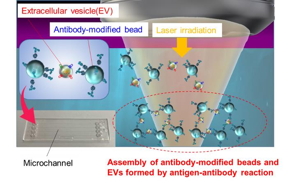 |
| Using laser irradiation, the researchers managed to directly detect nanoscale EVs in a cell supernatant within minutes. CREDIT Takuya Iida, Osaka Metropolitan University |
Abstract:
Can particles as minuscule as viruses be detected accurately within a mere 5 minutes? Osaka Metropolitan University scientists say yes, with their innovative method for ultrafast and ultrasensitive quantitative measurement of biological nanoparticles, opening doors for early diagnosis of a broad range of diseases.
Super-efficient laser light-induced detection of cancer cell-derived nanoparticles: Skipping ultracentrifugation, detection time reduced from hours to minutes!
Osaka, Japan | Posted on October 6th, 2023Nanoscale extracellular vesicles (EVs) including exosomes, with diameters of 50–150 nm, play essential roles in intercellular communication and have garnered attention as biomarkers for various diseases and drug delivery capsules. Consequently, the rapid and sensitive detection of nanoscale EVs from trace samples is of vital importance for early diagnosis of intractable diseases such as cancer and Alzheimer's disease. However, the extraction of nanoscale EVs from cell culture media previously required a complex and time-consuming process involving ultracentrifugation.
A research team led by Director Professor Takuya Iida, Deputy Director Associate Professor Shiho Tokonami, and Assistant Director Professor Ikuhiko Nakase, from the Research Institute for Light-induced Acceleration System (RILACS) at Osaka Metropolitan University, has utilized the power of laser light to accelerate the reaction between nanoscale EVs derived from cancer cells and antibody-modified microparticles. The three-dimensional structure of the resulting aggregates was then analyzed using confocal microscopy. As a result, the researchers demonstrated the ability to measure, within 5 minutes, approximately 103–104 nanoscale EVs contained in a 500 nL sample.
Professor Iida concluded, “This research achievement provides a method for ultrafast and ultrasensitive quantitative measurement of biological nanoparticles, offering a foundation for innovative analysis of cell-to-cell communication and early diagnosis of various diseases in the future.”
####
About Osaka Metropolitan University
Osaka Metropolitan University is the third largest public university in Japan, formed by a merger between Osaka City University and Osaka Prefecture University in 2022. OMU upholds "Convergence of Knowledge" through 11 undergraduate schools, a college, and 15 graduate schools. For more research news, visit https://www.omu.ac.jp/en/ or follow us on Twitter: @OsakaMetUniv_en, or Facebook.
For more information, please click here
Contacts:
Ngoc Han Hoang
Osaka Metropolitan University
Copyright © Osaka Metropolitan University
If you have a comment, please Contact us.Issuers of news releases, not 7th Wave, Inc. or Nanotechnology Now, are solely responsible for the accuracy of the content.
Bookmark:


| Related Links |
| Related News Press |
News and information
 Quantum computer improves AI predictions April 17th, 2026
Flexible sensor gains sensitivity under pressure April 17th, 2026
A reusable chip for particulate matter sensing April 17th, 2026
Detecting vibrational quantum beating in the predissociation dynamics of SF6 using time-resolved photoelectron spectroscopy April 17th, 2026
Cancer
New molecular technology targets tumors and simultaneously silences two ‘undruggable’ cancer genes August 8th, 2025
Ben-Gurion University of the Negev researchers several steps closer to harnessing patient's own T-cells to fight off cancer June 6th, 2025
Self-propelled protein-based nanomotors for enhanced cancer therapy by inducing ferroptosis June 6th, 2025
Possible Futures
A fundamentally new therapeutic approach to cystic fibrosis: Nanobody repairs cellular defect April 17th, 2026
UC Irvine physicists discover method to reverse ‘quantum scrambling’ : The work addresses the problem of information loss in quantum computing system April 17th, 2026
Nanomedicine
A fundamentally new therapeutic approach to cystic fibrosis: Nanobody repairs cellular defect April 17th, 2026
New molecular technology targets tumors and simultaneously silences two ‘undruggable’ cancer genes August 8th, 2025
New imaging approach transforms study of bacterial biofilms August 8th, 2025
Electrifying results shed light on graphene foam as a potential material for lab grown cartilage June 6th, 2025
Discoveries
Quantum computer improves AI predictions April 17th, 2026
Flexible sensor gains sensitivity under pressure April 17th, 2026
A reusable chip for particulate matter sensing April 17th, 2026
Detecting vibrational quantum beating in the predissociation dynamics of SF6 using time-resolved photoelectron spectroscopy April 17th, 2026
Announcements
A fundamentally new therapeutic approach to cystic fibrosis: Nanobody repairs cellular defect April 17th, 2026
UC Irvine physicists discover method to reverse ‘quantum scrambling’ : The work addresses the problem of information loss in quantum computing system April 17th, 2026
Interviews/Book Reviews/Essays/Reports/Podcasts/Journals/White papers/Posters
A fundamentally new therapeutic approach to cystic fibrosis: Nanobody repairs cellular defect April 17th, 2026
UC Irvine physicists discover method to reverse ‘quantum scrambling’ : The work addresses the problem of information loss in quantum computing system April 17th, 2026
Nanobiotechnology
A fundamentally new therapeutic approach to cystic fibrosis: Nanobody repairs cellular defect April 17th, 2026
New molecular technology targets tumors and simultaneously silences two ‘undruggable’ cancer genes August 8th, 2025
New imaging approach transforms study of bacterial biofilms August 8th, 2025
Electrifying results shed light on graphene foam as a potential material for lab grown cartilage June 6th, 2025
Photonics/Optics/Lasers
Metasurfaces smooth light to boost magnetic sensing precision January 30th, 2026
From sensors to smart systems: the rise of AI-driven photonic noses January 30th, 2026
 |
||
 |
||
| The latest news from around the world, FREE | ||
 |
||
|
|
||
| Premium Products | ||
 |
||
|
Only the news you want to read!
Learn More |
||
 |
||
|
Full-service, expert consulting
Learn More |
||
|
|
||