Home > Press > A new qubit platform is created atom by atom
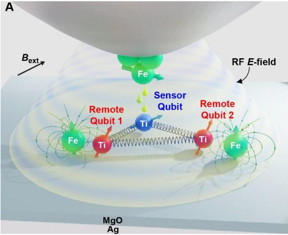 |
| The STM tip (Fe) operates the sensor qubit and romote qubits which creates the new multiple qubit platform. CREDIT Institute for Basic Science |
Abstract:
Researchers at the IBS Center for Quantum Nanoscience (QNS) at Ewha Womans University have accomplished a groundbreaking step forward in quantum information science. In partnership with teams from Japan, Spain, and the US, they created a novel electron-spin qubit platform, assembled atom-by-atom on a surface. This breakthrough was published in the journal Science on 2023/10/06.
A new qubit platform is created atom by atom
Seoul, Republic of Korea | Posted on October 6th, 2023Unlike previous atomic quantum devices on surfaces where only a single qubit could be controlled, the researchers at QNS successfully demonstrated the ability to control multiple qubits simultaneously, enabling the application of single-, two-, and three-qubit gates.
Qubits, the fundamental units of quantum information, are key to quantum applications such as quantum computing, sensing, and communication. PHARK Soo-hyon, one of the QNS principal investigators, highlights the significance of this project. "To date, scientists have only been able to create and control a single qubit on a surface, making this a major step forward towards multi-qubit systems," he stated.
Led by BAE Yujeong, PHARK Soo-hyon, and director Andreas HEINRICH, QNS developed this novel platform, which consists of individual magnetic atoms placed on a pristine surface of a thin insulator. These atoms can be precisely positioned using the tip of a scanning tunneling microscope (STM) and manipulated with the assistance of electron spin resonance (ESR-STM). This atomic-scale control has allowed researchers to manipulate quantum states coherently. They also established the possibility of controlling remote qubits, opening the path to scaling up to tens or hundreds of qubits in a defect-free environment.
BAE Yujeong pointed out, “It is truly amazing that we can now control the quantum states of multiple individual atoms on surfaces at the same time”. The atomic-scale precision of this platform allows for the remote manipulation of the atoms to perform qubit operations individually, without moving the tip of the STM.
This research marks a significant departure from other qubit platforms, such as photonic devices, ion and atom traps, and superconducting devices. One of the unique benefits of this surface-based electron-spin approach is the myriad of available spin species and the vast variety of two-dimensional geometries that can be precisely assembled.
Looking forward, the researchers anticipate quantum sensing, computation, and simulation protocols using these precisely assembled atomic architectures. Altogether, the work by the QNS researchers is expected to usher in a new era of atomic-scale control in quantum information science, cementing Korea’s position as a global leader in the field.
####
For more information, please click here
Contacts:
William Suh
Institute for Basic Science
Office: 82-010-379-37830
Copyright © Institute for Basic Science
If you have a comment, please Contact us.Issuers of news releases, not 7th Wave, Inc. or Nanotechnology Now, are solely responsible for the accuracy of the content.
Bookmark:


| Related Links |
| Related News Press |
News and information
 Quantum computer improves AI predictions April 17th, 2026
Flexible sensor gains sensitivity under pressure April 17th, 2026
A reusable chip for particulate matter sensing April 17th, 2026
Detecting vibrational quantum beating in the predissociation dynamics of SF6 using time-resolved photoelectron spectroscopy April 17th, 2026
Possible Futures
A fundamentally new therapeutic approach to cystic fibrosis: Nanobody repairs cellular defect April 17th, 2026
UC Irvine physicists discover method to reverse ‘quantum scrambling’ : The work addresses the problem of information loss in quantum computing system April 17th, 2026
Chip Technology
A reusable chip for particulate matter sensing April 17th, 2026
Metasurfaces smooth light to boost magnetic sensing precision January 30th, 2026
Quantum Computing
Quantum computer improves AI predictions April 17th, 2026
UC Irvine physicists discover method to reverse ‘quantum scrambling’ : The work addresses the problem of information loss in quantum computing system April 17th, 2026
Researchers develop molecular qubits that communicate at telecom frequencies October 3rd, 2025
Discoveries
Quantum computer improves AI predictions April 17th, 2026
Flexible sensor gains sensitivity under pressure April 17th, 2026
A reusable chip for particulate matter sensing April 17th, 2026
Detecting vibrational quantum beating in the predissociation dynamics of SF6 using time-resolved photoelectron spectroscopy April 17th, 2026
Announcements
A fundamentally new therapeutic approach to cystic fibrosis: Nanobody repairs cellular defect April 17th, 2026
UC Irvine physicists discover method to reverse ‘quantum scrambling’ : The work addresses the problem of information loss in quantum computing system April 17th, 2026
Interviews/Book Reviews/Essays/Reports/Podcasts/Journals/White papers/Posters
A fundamentally new therapeutic approach to cystic fibrosis: Nanobody repairs cellular defect April 17th, 2026
UC Irvine physicists discover method to reverse ‘quantum scrambling’ : The work addresses the problem of information loss in quantum computing system April 17th, 2026
Quantum nanoscience
Beyond silicon: Electronics at the scale of a single molecule January 30th, 2026
MXene nanomaterials enter a new dimension Multilayer nanomaterial: MXene flakes created at Drexel University show new promise as 1D scrolls January 30th, 2026
ICFO researchers overcome long-standing bottleneck in single photon detection with twisted 2D materials August 8th, 2025
 |
||
 |
||
| The latest news from around the world, FREE | ||
 |
||
|
|
||
| Premium Products | ||
 |
||
|
Only the news you want to read!
Learn More |
||
 |
||
|
Full-service, expert consulting
Learn More |
||
|
|
||