Home > Press > Unlocking quantum potential: Harnessing high-dimensional quantum states with QDs and OAM: Generation of nearly deterministic OAM-based entangled states offers a bridge between photonic technologies for quantum advancements
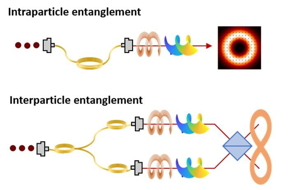 |
| Conceptual scheme of the proposed protocol. Manipulating the polarization and OAM of single photons generated from a QD source in a nearly deterministic fashion, intraparticle entangled states are generated by making the two degrees of freedom interact through a q-plate. In the interparticle regime, two photons characterized by specific states in the hybrid space composed of polarization and OAM interfere using a beam-splitter. Post-selecting on the coincidence counts, a probabilistic entangling gate has been implemented. CREDIT Alessia Suprano. |
Abstract:
Quantum technology's future rests on the exploitation of fascinating quantum mechanics concepts — such as high-dimensional quantum states. Think of these as states basic ingredients of quantum information science and quantum tech. To manipulate these states, scientists have turned to light, specifically a property called orbital angular momentum (OAM), which deals with how light twists and turns in space. Here's a catch: making super bright single photons with OAM in a deterministic fashion has been a tough nut to crack.
Unlocking quantum potential: Harnessing high-dimensional quantum states with QDs and OAM: Generation of nearly deterministic OAM-based entangled states offers a bridge between photonic technologies for quantum advancements
Bellingham, WA | Posted on September 8th, 2023Now, enter quantum dots (QDs), tiny particles with big potential. A team of researchers from Sapienza University of Rome, Paris-Saclay University, and University of Naples Federico II combined the features of OAM with those of QDs to create a bridge between two cutting-edge technologies. Their results are published in the peer-reviewed Gold Open Access journal Advanced Photonics.
So, where is the innovation? This bridge they've built can be flexibly used for two goals. First, it can make pure single photons that are entangled within the OAM-polarization space, and the researchers can count them directly. Second, this bridge can also make pairs of photons that are strongly correlated in the quantum world. They're entangled, so that each single photon state cannot be described independently of the other, even when they're far apart. This is a big deal for quantum communication and encryption.
This new platform has the potential to create hybrid entanglement states both within and between particles, all belonging to high-dimensional Hilbert spaces. On one hand, the team has achieved the generation of pure single photons, whose quantum states exhibit nonseparability within the hybrid OAM-polarization domain. By exploiting an almost deterministic quantum source in combination with a q-plate — a device capable of adjusting the OAM value based on single photon polarization — the researchers can directly validate these states through single-photon counts, thereby avoiding the need for a heralding process and enhancing the rate of generation.
On the other hand, the team also employs the concept of indistinguishability within single photons as a resource to generate pairs of single photons that possess entanglement within the hybrid OAM-polarization space. According to Professor Fabio Sciarrino, head of Quantum Information Lab in the Department of Physics of Sapienza University of Rome, “The proposed flexible scheme represents a step forward in high-dimensional multiphoton experiments, and it could provide an import platform for both fundamental investigations and quantum photonic applications.”
In simple terms, this research is a leap in our quest for better quantum technologies. It's like connecting two major cities. This connection opens exciting possibilities for quantum computing, communication, and much more. So, keep an eye on this — it's not just science; it's the future.
####
For more information, please click here
Contacts:
Daneet Steffens
SPIE--International Society for Optics and Photonics
Office: 360-685-5478
Copyright © SPIE--International Society for Optics and Photonics
If you have a comment, please Contact us.Issuers of news releases, not 7th Wave, Inc. or Nanotechnology Now, are solely responsible for the accuracy of the content.
Bookmark:


| Related Links |
| Related News Press |
News and information
 Quantum computer improves AI predictions April 17th, 2026
Flexible sensor gains sensitivity under pressure April 17th, 2026
A reusable chip for particulate matter sensing April 17th, 2026
Detecting vibrational quantum beating in the predissociation dynamics of SF6 using time-resolved photoelectron spectroscopy April 17th, 2026
Quantum Physics
Detecting vibrational quantum beating in the predissociation dynamics of SF6 using time-resolved photoelectron spectroscopy April 17th, 2026
Beyond silicon: Electronics at the scale of a single molecule January 30th, 2026
MXene nanomaterials enter a new dimension Multilayer nanomaterial: MXene flakes created at Drexel University show new promise as 1D scrolls January 30th, 2026
Physics
UC Irvine physicists discover method to reverse ‘quantum scrambling’ : The work addresses the problem of information loss in quantum computing system April 17th, 2026
Possible Futures
A fundamentally new therapeutic approach to cystic fibrosis: Nanobody repairs cellular defect April 17th, 2026
UC Irvine physicists discover method to reverse ‘quantum scrambling’ : The work addresses the problem of information loss in quantum computing system April 17th, 2026
Quantum Computing
Quantum computer improves AI predictions April 17th, 2026
UC Irvine physicists discover method to reverse ‘quantum scrambling’ : The work addresses the problem of information loss in quantum computing system April 17th, 2026
Researchers develop molecular qubits that communicate at telecom frequencies October 3rd, 2025
Discoveries
Quantum computer improves AI predictions April 17th, 2026
Flexible sensor gains sensitivity under pressure April 17th, 2026
A reusable chip for particulate matter sensing April 17th, 2026
Detecting vibrational quantum beating in the predissociation dynamics of SF6 using time-resolved photoelectron spectroscopy April 17th, 2026
Announcements
A fundamentally new therapeutic approach to cystic fibrosis: Nanobody repairs cellular defect April 17th, 2026
UC Irvine physicists discover method to reverse ‘quantum scrambling’ : The work addresses the problem of information loss in quantum computing system April 17th, 2026
Interviews/Book Reviews/Essays/Reports/Podcasts/Journals/White papers/Posters
A fundamentally new therapeutic approach to cystic fibrosis: Nanobody repairs cellular defect April 17th, 2026
UC Irvine physicists discover method to reverse ‘quantum scrambling’ : The work addresses the problem of information loss in quantum computing system April 17th, 2026
Photonics/Optics/Lasers
Metasurfaces smooth light to boost magnetic sensing precision January 30th, 2026
From sensors to smart systems: the rise of AI-driven photonic noses January 30th, 2026
 |
||
 |
||
| The latest news from around the world, FREE | ||
 |
||
|
|
||
| Premium Products | ||
 |
||
|
Only the news you want to read!
Learn More |
||
 |
||
|
Full-service, expert consulting
Learn More |
||
|
|
||