Home > Press > Ultrafast lasers for materials processing
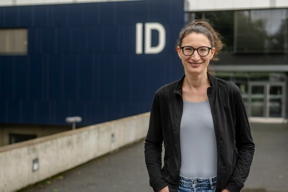 |
| In addition to her ERC Starting Grant, Clara Saraceno receives a Proof of Concept Grant from the European Research Council. CREDIT RUB, Marquard |
Abstract:
Lasers are an essential tool for materials processing. They can be used to cut, weld and remove material. A special kind of lasers known as femtosecond lasers can be used to create high-precision microstructures, such as those needed for smartphone displays and automotive technology. Professor Clara Saraceno from Ruhr University Bochum aims to introduce a cheaper and more efficient laser technology to the market. To this end, she is receiving a proof-of-concept grant amounting to 150,000 euros from the European Research Council (ERC). The project titled “Ultrafast 2.1 µm Holmium Lasers for GHz ablation” (Giga2u) will run for 18 months.
Ultrafast lasers for materials processing
Bochum, Germany | Posted on August 11th, 2023Faster and more efficient
Standard femtosecond lasers emit light pulses with wavelengths of one micrometer and a duration in the hundreds of femtosecond range; this is the equivalent of a quadrillionth of a second. The energy per pulse is high, and the systems are expensive. “New lasers that are faster and more efficient, while generating lower costs, could be a key technology for the market,” points out Clara Saraceno, head of the Photonics and Ultrafast Laser Science group.
As part of her ERC Starting Grant “TerAqua”, Clara Saraceno is currently developing femtosecond lasers that operate at wavelengths of 2.1 microns and with repetition frequencies in the GHz regime. They require less energy and are potentially more reliable than systems currently deployed in industry. They also promise lower costs and faster production speeds. So far, however, the systems have only been used for research applications, such as spectroscopy.
Testing market readiness
The Giga2u proof-of-concept grant is intended to demonstrate the potential of the technology for industrial applications. Such a system would be of interest primarily for processing glass and polymers, but also for ablating aqueous tissues. The latter could be useful for future directions in laser surgery application. The researchers headed by Clara Saraceno hope to develop a compact and stable laser prototype and explore the technology’s market potential. In the process, the group also intends to lay the groundwork for establishing a start-up.
####
For more information, please click here
Contacts:
Media Contact
Meike Driessen
Ruhr-University Bochum
Office: 49-234-32-26952
Expert Contact
Prof. Dr. Clara Saraceno
Photonics and Ultrafast Laser Science, Faculty of Electrical Engineering and Information Technology, Ruhr University Bochum, Germany
Office: +49 234 32 23027
@ruhrunibochum
Copyright © Ruhr-University Bochum
If you have a comment, please Contact us.Issuers of news releases, not 7th Wave, Inc. or Nanotechnology Now, are solely responsible for the accuracy of the content.
Bookmark:


| Related News Press |
News and information
 Quantum computer improves AI predictions April 17th, 2026
Flexible sensor gains sensitivity under pressure April 17th, 2026
A reusable chip for particulate matter sensing April 17th, 2026
Detecting vibrational quantum beating in the predissociation dynamics of SF6 using time-resolved photoelectron spectroscopy April 17th, 2026
Possible Futures
A fundamentally new therapeutic approach to cystic fibrosis: Nanobody repairs cellular defect April 17th, 2026
UC Irvine physicists discover method to reverse ‘quantum scrambling’ : The work addresses the problem of information loss in quantum computing system April 17th, 2026
Discoveries
Quantum computer improves AI predictions April 17th, 2026
Flexible sensor gains sensitivity under pressure April 17th, 2026
A reusable chip for particulate matter sensing April 17th, 2026
Detecting vibrational quantum beating in the predissociation dynamics of SF6 using time-resolved photoelectron spectroscopy April 17th, 2026
Materials/Metamaterials/Magnetoresistance
First real-time observation of two-dimensional melting process: Researchers at Mainz University unveil new insights into magnetic vortex structures August 8th, 2025
Researchers unveil a groundbreaking clay-based solution to capture carbon dioxide and combat climate change June 6th, 2025
A 1960s idea inspires NBI researchers to study hitherto inaccessible quantum states June 6th, 2025
Institute for Nanoscience hosts annual proposal planning meeting May 16th, 2025
Announcements
A fundamentally new therapeutic approach to cystic fibrosis: Nanobody repairs cellular defect April 17th, 2026
UC Irvine physicists discover method to reverse ‘quantum scrambling’ : The work addresses the problem of information loss in quantum computing system April 17th, 2026
Interviews/Book Reviews/Essays/Reports/Podcasts/Journals/White papers/Posters
A fundamentally new therapeutic approach to cystic fibrosis: Nanobody repairs cellular defect April 17th, 2026
UC Irvine physicists discover method to reverse ‘quantum scrambling’ : The work addresses the problem of information loss in quantum computing system April 17th, 2026
Photonics/Optics/Lasers
Metasurfaces smooth light to boost magnetic sensing precision January 30th, 2026
From sensors to smart systems: the rise of AI-driven photonic noses January 30th, 2026
 |
||
 |
||
| The latest news from around the world, FREE | ||
 |
||
|
|
||
| Premium Products | ||
 |
||
|
Only the news you want to read!
Learn More |
||
 |
||
|
Full-service, expert consulting
Learn More |
||
|
|
||