Home > Press > Ribbons of graphene push the material’s potential: A new technique developed at Columbia offers a systematic evaluation of twist angle and strain in layered 2D materials
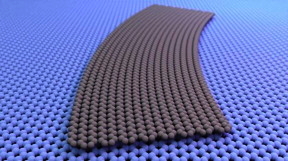 |
| A curved graphene ribbon, illustrated in grey, shown laid flat against another graphene sheet. There is a continuous change in the twist angle between the ribbon above and the sheet below. In some places the atomic lattices of the two sheets line up at a 0° angle to each other, while in others, they are twisted relative to each other by as much as 5°. CREDIT Cory Dean, Columbia University |
Abstract:
Think you know everything about a material? Try giving it a twist—literally. That’s the main idea of an emerging field in condensed matter physics called “twistronics,” which has researchers drastically changing the properties of 2D materials, like graphene, with subtle changes—as small as going from a 1.1° to 1.2°—in the angle between stacked layers. Twisted layers of graphene, for example, have been shown to behave in ways that single sheets have not, including acting like magnets, like electrical superconductors, or like a superconductor’s opposite, insulators, all due to small changes in the twist angle between sheets.
Ribbons of graphene push the material’s potential: A new technique developed at Columbia offers a systematic evaluation of twist angle and strain in layered 2D materials
New York, NY | Posted on August 11th, 2023In theory, you could dial in any property by turning a knob that changes the twist angle. The reality, however, isn’t so straightforward, says Columbia physicist Cory Dean. Two twisted layers of graphene can become like a new material, but exactly why these different properties manifest is not well understood, let alone something that can be fully controlled yet.
Dean and his lab have come up with a simple new fabrication technique that may help physicists probe the fundamental properties of twisted layers of graphene and other 2D materials in a more systematic and reproducible way. Writing in Science, they use long “ribbons” of graphene, rather than square flakes, to create devices that offer a new level of predictability and control over both twist angle and strain.
Graphene devices have typically been assembled from atom-thin flakes of graphene that are just a few square micrometers. The resulting twist angle between the sheets is fixed in place, and the flakes can be tricky to layer together smoothly. “Imagine graphene as pieces of saran wrap—when you put two pieces together you get random little wrinkles and bubbles,” says postdoc Bjarke Jessen, a co-author on the paper. Those bubbles and wrinkles are akin to changes in the twist angle between the sheets and the physical strain that develops in between and can cause the material to buckle, bend, and pinch randomly. All these variations can yield new behaviors, but they have been difficult to control within and between devices.
Ribbons can help smooth things out. The lab’s new research shows that, with just a little push from the tip of an atomic force microscope, they can bend a graphene ribbon into a stable arc that can then be placed flat on top of a second, uncurved, graphene layer. The result is a continuous variation in the twist angle between the two sheets that spans from 0° to 5° across the length of the device, with evenly distributed strain throughout—no more random bubbles or wrinkles to contend with. “We no longer have to make 10 separate devices with 10 different angles to see what happens,” said postdoc and co-author Maëlle Kapfer. “And, we can now control for strain, which was completely lacking in prior twisted devices.”
The team used special high-resolution microscopes to confirm how uniform their devices were. With that spatial information, they developed a mechanical model that predicts twist angles and strain values simply based on the shape of the curved ribbon.
This first paper was focused on characterizing the behavior and properties of ribbons of graphene as well as other materials that can be thinned to single layers and stacked on top of each other. “It’s worked with every 2D material that we’ve tried so far,” noted Dean. From here, the lab plans to use their new technique to explore how the fundamental properties of quantum materials change as a function of twist angle and strain. For example, prior research has shown that two twisted layers of graphene act like a superconductor when the twist angle is 1.1. However, there are competing models to explain the origins of superconductivity at this so-called “magic angle,” as well as predictions of additional magic angles that have thus far been too difficult to stabilize, Dean said. With devices made with ribbons, which contain all angles between 0° and 5°, the team can more precisely explore the origins of this phenomenon, and others.
“What we are doing is like quantum alchemy: taking a material and turning it into something else. We now have a platform to systematically explore how that happens,” said Jessen.
####
For more information, please click here
Contacts:
Ellen Neff
Columbia University
Office: 212-853-8048
Copyright © Columbia University
If you have a comment, please Contact us.Issuers of news releases, not 7th Wave, Inc. or Nanotechnology Now, are solely responsible for the accuracy of the content.
Bookmark:


| Related Links |
| Related News Press |
News and information
 Quantum computer improves AI predictions April 17th, 2026
Flexible sensor gains sensitivity under pressure April 17th, 2026
A reusable chip for particulate matter sensing April 17th, 2026
Detecting vibrational quantum beating in the predissociation dynamics of SF6 using time-resolved photoelectron spectroscopy April 17th, 2026
2 Dimensional Materials
Flexible sensor gains sensitivity under pressure April 17th, 2026
Graphene/ Graphite
Electrifying results shed light on graphene foam as a potential material for lab grown cartilage June 6th, 2025
Breakthrough in proton barrier films using pore-free graphene oxide: Kumamoto University researchers achieve new milestone in advanced coating technologies September 13th, 2024
Possible Futures
A fundamentally new therapeutic approach to cystic fibrosis: Nanobody repairs cellular defect April 17th, 2026
UC Irvine physicists discover method to reverse ‘quantum scrambling’ : The work addresses the problem of information loss in quantum computing system April 17th, 2026
Discoveries
Quantum computer improves AI predictions April 17th, 2026
Flexible sensor gains sensitivity under pressure April 17th, 2026
A reusable chip for particulate matter sensing April 17th, 2026
Detecting vibrational quantum beating in the predissociation dynamics of SF6 using time-resolved photoelectron spectroscopy April 17th, 2026
Materials/Metamaterials/Magnetoresistance
First real-time observation of two-dimensional melting process: Researchers at Mainz University unveil new insights into magnetic vortex structures August 8th, 2025
Researchers unveil a groundbreaking clay-based solution to capture carbon dioxide and combat climate change June 6th, 2025
A 1960s idea inspires NBI researchers to study hitherto inaccessible quantum states June 6th, 2025
Institute for Nanoscience hosts annual proposal planning meeting May 16th, 2025
Announcements
A fundamentally new therapeutic approach to cystic fibrosis: Nanobody repairs cellular defect April 17th, 2026
UC Irvine physicists discover method to reverse ‘quantum scrambling’ : The work addresses the problem of information loss in quantum computing system April 17th, 2026
Interviews/Book Reviews/Essays/Reports/Podcasts/Journals/White papers/Posters
A fundamentally new therapeutic approach to cystic fibrosis: Nanobody repairs cellular defect April 17th, 2026
UC Irvine physicists discover method to reverse ‘quantum scrambling’ : The work addresses the problem of information loss in quantum computing system April 17th, 2026
 |
||
 |
||
| The latest news from around the world, FREE | ||
 |
||
|
|
||
| Premium Products | ||
 |
||
|
Only the news you want to read!
Learn More |
||
 |
||
|
Full-service, expert consulting
Learn More |
||
|
|
||