Home > Press > Discovery may lead to terahertz technology for quantum sensing: Metal oxide’s properties could enable wide range of terahertz frequency photonics
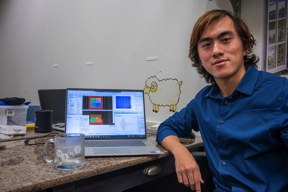 |
| Rui Xu, a Rice University materials science and nanoengineering student, is a lead author on a study that shows strontium titanate has the potential to enable efficient photonic devices at frequencies from 3-19 terahertz. CREDIT (Photo by Gustavo Raskosky/Rice University) |
Abstract:
Visible light is a mere fraction of the electromagnetic spectrum, and the manipulation of light waves at frequencies beyond human vision has enabled such technologies as cell phones and CT scans.
Discovery may lead to terahertz technology for quantum sensing: Metal oxide’s properties could enable wide range of terahertz frequency photonics
Houston, TX | Posted on July 21st, 2023Rice University researchers have a plan for leveraging a previously unused portion of the spectrum.
“There is a notable gap in mid- and far-infrared light, roughly the frequencies of 5-15 terahertz and wavelengths ranging from 20-60 micrometers, for which there are no good commercial products compared with higher optical frequencies and lower radio frequencies,” said Rui Xu, a third-year doctoral student at Rice and lead author on an article published in Advanced Materials.
The research was performed in the Emerging Quantum and Ultrafast Materials Laboratory of co-author Hanyu Zhu, William Marsh Rice Chair and assistant professor of materials science and nanoengineering.
“Optical technologies in this frequency region ⎯ sometimes called ‘the new terahertz gap’ because it is far less accessible than the rest of the 0.3-30 terahertz ‘gap’ ⎯ could be very useful for studying and developing quantum materials for quantum electronics closer to room temperature, as well as sensing functional groups in biomolecules for medical diagnosis,” Zhu said.
The challenge faced by researchers has been identifying proper materials to carry and process light in the “new terahertz gap.” Such light strongly interacts with the atomic structures of most materials and is quickly absorbed by them. Zhu’s group has turned the strong interaction to its advantage with strontium titanate, an oxide of strontium and titanium.
“Its atoms couple with terahertz light so strongly that they form new particles called phonon-polaritons, which are confined to the surface of the material and are not lost inside of it,” Xu said.
Unlike other materials that support phonon-polaritons in higher frequencies and usually in a narrow range, strontium titanate works for the entire 5-15 terahertz gap because of a property called quantum paraelectricity. Its atoms exhibit large quantum fluctuations and vibrate randomly, thus capturing light effectively without being self-trapped by the captured light, even at zero degrees Kelvin.
“We proved the concept of strontium titanate phonon-polariton devices in the frequency range of 7-13 terahertz by designing and fabricating ultrafast field concentrators,” Xu said. “The devices squeeze the light pulse into a volume smaller than the wavelength of light and maintain the short duration. Thus, we achieve a strong transient electric field of nearly a gigavolt per meter.”
The electric field is so strong that it can be used to change the materials’ structure to create new electronic properties, or to create a new nonlinear optical response from trace amounts of specific molecules which can be detected by a common optical microscope. Zhu said the design and fabrication methodology developed by his group are applicable to many commercially available materials and could enable photonic devices in the 3-19 terahertz range.
Other co-authors of the paper are Xiaotong Chen, a postdoctoral researcher in materials science and nanoengineering; Elizabeth Blackert and Tong Lin, doctoral students in materials science and nanoengineering; Jiaming Luo, a third-year doctoral student in applied physics; Alyssa Moon, now at Texas A&M University and formerly enrolled at Rice in the Nanotechnology Research Experience for Undergraduates Program; and Khalil JeBailey, a senior in materials science and nanoengineering at Rice.
The research was supported by the National Science Foundation (2005096, 1842494, 1757967) and the Welch Foundation (C-2128).
By Patrick Kurp, science writer for the George R. Brown School of Engineering
####
About Rice University
Located on a 300-acre forested campus in Houston, Rice University is consistently ranked among the nation’s top 20 universities by U.S. News & World Report. Rice has highly respected schools of Architecture, Business, Continuing Studies, Engineering, Humanities, Music, Natural Sciences and Social Sciences and is home to the Baker Institute for Public Policy. With 4,552 undergraduates and 3,998 graduate students, Rice’s undergraduate student-to-faculty ratio is just under 6-to-1. Its residential college system builds close-knit communities and lifelong friendships, just one reason why Rice is ranked No. 1 for lots of race/class interaction and No. 4 for quality of life by the Princeton Review. Rice is also rated as a best value among private universities by Kiplinger’s Personal Finance.
For more information, please click here
Contacts:
Silvia Cernea Clark
Rice University
Office: 7133486728
Copyright © Rice University
If you have a comment, please Contact us.Issuers of news releases, not 7th Wave, Inc. or Nanotechnology Now, are solely responsible for the accuracy of the content.
Bookmark:


| Related Links |
| Related News Press |
News and information
 Quantum computer improves AI predictions April 17th, 2026
Flexible sensor gains sensitivity under pressure April 17th, 2026
A reusable chip for particulate matter sensing April 17th, 2026
Detecting vibrational quantum beating in the predissociation dynamics of SF6 using time-resolved photoelectron spectroscopy April 17th, 2026
Quantum Physics
Detecting vibrational quantum beating in the predissociation dynamics of SF6 using time-resolved photoelectron spectroscopy April 17th, 2026
Beyond silicon: Electronics at the scale of a single molecule January 30th, 2026
Imaging
Govt.-Legislation/Regulation/Funding/Policy
Quantum computer improves AI predictions April 17th, 2026
Metasurfaces smooth light to boost magnetic sensing precision January 30th, 2026
New imaging approach transforms study of bacterial biofilms August 8th, 2025
Possible Futures
A fundamentally new therapeutic approach to cystic fibrosis: Nanobody repairs cellular defect April 17th, 2026
UC Irvine physicists discover method to reverse ‘quantum scrambling’ : The work addresses the problem of information loss in quantum computing system April 17th, 2026
Discoveries
Quantum computer improves AI predictions April 17th, 2026
Flexible sensor gains sensitivity under pressure April 17th, 2026
A reusable chip for particulate matter sensing April 17th, 2026
Detecting vibrational quantum beating in the predissociation dynamics of SF6 using time-resolved photoelectron spectroscopy April 17th, 2026
Announcements
A fundamentally new therapeutic approach to cystic fibrosis: Nanobody repairs cellular defect April 17th, 2026
UC Irvine physicists discover method to reverse ‘quantum scrambling’ : The work addresses the problem of information loss in quantum computing system April 17th, 2026
Quantum nanoscience
Beyond silicon: Electronics at the scale of a single molecule January 30th, 2026
MXene nanomaterials enter a new dimension Multilayer nanomaterial: MXene flakes created at Drexel University show new promise as 1D scrolls January 30th, 2026
ICFO researchers overcome long-standing bottleneck in single photon detection with twisted 2D materials August 8th, 2025
 |
||
 |
||
| The latest news from around the world, FREE | ||
 |
||
|
|
||
| Premium Products | ||
 |
||
|
Only the news you want to read!
Learn More |
||
 |
||
|
Full-service, expert consulting
Learn More |
||
|
|
||