Home > Press > Liquid metal sticks to surfaces without a binding agent
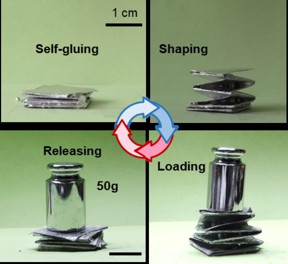 |
| A multifunctional Origami structure built by the liquid metal-treated paper CREDIT Cell Reports Physical Science/Yuan et al. |
Abstract:
Everyday materials such as paper and plastic could be transformed into electronic “smart devices” by using a simple new method to apply liquid metal to surfaces, according to scientists in Beijing, China. The study, published June 9 in the journal Cell Reports Physical Science, demonstrates a technique for applying a liquid metal coating to surfaces that do not easily bond with liquid metal. The approach is designed to work at a large scale and may have applications in wearable testing platforms, flexible devices, and soft robotics
Liquid metal sticks to surfaces without a binding agent
Cambridge, MA | Posted on June 9th, 2023“Before, we thought that it was impossible for liquid metal to adhere to non-wetting surfaces so easily, but here it can adhere to various surfaces only by adjusting the pressure, which is very interesting,” said Bo Yuan, a scientist at Tsinghua University and the first author of the study.
Scientists seeking to combine liquid metal with traditional materials have been impeded by liquid metal’s extremely high surface tension, which prevents it from binding with most materials, including paper. To overcome this issue, previous research has mainly focused on a technique called “transfer printing,” which involves using a third material to bind the liquid metal to the surface. But this strategy comes with drawbacks—adding more materials can complicate the process and may weaken the end product’s electrical, thermal, or mechanical performance.
To explore an alternative approach that would allow them to directly print liquid metal on substrates without sacrificing the metal’s properties, Yuan and colleagues applied two different liquid metals (eGaln and BilnSn) to various silicone and silicone polymer stamps, then applied different forces as they rubbed the stamps onto paper surfaces.
“At first, it was hard to realize stable adhesion of the liquid metal coating on the substrate,” said Yuan. “However, after a lot of trial and error, we finally had the right parameters to achieve stable, repeatable adhesion.”
The researchers found that rubbing the liquid metal-covered stamp against the paper with a small amount of force enabled the metal droplets to bind effectively to the surface, while applying larger amounts of force prevented the droplets from staying in place.
Next, the team folded the metal-coated paper into a paper crane, demonstrating that the surface can still be folded as usual after the process is completed. And after doing so, the modified paper still maintains its usual properties.
While the technique appears promising, Yuan noted that the researchers are still figuring out how to guarantee that the liquid metal coating stays in place after it has been applied. For now, a packaging material can be added to the paper’s surface, but the team hopes to figure out a solution that won’t require it.
“Just like wet ink on paper can be wiped off by hand, the liquid metal coating without packaging here also can be wiped off by the object it touches as it is applied,” said Yuan. “The properties of the coating itself will not be greatly affected, but objects in contact may be soiled.”
In the future, the team also plans to build on the method so that it can be used to apply liquid metal to a greater variety of surfaces, including metal and ceramic.
“We also plan to construct smart devices using materials treated by this method,” said Yuan.
###
This work was supported by China Postdoctoral Science Foundation, the National Nature Science Foundation of China, and the cooperation funding between Nanshan and Tsinghua SIGS in science and technology.
Cell Reports Physical Science, Yuan et al. “Direct fabrication of liquid-metal multifunctional paper based on force-responsive adhesion” https://www.cell.com/cell-reports-physical-science/fulltext/S2666-3864(23)00193-5
Cell Reports Physical Science published by Cell Press, is a new broad-scope, open access journal that publishes cutting-edge research across the spectrum of the physical sciences, including chemistry, physics, materials science, energy science, engineering, and related interdisciplinary work. Visit https://www.cell.com/cell-reports-physical-science/home. To receive Cell Press media alerts, please contact
####
For more information, please click here
Contacts:
Kristopher Benke
Cell Press
Copyright © Cell Press
If you have a comment, please Contact us.Issuers of news releases, not 7th Wave, Inc. or Nanotechnology Now, are solely responsible for the accuracy of the content.
Bookmark:


| Related Links |
| Related News Press |
News and information
 Quantum computer improves AI predictions April 17th, 2026
Flexible sensor gains sensitivity under pressure April 17th, 2026
A reusable chip for particulate matter sensing April 17th, 2026
Detecting vibrational quantum beating in the predissociation dynamics of SF6 using time-resolved photoelectron spectroscopy April 17th, 2026
Flexible Electronics
Flexible sensor gains sensitivity under pressure April 17th, 2026
Flexible electronics integrated with paper-thin structure for use in space January 17th, 2025
Wearable electronics
Breakthrough brings body-heat powered wearable devices closer to reality December 13th, 2024
Nanofibrous metal oxide semiconductor for sensory face November 8th, 2024
Robotics
Nanofibrous metal oxide semiconductor for sensory face November 8th, 2024
Possible Futures
A fundamentally new therapeutic approach to cystic fibrosis: Nanobody repairs cellular defect April 17th, 2026
UC Irvine physicists discover method to reverse ‘quantum scrambling’ : The work addresses the problem of information loss in quantum computing system April 17th, 2026
Discoveries
Quantum computer improves AI predictions April 17th, 2026
Flexible sensor gains sensitivity under pressure April 17th, 2026
A reusable chip for particulate matter sensing April 17th, 2026
Detecting vibrational quantum beating in the predissociation dynamics of SF6 using time-resolved photoelectron spectroscopy April 17th, 2026
Announcements
A fundamentally new therapeutic approach to cystic fibrosis: Nanobody repairs cellular defect April 17th, 2026
UC Irvine physicists discover method to reverse ‘quantum scrambling’ : The work addresses the problem of information loss in quantum computing system April 17th, 2026
Interviews/Book Reviews/Essays/Reports/Podcasts/Journals/White papers/Posters
A fundamentally new therapeutic approach to cystic fibrosis: Nanobody repairs cellular defect April 17th, 2026
UC Irvine physicists discover method to reverse ‘quantum scrambling’ : The work addresses the problem of information loss in quantum computing system April 17th, 2026
 |
||
 |
||
| The latest news from around the world, FREE | ||
 |
||
|
|
||
| Premium Products | ||
 |
||
|
Only the news you want to read!
Learn More |
||
 |
||
|
Full-service, expert consulting
Learn More |
||
|
|
||