Home > Press > When all details matter -- Heat transport in energy materials
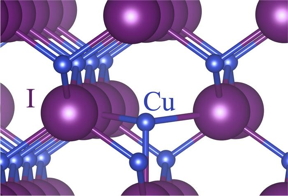 |
| Temporary formation of a defect pair in copper iodide. Although these defects only survive for a couple of picoseconds, i.e., for a trillionth of a second, they substantially influence macroscopic heat transport processes. CREDIT © Florian Knoop, NOMAD Laboratory |
Abstract:
The NOMAD Laboratory researchers have recently elucidated on fundamental microscopic mechanisms that offer to tailor materials for heat insulation. This development advances the ongoing efforts to enhance energy efficiency and sustainability.
When all details matter -- Heat transport in energy materials
Berlin, Germany | Posted on June 9th, 2023The role of heat transport is crucial in various scientific and industrial applications, such as catalysis, turbine technologies, and thermoelectric heat converters that convert waste heat into electricity. Particularly in the context of energy conservation and the development of sustainable technologies, materials with high thermal insulation capabilities are of utmost importance. These materials allow to retain and utilize heat that would otherwise go to waste. Therefore, improving the design of highly insulating materials is a key research objective in enabling more energy-efficient applications.
However, designing strongly heat insulators is far from trivial, despite the fact that the underlying fundamental physical laws are known for nearly a century. At a microscopic level, heat transport in semiconductors and insulators was understood in terms of the collective oscillation of the atoms around their equilibrium positions in the crystal lattice. These oscillations, called “phonons” in the field, involve zillions of atoms in solid materials and hence cover large, almost macroscopic length- and time-scales.
In a recent joined publication in Physical Review B (Editors Suggestions) and Physical Review Letters, researchers from the NOMAD Laboratory at the Fritz Haber Institute have advanced the computational possibilities to compute thermal conductivities without experimental input at unprecedented accuracy. They demonstrated that for strong heat insulators the above-mentioned phonon picture is not appropriate. Using large-scale calculations on supercomputers at of the Max Planck Society, the North-German Supercomputing Alliance, and the Jülich Supercomputing Centre, they scanned over 465 crystalline materials, for which the thermal conductivity had not been measured yet. Besides finding 28 strong thermal insulators, six of which featuring an ultra-low thermal conductivity comparable to wood, this study shed light on a hitherto typically overseen mechanisms that allows to systematically lower the thermal conductivity. “We observed the temporary formation of defect structures that massively influences the atomic motion for an extremely short period of time”, says Dr. Florian Knoop (now Linköping University), first author of both publications. “Such effects are typically neglected in thermal-conductivity simulations, since these defects are so short-lived and so microscopically localised compared to typical heat-transport scales, that they are assumed to be irrelevant. However, the performed calculations showed that they trigger lower thermal conductivities”, adds Dr. Christian Carbogno, a senior author of the studies.
These insights may offer new opportunities to fine-tune and design thermal insulators on a nanoscale level through defect engineering, potentially contributing to advances in energy-efficient technology.
####
For more information, please click here
Contacts:
Media Contact
Jelena Tomovic
Fritz Haber Institute of the Max Planck Society
Office: 3084135122
Expert Contacts
Dr. Christian Carbogno
Fritz Haber Institute
Office: +49308413-4817
@fhi_mpg_de
Prof. Dr. Matthias Scheffler
Fritz Haber Institute
Office: +49308413-4711
@fhi_mpg_de
Copyright © Fritz Haber Institute of the Max Planck Society
If you have a comment, please Contact us.Issuers of news releases, not 7th Wave, Inc. or Nanotechnology Now, are solely responsible for the accuracy of the content.
Bookmark:


| Related Links |
| Related News Press |
News and information
 Quantum computer improves AI predictions April 17th, 2026
Flexible sensor gains sensitivity under pressure April 17th, 2026
A reusable chip for particulate matter sensing April 17th, 2026
Detecting vibrational quantum beating in the predissociation dynamics of SF6 using time-resolved photoelectron spectroscopy April 17th, 2026
Possible Futures
A fundamentally new therapeutic approach to cystic fibrosis: Nanobody repairs cellular defect April 17th, 2026
UC Irvine physicists discover method to reverse ‘quantum scrambling’ : The work addresses the problem of information loss in quantum computing system April 17th, 2026
Discoveries
Quantum computer improves AI predictions April 17th, 2026
Flexible sensor gains sensitivity under pressure April 17th, 2026
A reusable chip for particulate matter sensing April 17th, 2026
Detecting vibrational quantum beating in the predissociation dynamics of SF6 using time-resolved photoelectron spectroscopy April 17th, 2026
Announcements
A fundamentally new therapeutic approach to cystic fibrosis: Nanobody repairs cellular defect April 17th, 2026
UC Irvine physicists discover method to reverse ‘quantum scrambling’ : The work addresses the problem of information loss in quantum computing system April 17th, 2026
Interviews/Book Reviews/Essays/Reports/Podcasts/Journals/White papers/Posters
A fundamentally new therapeutic approach to cystic fibrosis: Nanobody repairs cellular defect April 17th, 2026
UC Irvine physicists discover method to reverse ‘quantum scrambling’ : The work addresses the problem of information loss in quantum computing system April 17th, 2026
Environment
A reusable chip for particulate matter sensing April 17th, 2026
Researchers unveil a groundbreaking clay-based solution to capture carbon dioxide and combat climate change June 6th, 2025
Energy
Sensors innovations for smart lithium-based batteries: advancements, opportunities, and potential challenges August 8th, 2025
Simple algorithm paired with standard imaging tool could predict failure in lithium metal batteries August 8th, 2025
 |
||
 |
||
| The latest news from around the world, FREE | ||
 |
||
|
|
||
| Premium Products | ||
 |
||
|
Only the news you want to read!
Learn More |
||
 |
||
|
Full-service, expert consulting
Learn More |
||
|
|
||