Home > Press > Breaking through the limits of stretchable semiconductors with molecular brakes that harness light
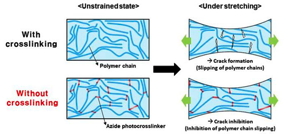 |
| Research Image CREDIT POSTECH |
Abstract:
Like the brakes that stop cars, a molecular brake exists that can prevent semiconductor chains from slipping, enabling the creation of more groundbreaking devices. Recently, a joint research team led by Professor Kilwon Cho and PhD candidates Seung Hyun Kim and Sein Chung from the Department of Chemical Engineering at POSTECH, and Professor Boseok Kang from the Department of Nano Engineering at Sungkyunkwan University (SKKU) has developed a technology for high-performance organic polymer semiconductors that exhibit both stretchability and electrical functionality. This study was recently featured on the inside back cover of Advanced Functional Materials.
Breaking through the limits of stretchable semiconductors with molecular brakes that harness light
Pohang, South Korea | Posted on June 9th, 2023For semiconductors to find applications in diverse flexible devices like flexible displays and skin-attachable medical devices, it is necessary to use stretchable materials instead of rigid ones. However, the force exerted during the stretching of semiconductors can be up to ten times greater than that experienced during simple bending, leading to the breakdown of the semiconductor layers and a decline in their electrical performance. Researchers have been diligently exploring methods to preserve semiconductor performance even under deformation, but a definitive solution to this challenge remains elusive.
The research team successfully created a flexible molecular photocrosslinker1 featuring azide-reactive groups at both ends. When exposed to ultraviolet light, this photocrosslinker forms a network structure with the polymer semiconductor, acting as a brake that prevents slipping even under stretching conditions. In contrast to conventional semiconductor materials, where polymer chains become intertwined and irreversibly slip and fracture when stretched, the presence of this "brake" allows the polymer chains to retain their stretchability and performance without any slipping.
Using this approach, the research team successfully preserved up to 96 percent of the electrical performance of the polymer semiconductor, even when it was stretched to 80 percent. Moreover, the semiconductor exhibited significantly enhanced stretchability and durability compared to conventional semiconductors, clearly demonstrating the effectiveness of the developed technology.
Professor Kilwon Cho explained, "By incorporating azide photocrosslinkers into the films, we have successfully preserved the excellent electrical properties of polymer semiconductors for organic thin-film transistors even under significant mechanical deformation. This simple approach significantly enhances the stretchability and UV-patternability of organic semiconducting polymers, making it highly valuable for industries requiring large-area production and photolithography for the development of next-generation flexible electronics."
This study was conducted with the support of the Mid-career Researcher Program of the National Research Foundation of Korea and the Strategic Reinforcement of International Cooperation Network of the Ministry of Science and ICT of Korea.
####
For more information, please click here
Contacts:
Jinyoung Huh
Pohang University of Science & Technology (POSTECH)
Office: 82-54-279-2415
Copyright © Pohang University of Science & Technology (POSTECH)
If you have a comment, please Contact us.Issuers of news releases, not 7th Wave, Inc. or Nanotechnology Now, are solely responsible for the accuracy of the content.
Bookmark:


| Related Links |
| Related News Press |
News and information
 Quantum computer improves AI predictions April 17th, 2026
Flexible sensor gains sensitivity under pressure April 17th, 2026
A reusable chip for particulate matter sensing April 17th, 2026
Detecting vibrational quantum beating in the predissociation dynamics of SF6 using time-resolved photoelectron spectroscopy April 17th, 2026
Flexible Electronics
Flexible sensor gains sensitivity under pressure April 17th, 2026
Flexible electronics integrated with paper-thin structure for use in space January 17th, 2025
Wearable electronics
Breakthrough brings body-heat powered wearable devices closer to reality December 13th, 2024
Govt.-Legislation/Regulation/Funding/Policy
Quantum computer improves AI predictions April 17th, 2026
Metasurfaces smooth light to boost magnetic sensing precision January 30th, 2026
New imaging approach transforms study of bacterial biofilms August 8th, 2025
Possible Futures
A fundamentally new therapeutic approach to cystic fibrosis: Nanobody repairs cellular defect April 17th, 2026
UC Irvine physicists discover method to reverse ‘quantum scrambling’ : The work addresses the problem of information loss in quantum computing system April 17th, 2026
Chip Technology
A reusable chip for particulate matter sensing April 17th, 2026
Metasurfaces smooth light to boost magnetic sensing precision January 30th, 2026
Discoveries
Quantum computer improves AI predictions April 17th, 2026
Flexible sensor gains sensitivity under pressure April 17th, 2026
A reusable chip for particulate matter sensing April 17th, 2026
Detecting vibrational quantum beating in the predissociation dynamics of SF6 using time-resolved photoelectron spectroscopy April 17th, 2026
Announcements
A fundamentally new therapeutic approach to cystic fibrosis: Nanobody repairs cellular defect April 17th, 2026
UC Irvine physicists discover method to reverse ‘quantum scrambling’ : The work addresses the problem of information loss in quantum computing system April 17th, 2026
Interviews/Book Reviews/Essays/Reports/Podcasts/Journals/White papers/Posters
A fundamentally new therapeutic approach to cystic fibrosis: Nanobody repairs cellular defect April 17th, 2026
UC Irvine physicists discover method to reverse ‘quantum scrambling’ : The work addresses the problem of information loss in quantum computing system April 17th, 2026
 |
||
 |
||
| The latest news from around the world, FREE | ||
 |
||
|
|
||
| Premium Products | ||
 |
||
|
Only the news you want to read!
Learn More |
||
 |
||
|
Full-service, expert consulting
Learn More |
||
|
|
||