Home > Press > Recent progress of carbon-based non-noble metal single-atom catalysts for energy conversion electrocatalysis
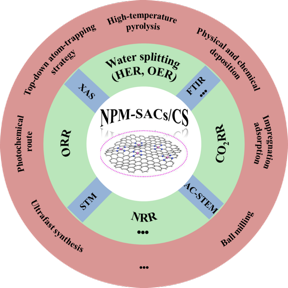 |
| The red outer ring represents the synthesis method of the catalyst, the green inner ring represents the catalytic application, the blue matrix represents the characterization technique, and the white inner circle represents NPM-SACs/CS. CREDIT Art by Yangyang Ding. |
Abstract:
This review is led by Prof. Yuehe Lin (Washington State University), Prof. Welei Zhu (Nanjing University), and Prof. Yuanyuan Wang (Nanjing University), they provided an overview of recent developments in non-precious metal single-atom catalysts (NPM-SACs) for the electrocatalytic field. NPM-SACs with unique electronic structures and coordination environments has gained much attention in electrocatalysis owing to their low cost, high atomic utilization, and high performance. NPM-SACs on carbon support (NPM-SACs/CS) are promising because of the carbon substrate with a large surface area, excellent electrical conductivity, and high chemical stability.
Recent progress of carbon-based non-noble metal single-atom catalysts for energy conversion electrocatalysis
Beijing, China | Posted on March 3rd, 2023First, the team not only introduced some widely used methods, such as high-temperature pyrolysis, physical and chemical deposition, impregnation adsorption and etc, but also collected some other innovative and unique ultrafast synthesis method reported recently. For characterization, the team classified scanning tunneling microscopy (STM) and aberration-corrected high-angle annular dark-field scanning transmission (AC HAADF-STEM) for morphological observation, X-ray absorption spectroscopy (XAS) for atomic structure and electronic property studies, and other specific characterizations for auxiliary analysis.
Then, the team summarizes strategies to optimize the macro- and micro-environment of NPM-SACs/CS. The microenvironment here mainly includes adjusting the type of central metal atom, changing the coordination number of a nitrogen atom, building non-nitrogen heteroatom coordination, adjusting carbon basal plane, and building bimetallic sites.
Furthermore, the team some comprehensive summary of recent advances in developing NPM-SACs/CS for important electrochemical reactions, including carbon dioxide reduction reaction (CO2RR), hydrogen evolution reaction (HER), oxygen evolution reaction (OER), oxygen reduction reaction (ORR), and nitrogen reduction reaction (NRR).
Last, the team highlighted the existing challenges and future opportunities of NPM-SACs/CS in the electrocatalytic field, involving the control synthesis of high metal loading NPM-SACs/CS, the development of advanced single-atom characterization techniques, the exploration of structure-activity relationship of NPM-SACs/CS for electrochemical reactions, construction of new coordination environments for boosting the catalytic performances, and the improvement of catalytic stability under reaction conditions.
####
For more information, please click here
Contacts:
Bei Yan
Science China Press
Expert Contact
Yuehe Lin
School of Mechanical and Materials Engineering, Washington State University, Pullman, WA 99164, USA
Copyright © Science China Press
If you have a comment, please Contact us.Issuers of news releases, not 7th Wave, Inc. or Nanotechnology Now, are solely responsible for the accuracy of the content.
Bookmark:


| Related Links |
| Related News Press |
News and information
 Quantum computer improves AI predictions April 17th, 2026
Flexible sensor gains sensitivity under pressure April 17th, 2026
A reusable chip for particulate matter sensing April 17th, 2026
Detecting vibrational quantum beating in the predissociation dynamics of SF6 using time-resolved photoelectron spectroscopy April 17th, 2026
Chemistry
Projecting light to dispense liquids: A new route to ultra-precise microdroplets January 30th, 2026
From sensors to smart systems: the rise of AI-driven photonic noses January 30th, 2026
"Nanoreactor" cage uses visible light for catalytic and ultra-selective cross-cycloadditions October 3rd, 2025
Cambridge chemists discover simple way to build bigger molecules – one carbon at a time June 6th, 2025
Possible Futures
A fundamentally new therapeutic approach to cystic fibrosis: Nanobody repairs cellular defect April 17th, 2026
UC Irvine physicists discover method to reverse ‘quantum scrambling’ : The work addresses the problem of information loss in quantum computing system April 17th, 2026
Discoveries
Quantum computer improves AI predictions April 17th, 2026
Flexible sensor gains sensitivity under pressure April 17th, 2026
A reusable chip for particulate matter sensing April 17th, 2026
Detecting vibrational quantum beating in the predissociation dynamics of SF6 using time-resolved photoelectron spectroscopy April 17th, 2026
Announcements
A fundamentally new therapeutic approach to cystic fibrosis: Nanobody repairs cellular defect April 17th, 2026
UC Irvine physicists discover method to reverse ‘quantum scrambling’ : The work addresses the problem of information loss in quantum computing system April 17th, 2026
Interviews/Book Reviews/Essays/Reports/Podcasts/Journals/White papers/Posters
A fundamentally new therapeutic approach to cystic fibrosis: Nanobody repairs cellular defect April 17th, 2026
UC Irvine physicists discover method to reverse ‘quantum scrambling’ : The work addresses the problem of information loss in quantum computing system April 17th, 2026
 |
||
 |
||
| The latest news from around the world, FREE | ||
 |
||
|
|
||
| Premium Products | ||
 |
||
|
Only the news you want to read!
Learn More |
||
 |
||
|
Full-service, expert consulting
Learn More |
||
|
|
||