Home > Press > Stanford researchers develop a new way to identify bacteria in fluids: An innovative adaptation of the technology in an old inkjet printer plus AI-assisted imaging leads to a faster, cheaper way to spot bacteria in blood, wastewater, and more
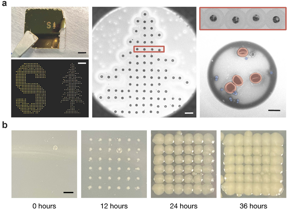 |
| Details of the printed dots on a gold-coated slide (a) where false coloring in the close-up of a single dot shows red blood calls in red and Staphylococcus epidermidis bacteria in blue. The researchers also printed onto an agar-coated slide (b) to show how the dots fare under incubation. CREDIT Fareeha Safir |
Abstract:
Shine a laser on a drop of blood, mucus, or wastewater, and the light reflecting back can be used to positively identify bacteria in the sample.
Stanford researchers develop a new way to identify bacteria in fluids: An innovative adaptation of the technology in an old inkjet printer plus AI-assisted imaging leads to a faster, cheaper way to spot bacteria in blood, wastewater, and more
Stanford, CA | Posted on March 3rd, 2023“We can find out not just that bacteria are present, but specifically which bacteria are in the sample – E. coli, Staphylococcus, Streptococcus, Salmonella, anthrax, and more,” said Jennifer Dionne, an associate professor of materials science and engineering and, by courtesy, of radiology at Stanford University. “Every microbe has its own unique optical fingerprint. It’s like the genetic and proteomic code scribbled in light.”
Dionne is senior author of a new study in the journal Nano Letters detailing an innovative method her team has developed that could lead to faster (almost immediate), inexpensive, and more accurate microbial assays of virtually any fluid one might want to test for microbes.
Traditional culturing methods still in use today can take hours if not days to complete. A tuberculosis culture takes 40 days, Dionne said. The new test can be done in minutes and holds the promise of better and faster diagnoses of infection, improved use of antibiotics, safer foods, enhanced environmental monitoring, and faster drug development, says the team.
Old dogs, new tricks
The breakthrough is not that bacteria display these spectral fingerprints, a fact that has been known for decades, but in how the team has been able to reveal those spectra amid the blinding array of light reflecting from each sample.
“Not only does each type of bacterium demonstrate unique patterns of light but virtually every other molecule or cell in a given sample does too,” said first author Fareeha Safir, a PhD student in Dionne’s lab. “Red blood cells, white blood cells, and other components in the sample are sending back their own signals, making it hard if not impossible to distinguish the microbial patterns from the noise of other cells.”
A milliliter of blood – about the size of a raindrop – can contain billions of cells, only a few of which might be microbes. The team had to find a way to separate and amplify the light reflecting from the bacteria alone. To do that, they ventured along several surprising scientific tangents, combining a four-decade-old technology borrowed from computing – the inkjet printer – and two cutting-edge technologies of our time – nanoparticles and artificial intelligence.
“The key to separating bacterial spectra from other signals is to isolate the cells in extremely small samples. We use the principles of inkjet printing to print thousands of tiny dots of blood instead of interrogating a single large sample,” explained co-author Butrus “Pierre” Khuri-Yakub, a professor emeritus of electrical engineering at Stanford who helped develop the original inkjet printer in the 1980s.
“But you can’t just get an off-the-shelf inkjet printer and add blood or wastewater,” Safir emphasized. To circumvent challenges in handling biological samples, the researchers modified the printer to put samples to paper using acoustic pulses. Each dot of printed blood is then just two trillionths of a liter in volume – more than a billion times smaller than a raindrop. At that scale, the droplets are so small they may hold just a few dozen cells.
In addition, the researchers infused the samples with gold nanorods that attach themselves to bacteria, if present, and act like antennas, drawing the laser light toward the bacteria and amplifying the signal some 1500 times its unenhanced strength. Appropriately isolated and amplified, the bacterial spectra stick out like scientific sore thumbs.
The final piece of the puzzle is the use of machine learning to compare the several spectra reflecting from each printed dot of fluid to spot the telltale signatures of any bacteria in the sample.
“It’s an innovative solution with the potential for life-saving impact. We are now excited for commercialization opportunities that can help redefine the standard of bacterial detection and single-cell characterization,” said senior co-author Amr Saleh, a former postdoctoral scholar in Dionne’s lab and now a professor at Cairo University.
Catalyst for collaboration
This sort of cross-disciplinary collaboration is a hallmark of the Stanford tradition in which experts from seemingly disparate fields bring their varying expertise to bear to solve longstanding challenges with societal impact.
This particular approach was hatched during a lunchtime meeting at a café on campus and, in 2017, was among the first recipients of a series of $3 million grants distributed by Stanford’s Catalyst for Collaborative Solutions. Catalyst grants are specifically targeted at inspiring interdisciplinary risk-taking and collaboration among Stanford researchers in high-reward fields such as health care, the environment, autonomy, and security.
While this technique was created and perfected using samples of blood, Dionne is equally confident that it can be applied to other sorts of fluids and target cells beyond bacteria, like testing drinking water for purity or perhaps spotting viruses faster, more accurately, and at lower cost than present methods.
Additional Stanford co-authors include former PhD student Loza Tadesse; research staff Kamyar Firouzi; Niaz Banaei, professor of pathology and of medicine at the School of Medicine; and Stefanie Jeffrey, the John and Marva Warnock Professor, Emerita, in the School of Medicine. Nhat Vu from Pumpkinseed Technologies is also a co-author. Banaei, Dionne, Jeffrey, and Khuri-Yakub are also members of Stanford Bio-X. Dionne is also senior associate vice provost of research platforms/shared facilities, a member of the Cardiovascular Institute and the Wu Tsai Neurosciences Institute, and an affiliate of the Precourt Institute for Energy. Jeffrey is also a member of the Stanford Cancer Institute. Khuri-Yakub is also a member of the Cardiovascular Institute, the Stanford Cancer Institute, and the Wu Tsai Neurosciences Institute.
This research was funded by the Stanford Catalyst for Collaborative Solutions, the Chan Zuckerberg Biohub Investigator Program, the NIH-NCATS-CTSA, the Gates Foundation, the National Science Foundation, the NIH New Innovator Award, and from seed funds from the Stanford Center for Innovation in Global Health. Part of this work was performed at the Stanford Nano Shared Facilities (SNSF) and the Soft & Hybrid Materials Facility (SMF), which are supported by the National Science Foundation and National Nanotechnology Coordinated Infrastructure.
####
For more information, please click here
Contacts:
Jill Wu
Stanford University School of Engineering
Copyright © Stanford University School of Engineering
If you have a comment, please Contact us.Issuers of news releases, not 7th Wave, Inc. or Nanotechnology Now, are solely responsible for the accuracy of the content.
Bookmark:


| Related Links |
| Related News Press |
News and information
 Quantum computer improves AI predictions April 17th, 2026
Flexible sensor gains sensitivity under pressure April 17th, 2026
A reusable chip for particulate matter sensing April 17th, 2026
Detecting vibrational quantum beating in the predissociation dynamics of SF6 using time-resolved photoelectron spectroscopy April 17th, 2026
Govt.-Legislation/Regulation/Funding/Policy
Quantum computer improves AI predictions April 17th, 2026
Metasurfaces smooth light to boost magnetic sensing precision January 30th, 2026
New imaging approach transforms study of bacterial biofilms August 8th, 2025
Possible Futures
A fundamentally new therapeutic approach to cystic fibrosis: Nanobody repairs cellular defect April 17th, 2026
UC Irvine physicists discover method to reverse ‘quantum scrambling’ : The work addresses the problem of information loss in quantum computing system April 17th, 2026
Nanomedicine
A fundamentally new therapeutic approach to cystic fibrosis: Nanobody repairs cellular defect April 17th, 2026
New molecular technology targets tumors and simultaneously silences two ‘undruggable’ cancer genes August 8th, 2025
New imaging approach transforms study of bacterial biofilms August 8th, 2025
Electrifying results shed light on graphene foam as a potential material for lab grown cartilage June 6th, 2025
Discoveries
Quantum computer improves AI predictions April 17th, 2026
Flexible sensor gains sensitivity under pressure April 17th, 2026
A reusable chip for particulate matter sensing April 17th, 2026
Detecting vibrational quantum beating in the predissociation dynamics of SF6 using time-resolved photoelectron spectroscopy April 17th, 2026
Announcements
A fundamentally new therapeutic approach to cystic fibrosis: Nanobody repairs cellular defect April 17th, 2026
UC Irvine physicists discover method to reverse ‘quantum scrambling’ : The work addresses the problem of information loss in quantum computing system April 17th, 2026
Interviews/Book Reviews/Essays/Reports/Podcasts/Journals/White papers/Posters
A fundamentally new therapeutic approach to cystic fibrosis: Nanobody repairs cellular defect April 17th, 2026
UC Irvine physicists discover method to reverse ‘quantum scrambling’ : The work addresses the problem of information loss in quantum computing system April 17th, 2026
Artificial Intelligence
Quantum computer improves AI predictions April 17th, 2026
From sensors to smart systems: the rise of AI-driven photonic noses January 30th, 2026
New quantum encoding methods slash circuit complexity in machine learning November 8th, 2024
Grants/Sponsored Research/Awards/Scholarships/Gifts/Contests/Honors/Records
Quantum computer improves AI predictions April 17th, 2026
Detecting vibrational quantum beating in the predissociation dynamics of SF6 using time-resolved photoelectron spectroscopy April 17th, 2026
Metasurfaces smooth light to boost magnetic sensing precision January 30th, 2026
Nanobiotechnology
A fundamentally new therapeutic approach to cystic fibrosis: Nanobody repairs cellular defect April 17th, 2026
New molecular technology targets tumors and simultaneously silences two ‘undruggable’ cancer genes August 8th, 2025
New imaging approach transforms study of bacterial biofilms August 8th, 2025
Electrifying results shed light on graphene foam as a potential material for lab grown cartilage June 6th, 2025
Photonics/Optics/Lasers
Metasurfaces smooth light to boost magnetic sensing precision January 30th, 2026
From sensors to smart systems: the rise of AI-driven photonic noses January 30th, 2026
 |
||
 |
||
| The latest news from around the world, FREE | ||
 |
||
|
|
||
| Premium Products | ||
 |
||
|
Only the news you want to read!
Learn More |
||
 |
||
|
Full-service, expert consulting
Learn More |
||
|
|
||