Home > Press > Scientists boost quantum signals while reducing noise: “Squeezing” noise over a broad frequency bandwidth in a quantum system could lead to faster and more accurate quantum measurements
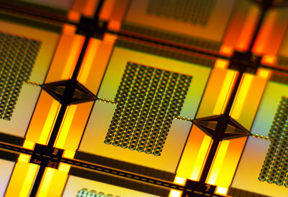 |
| This superconducting parametric amplifier can achieve quantum squeezing over much broader bandwidths than other designs, which could lead to faster and more accurate quantum measurements. CREDIT Image courtesy of Jack Qiu, William D. Oliver, and Kevin P. O’Brien |
Abstract:
A certain amount of noise is inherent in any quantum system. For instance, when researchers want to read information from a quantum computer, which harnesses quantum mechanical phenomena to solve certain problems too complex for classical computers, the same quantum mechanics also imparts a minimum level of unavoidable error that limits the accuracy of the measurements.
Scientists boost quantum signals while reducing noise: “Squeezing” noise over a broad frequency bandwidth in a quantum system could lead to faster and more accurate quantum measurements
Cambridge, MA | Posted on February 10th, 2023Scientists can effectively get around this limitation by using “parametric” amplification to “squeeze” the noise –– a quantum phenomenon that decreases the noise affecting one variable while increasing the noise that affects its conjugate partner. While the total amount of noise remains the same, it is effectively redistributed. Researchers can then make more accurate measurements by looking only at the lower-noise variable.
A team of researchers from MIT and elsewhere has now developed a new superconducting parametric amplifier that operates with the gain of previous narrowband squeezers while achieving quantum squeezing over much larger bandwidths. Their work is the first to demonstrate squeezing over a broad frequency bandwidth of up to 1.75 gigahertz while maintaining a high degree of squeezing (selective noise reduction). In comparison, previous microwave parametric amplifiers generally achieved bandwidths of only 100 megahertz or less.
This new broadband device may enable scientists to read out quantum information much more efficiently, leading to faster and more accurate quantum systems. By reducing the error in measurements, this architecture could be utilized in multiqubit systems or other metrological applications that demand extreme precision.
“As the field of quantum computing grows, and the number of qubits in these systems increases to thousands or more, we will need broadband amplification. With our architecture, with just one amplifier you could theoretically read out thousands of qubits at the same time,” says electrical engineering and computer science graduate student Jack Qiu, who is a member of the Engineering Quantum Systems Group and lead author of the paper detailing this advance.
The senior authors are William D. Oliver, the Henry Ellis Warren professor of electrical engineering and computer science and of physics, director of the Center for Quantum Engineering, and associate director of the Research Laboratory of Electronics; and Kevin P. O’Brien, the Emanuel E. Landsman Career Development professor of electrical engineering and computer science. The paper will appear in Nature Physics.
Squeezing noise below the standard quantum limit
Superconducting quantum circuits, like quantum bits or “qubits,” process and transfer information in quantum systems. This information is carried by microwave electromagnetic signals comprising photons. But these signals can be extremely weak, so researchers use amplifiers to boost the signal level such that clean measurements can be made.
However, a quantum property known as the Heisenberg Uncertainty Principle requires a minimum amount of noise be added during the amplification process, leading to the “standard quantum limit” of background noise. However, a special device, called a Josephson parametric amplifier, can reduce the added noise by “squeezing” it below the fundamental limit by effectively redistributing it elsewhere.
Quantum information is represented in the conjugate variables, for example, the amplitude and phase of electromagnetic waves. However, in many instances, researchers need only measure one of these variables – the amplitude or the phase – to determine the quantum state of the system. In these instances, they can “squeeze the noise,” lowering it for one variable, say amplitude, while raising it for the other, in this case phase. The total amount of noise stays the same due to Heisenberg’s Uncertainty Principle, but its distribution can be shaped in such a way that less noisy measurements are possible on one of the variables.
A conventional Josephson parametric amplifier is resonator-based: It’s like an echo chamber with a superconducting nonlinear element called a Josephson junction in the middle. Photons enter the echo chamber and bounce around to interact with the same Josephson junction multiple times. In this environment, the system nonlinearity — realized by the Josephson junction — is enhanced and leads to parametric amplification and squeezing. But, since the photons traverse the same Josephson junction many times before exiting, the junction is stressed. As a result, both the bandwidth and the maximum signal the resonator-based amplifier can accommodate is limited.
The MIT researchers took a different approach. Instead of embedding a single or a few Josephson junctions inside a resonator, they chained more than 3,000 junctions together, creating what is known as a Josephson traveling-wave parametric amplifier. Photons interact with each other as they travel from junction to junction, resulting in noise squeezing without stressing any single junction.
Their traveling-wave system can tolerate much higher-power signals than resonator-based Josephson amplifiers without the bandwidth constraint of the resonator, leading to broadband amplification and high levels of squeezing, Qiu says.
“You can think of this system as a really long optical fiber, another type of distributed nonlinear parametric amplifier. And, we can push to 10,000 junctions or more. This is an extensible system, as opposed to the resonant architecture,” he says.
Nearly noiseless amplification
A pair of pump photons enters the device, serving as the energy source. Researchers can tune the frequency of photons coming from each pump to generate squeezing at the desired signal frequency. For instance, if they want to squeeze a 6-gigahertz signal, they would adjust the pumps to send photons at 5 and 7 gigahertz, respectively. When the pump photons interact inside the device, they combine to produce an amplified signal with a frequency right in the middle of the two pumps. This is a special process of a more generic phenomenon called nonlinear wave mixing.
“Squeezing of the noise results from a two-photon quantum interference effect that arises during the parametric process,” he explains.
This architecture enabled them to reduce the noise power by a factor 10 below the fundamental quantum limit while operating with 3.5 gigahertz of amplification bandwidth — a frequency range that is almost two orders of magnitude higher than previous devices.
Their device also demonstrates broadband generation of entangled photon pairs, which could enable researchers to read out quantum information more efficiently with a much higher signal-to-noise ratio, Qiu says.
While Qiu and his collaborators are excited by these results, he says there is still room for improvement. The materials they used to fabricate the amplifier introduce some microwave loss, which can reduce performance. Moving forward, they are exploring different fabrication methods that could improve the insertion loss.
“This work is not meant to be a standalone project. It has tremendous potential if you apply it to other quantum systems— to interface with a qubit system to enhance the readout, or to entangle qubits, or extend the device operating frequency range to be utilized in dark matter detection and improve its detection efficiency. This is essentially like a blueprint for future work,” he says.
Additional co-authors include Arne Grimsmo, senior lecturer at the University of Sydney; Kaidong Peng, an EECS graduate student in the Quantum Coherent Electronics Group at MIT; Bharath Kannan, PhD ’22, CEO of Atlantic Quantum; Benjamin Lienhard, PhD ’21, a postdoc at Princeton University; Youngkyu Sung, an EECS grad student at MIT; Philip Krantz, an MIT postdoc; Vladimir Bolkhovsky, Greg Calusine, David Kim, Alex Melville, Bethany Niedzielski, Jonilyn Yoder, and Mollie Schwartz, members of the technical staff at MIT Lincoln Laboratory; Terry Orlando, professor of electrical engineering at MIT and a member of RLE; Irfan Siddiqi, a professor of physics at the University of California at Berkeley; and Simon Gustavsson, a principal research scientist in the Engineering Quantum Systems group at MIT.
This work was funded, in part, by the NTT Physics and Informatics Laboratories and the Office of the Director of National Intelligence IARPA program.
###
Written by Adam Zewe, MIT News Office
####
For more information, please click here
Contacts:
Abby Abazorius
Massachusetts Institute of Technology
Office: 617-253-2709
Copyright © Massachusetts Institute of Technology
If you have a comment, please Contact us.Issuers of news releases, not 7th Wave, Inc. or Nanotechnology Now, are solely responsible for the accuracy of the content.
Bookmark:


| Related Links |
| Related News Press |
News and information
 Quantum computer improves AI predictions April 17th, 2026
Flexible sensor gains sensitivity under pressure April 17th, 2026
A reusable chip for particulate matter sensing April 17th, 2026
Detecting vibrational quantum beating in the predissociation dynamics of SF6 using time-resolved photoelectron spectroscopy April 17th, 2026
Quantum Physics
Detecting vibrational quantum beating in the predissociation dynamics of SF6 using time-resolved photoelectron spectroscopy April 17th, 2026
Beyond silicon: Electronics at the scale of a single molecule January 30th, 2026
Govt.-Legislation/Regulation/Funding/Policy
Quantum computer improves AI predictions April 17th, 2026
Metasurfaces smooth light to boost magnetic sensing precision January 30th, 2026
New imaging approach transforms study of bacterial biofilms August 8th, 2025
Possible Futures
A fundamentally new therapeutic approach to cystic fibrosis: Nanobody repairs cellular defect April 17th, 2026
UC Irvine physicists discover method to reverse ‘quantum scrambling’ : The work addresses the problem of information loss in quantum computing system April 17th, 2026
Quantum Computing
Quantum computer improves AI predictions April 17th, 2026
UC Irvine physicists discover method to reverse ‘quantum scrambling’ : The work addresses the problem of information loss in quantum computing system April 17th, 2026
Researchers develop molecular qubits that communicate at telecom frequencies October 3rd, 2025
Discoveries
Quantum computer improves AI predictions April 17th, 2026
Flexible sensor gains sensitivity under pressure April 17th, 2026
A reusable chip for particulate matter sensing April 17th, 2026
Detecting vibrational quantum beating in the predissociation dynamics of SF6 using time-resolved photoelectron spectroscopy April 17th, 2026
Announcements
A fundamentally new therapeutic approach to cystic fibrosis: Nanobody repairs cellular defect April 17th, 2026
UC Irvine physicists discover method to reverse ‘quantum scrambling’ : The work addresses the problem of information loss in quantum computing system April 17th, 2026
Interviews/Book Reviews/Essays/Reports/Podcasts/Journals/White papers/Posters
A fundamentally new therapeutic approach to cystic fibrosis: Nanobody repairs cellular defect April 17th, 2026
UC Irvine physicists discover method to reverse ‘quantum scrambling’ : The work addresses the problem of information loss in quantum computing system April 17th, 2026
Military
Quantum engineers ‘squeeze’ laser frequency combs to make more sensitive gas sensors January 17th, 2025
Chainmail-like material could be the future of armor: First 2D mechanically interlocked polymer exhibits exceptional flexibility and strength January 17th, 2025
Single atoms show their true color July 5th, 2024
NRL charters Navy’s quantum inertial navigation path to reduce drift April 5th, 2024
Quantum nanoscience
Beyond silicon: Electronics at the scale of a single molecule January 30th, 2026
MXene nanomaterials enter a new dimension Multilayer nanomaterial: MXene flakes created at Drexel University show new promise as 1D scrolls January 30th, 2026
ICFO researchers overcome long-standing bottleneck in single photon detection with twisted 2D materials August 8th, 2025
 |
||
 |
||
| The latest news from around the world, FREE | ||
 |
||
|
|
||
| Premium Products | ||
 |
||
|
Only the news you want to read!
Learn More |
||
 |
||
|
Full-service, expert consulting
Learn More |
||
|
|
||