Home > Press > HKUST researchers develop a novel integration scheme for efficient coupling between III-V and silicon
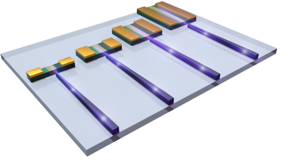 |
| High-performance Si-waveguide coupled III-V photodetectors grown on SOI CREDIT Credit: The Hong Kong University of Science and Technology |
Abstract:
Researchers at the Hong Kong University of Science and Technology (HKUST) has recently developed a novel integration scheme for efficient coupling between III-V compound semiconductor devices and silicon components on silicon photonics (Si-photonics) platform by selective direct epitaxy, unlocking the potential of integrating energy-efficient photonics with cost-effective electronics, as well as enabling the next generation telecommunications with low cost, high speed and large capacity.
HKUST researchers develop a novel integration scheme for efficient coupling between III-V and silicon
Hong Kong, China | Posted on November 18th, 2022Over the past few years, data traffic has been growing exponentially driven by various applications and emerging techniques such as big data, automobiles, cloud applications and sensors. To address the issues, Si-photonics has been widely investigated as a core technology to enable, extend, and increase data transmission through energy-efficient, high-capacity and low-cost optical interconnects. While silicon-based passive components have been well established on Si-photonics platform, the lasers and photodetectors can’t be realized by silicon and necessitate the integration of other materials such as III-V compound semiconductors on silicon.
III-V lasers and photodetectors on silicon has been investigated by two main methods. The first one is the bonding-based method which has yielded devices with impressive performance. However, it requires complicated manufacturing technique that is low yield and high-cost, making mass production very challenging. The other way is direct epitaxy method by growing multiple layers of III-V on silicon. While it provides a solution with lower cost, larger scalability and higher integration density, the micrometers thick III-V buffer layers which are crucial for this method hinders efficient light coupling between III-V and silicon - the key for integrated Si-photonics.
To address these issues, the team led by Prof. Kei-May LAU, Professor Emeritus of the Department of Electronic and Computer Engineering at Hong Kong University of Science and Technology (HKUST), developed lateral aspect ratio trapping (LART) - a novel selective direct epitaxy method that can selectively grow III-V materials on silicon-on-insulator (SOI) in a lateral direction without the need of thick buffers. Furthermore, based on this novel technology, the team devised and demonstrated unique in-plane integration of III-V photodetectors and silicon elements with high coupling efficiency between III-V and silicon. Compared to the commercial ones, the performance of photodetectors by such approach is less noisy, more sensitive, and has wider operation range, with record-high speed of over 112 Gb/s – way faster than existing products. For the first time, the III-V devices can be efficiently coupled with Si elements by direct epitaxy. The integration strategy can be easily applied to the integration of various III-V devices and Si-based components, thereby enabling the ultimate goal of integrating photonics with electronics on silicon photonics platform for data communications.
“This was made possible by our latest development of a novel growth technique named lateral aspect ratio trapping (LART) and our unique design of coupling strategy on the SOI platform. Our team’s combined expertise and insights into both device physics and growth mechanisms allow us to accomplish the challenging task of efficient coupling between III-V and Si and cross-correlated analysis of epitaxial growth and device performance,” said Prof. Lau.
“This work will provide practical solutions for photonic integrated circuits and fully integrated Si-photonics, light coupling between III-V lasers and Si components can be realized through this method” said Dr. Ying Xue, first author of the study.
This is a collaborative work with a research team led by Prof. Hon Ki Tsang of Department of Electronic Engineering at Chinese University of Hong Kong (CUHK) and a research team led by Prof. Xinlun Cai of School of Electronics and Information Technology at Sun Yat-sen University (SYSU). The device fabrication technology in the work was developed at HKUST’s Nanosystem Fabrication Facility (NFF) on Clear Water Bay campus. The work is supported by Research Grants Council of Hong Kong and Innovation Technology Fund of Hong Kong. This work has recently been published in Optica.
####
For more information, please click here
Contacts:
Chun-ki WONG
Hong Kong University of Science and Technology
Office: 852-346-92512
Copyright © Hong Kong University of Science and Technology
If you have a comment, please Contact us.Issuers of news releases, not 7th Wave, Inc. or Nanotechnology Now, are solely responsible for the accuracy of the content.
Bookmark:


| Related Links |
| Related News Press |
News and information
 Quantum computer improves AI predictions April 17th, 2026
Flexible sensor gains sensitivity under pressure April 17th, 2026
A reusable chip for particulate matter sensing April 17th, 2026
Detecting vibrational quantum beating in the predissociation dynamics of SF6 using time-resolved photoelectron spectroscopy April 17th, 2026
Wireless/telecommunications/RF/Antennas/Microwaves
Researchers develop molecular qubits that communicate at telecom frequencies October 3rd, 2025
HKUST researchers develop new integration technique for efficient coupling of III-V and silicon February 16th, 2024
Possible Futures
A fundamentally new therapeutic approach to cystic fibrosis: Nanobody repairs cellular defect April 17th, 2026
UC Irvine physicists discover method to reverse ‘quantum scrambling’ : The work addresses the problem of information loss in quantum computing system April 17th, 2026
Discoveries
Quantum computer improves AI predictions April 17th, 2026
Flexible sensor gains sensitivity under pressure April 17th, 2026
A reusable chip for particulate matter sensing April 17th, 2026
Detecting vibrational quantum beating in the predissociation dynamics of SF6 using time-resolved photoelectron spectroscopy April 17th, 2026
Announcements
A fundamentally new therapeutic approach to cystic fibrosis: Nanobody repairs cellular defect April 17th, 2026
UC Irvine physicists discover method to reverse ‘quantum scrambling’ : The work addresses the problem of information loss in quantum computing system April 17th, 2026
Interviews/Book Reviews/Essays/Reports/Podcasts/Journals/White papers/Posters
A fundamentally new therapeutic approach to cystic fibrosis: Nanobody repairs cellular defect April 17th, 2026
UC Irvine physicists discover method to reverse ‘quantum scrambling’ : The work addresses the problem of information loss in quantum computing system April 17th, 2026
Photonics/Optics/Lasers
Metasurfaces smooth light to boost magnetic sensing precision January 30th, 2026
From sensors to smart systems: the rise of AI-driven photonic noses January 30th, 2026
 |
||
 |
||
| The latest news from around the world, FREE | ||
 |
||
|
|
||
| Premium Products | ||
 |
||
|
Only the news you want to read!
Learn More |
||
 |
||
|
Full-service, expert consulting
Learn More |
||
|
|
||