Home > Press > Rutgers researchers develop method with single-molecule precision to engineer enzyme ‘stickiness’: The method aids in optimizing enzymes or proteins ‘stickiness’ for diverse biotechnological applications
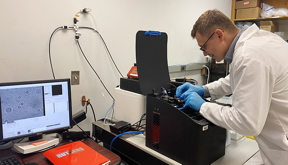 |
| Markus Hackl, a doctoral candidate in the Department of Chemical and Biochemical Engineering at Rutgers, led the development of the toolkit. Courtesy of Markus Hackl |
Abstract:
Rutgers scientists have developed an analytical toolkit to measure the binding forces of single proteins when they are pulled away from their substrate – such as an enzyme – that will help the development of new nanomaterials, improve biofuel production and global carbon cycling, and identify new and better drug targets, according to a new study.
Rutgers researchers develop method with single-molecule precision to engineer enzyme ‘stickiness’: The method aids in optimizing enzymes or proteins ‘stickiness’ for diverse biotechnological applications
New Brunswick | Posted on October 14th, 2022The study, published in the Proceedings of the National Academy of Sciences, examines the molecular interactions between a carbohydrate binding module (CBM) protein and its binding substrate cellulose. Cellulose, a type of plant fiber polymer made of repeating glucose sugars, can be used to make textiles, cellophane, paperboard and paper, in addition to serving as renewable feedstock to produce biofuels and biochemicals.
Cellulose is the most abundant organic compound on Earth that is naturally decomposed by microorganisms and hence plays a central role in the global carbon cycle. However, scientists still have a limited understanding of how microorganisms like bacteria breakdown cellulose by first anchoring or ‘sticking’ to the substrate surface using carbohydrate binding proteins and enzymes.
According to Rutgers researchers, to engineer more efficient enzymes and microbes that decompose cellulose into sugars for biofuels production such as ethanol, biodiesel, green diesel or biogas, it is necessary to better understand how carbohydrate binding proteins anchor to substrates to engineer better enzymes with optimum ‘stickiness’ that can maximize cellulose decomposition by microbes.
“The binding of proteins and enzymes to complex carbohydrates at the solid-liquid interface is a fundamentally important biological phenomena relevant to plant growth, pathogen-host cell infections, and biofuels production,” said Shishir Chundawat, senior author of the study and an associate professor in the Department of Chemical and Biochemical Engineering at Rutgers. “But such interfacial binding processes are not well understood because of the lack of analytical tools to observe these subtle and short-lived molecular interactions between proteins and carbohydrates like cellulose.”
The methodology describes the researcher’s analytical technique to examine how proteins stick to cellulose surfaces with molecular-level precision, providing insight into the complex mechanisms employed by microbial enzymes during cellulose decomposition.
Chundawat said the toolkit developed at Rutgers can measure single protein-carbohydrate molecule contacts and relevant forces involved with 1 trillionth of newton precision. One newton is equivalent to the minimum force often required to unstick a gecko lizard anchored to a wall or surface.
The research team studied a CBM protein that enables bacterial cells to anchor tightly to cellulose surfaces like a gecko and changed the engineered proteins surface ‘stickiness’ as measured using this new toolkit to enhance cellulose decomposition activity. The findings from the toolkit were in agreement with other experiments and simulations conducted to further explain the underlying molecular rules that are responsible for CBM protein stickiness towards cellulose surfaces.
“If particular CBMs can stick to the carbohydrates in specific structural orientations that enhances enzymatic function, traditional methods are not able to differentiate one specific binding orientation from the other necessary to fine-tune protein stickiness for surfaces,” said Markus Hackl, first author of the study who led the development of the toolkit and a doctoral candidate in the Department of Chemical and Biochemical Engineering at Rutgers. “Our method, however, can pick up on those subtle differences in protein stickiness by detecting and measuring the signal from a single protein molecule interaction with cellulose.”
Such a toolkit can help scientists’ study and fine-tune sticky molecular interactions between proteins and carbohydrates, that ultimately aid in the development of better targeting protein-based drugs for improved healthcare or efficient industrial-grade enzymes for low-cost biofuels production.
Development of the toolkit is supported by the National Science Foundation (NSF) Division of Chemical, Bioengineering, Environmental and Transport Systems as part of a Faculty Early Career Development (CAREER) grant awarded by NSF to Chundawat in 2019.
Other Rutgers co-authors on the study include Edward Contrada, Jonathan Ash, Atharv Kulkarni, Ki-Bum Lee, Jinho Yoon, Hyeon-Yeol Cho and researchers from the National Renewable Energy Laboratory (John Yarbrough) and Los Alamos National Laboratory (Cesar López and Sandrasegaram Gnanakaran).
####
For more information, please click here
Contacts:
Megan Schumann
Rutgers University
Office: 848-445-1907
Copyright © Rutgers University
If you have a comment, please Contact us.Issuers of news releases, not 7th Wave, Inc. or Nanotechnology Now, are solely responsible for the accuracy of the content.
Bookmark:


| Related News Press |
News and information
 Quantum computer improves AI predictions April 17th, 2026
Flexible sensor gains sensitivity under pressure April 17th, 2026
A reusable chip for particulate matter sensing April 17th, 2026
Detecting vibrational quantum beating in the predissociation dynamics of SF6 using time-resolved photoelectron spectroscopy April 17th, 2026
Laboratories
Researchers develop molecular qubits that communicate at telecom frequencies October 3rd, 2025
A battery’s hopping ions remember where they’ve been: Seen in atomic detail, the seemingly smooth flow of ions through a battery’s electrolyte is surprisingly complicated February 16th, 2024
Govt.-Legislation/Regulation/Funding/Policy
Quantum computer improves AI predictions April 17th, 2026
Metasurfaces smooth light to boost magnetic sensing precision January 30th, 2026
New imaging approach transforms study of bacterial biofilms August 8th, 2025
Possible Futures
A fundamentally new therapeutic approach to cystic fibrosis: Nanobody repairs cellular defect April 17th, 2026
UC Irvine physicists discover method to reverse ‘quantum scrambling’ : The work addresses the problem of information loss in quantum computing system April 17th, 2026
Nanomedicine
A fundamentally new therapeutic approach to cystic fibrosis: Nanobody repairs cellular defect April 17th, 2026
New molecular technology targets tumors and simultaneously silences two ‘undruggable’ cancer genes August 8th, 2025
New imaging approach transforms study of bacterial biofilms August 8th, 2025
Electrifying results shed light on graphene foam as a potential material for lab grown cartilage June 6th, 2025
Discoveries
Quantum computer improves AI predictions April 17th, 2026
Flexible sensor gains sensitivity under pressure April 17th, 2026
A reusable chip for particulate matter sensing April 17th, 2026
Detecting vibrational quantum beating in the predissociation dynamics of SF6 using time-resolved photoelectron spectroscopy April 17th, 2026
Announcements
A fundamentally new therapeutic approach to cystic fibrosis: Nanobody repairs cellular defect April 17th, 2026
UC Irvine physicists discover method to reverse ‘quantum scrambling’ : The work addresses the problem of information loss in quantum computing system April 17th, 2026
Interviews/Book Reviews/Essays/Reports/Podcasts/Journals/White papers/Posters
A fundamentally new therapeutic approach to cystic fibrosis: Nanobody repairs cellular defect April 17th, 2026
UC Irvine physicists discover method to reverse ‘quantum scrambling’ : The work addresses the problem of information loss in quantum computing system April 17th, 2026
Environment
A reusable chip for particulate matter sensing April 17th, 2026
Researchers unveil a groundbreaking clay-based solution to capture carbon dioxide and combat climate change June 6th, 2025
Energy
Sensors innovations for smart lithium-based batteries: advancements, opportunities, and potential challenges August 8th, 2025
Simple algorithm paired with standard imaging tool could predict failure in lithium metal batteries August 8th, 2025
Grants/Sponsored Research/Awards/Scholarships/Gifts/Contests/Honors/Records
Quantum computer improves AI predictions April 17th, 2026
Detecting vibrational quantum beating in the predissociation dynamics of SF6 using time-resolved photoelectron spectroscopy April 17th, 2026
Metasurfaces smooth light to boost magnetic sensing precision January 30th, 2026
Nanobiotechnology
A fundamentally new therapeutic approach to cystic fibrosis: Nanobody repairs cellular defect April 17th, 2026
New molecular technology targets tumors and simultaneously silences two ‘undruggable’ cancer genes August 8th, 2025
New imaging approach transforms study of bacterial biofilms August 8th, 2025
Electrifying results shed light on graphene foam as a potential material for lab grown cartilage June 6th, 2025
 |
||
 |
||
| The latest news from around the world, FREE | ||
 |
||
|
|
||
| Premium Products | ||
 |
||
|
Only the news you want to read!
Learn More |
||
 |
||
|
Full-service, expert consulting
Learn More |
||
|
|
||