Home > Press > Underwater movement sensor alerts when a swimmer might be drowning
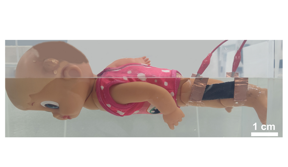 |
| An underwater movement sensor attached to a motorized swimming doll’s knee alerts a smartphone app when the doll stops kicking, simulating a swimmer in distress. CREDIT Adapted from ACS Nano 2022, DOI: 10.1021/acsnano.2c08325 |
Abstract:
Many flexible fitness trackers can’t be submerged in water because the coatings required to completely seal these devices would make them uncomfortable to wear. Now, researchers reporting in ACS Nano have applied a thin, slippery coating to conductive fabric, creating a breathable underwater movement sensor. They integrated the sensor into a smart device that wirelessly alerts a smartphone app when a swimmer stops moving, an indication that they could be drowning.
Underwater movement sensor alerts when a swimmer might be drowning
Washington, DC | Posted on October 7th, 2022Underwater movement sensors could have many applications, such as monitoring heart rate and tracking swimmers’ activity and safety. However, current methods to protect these electronics make the devices thick and impermeable to air, which could lead to skin irritation. Previous research, though, has shown that thin, even layers of polydimethylsiloxane (PDMS) provide enough water repulsion to protect flexible movement sensors underwater, but it’s unclear whether the coating would be comfortable. So, Jianying Huang, Cheolmin Park, Yuekun Lai and colleagues wanted to test PDMS as a water-repellent coating for a fabric-based sensor that would be part of a wireless underwater movement detection system.
To do this, the researchers dipped a piece of polyester knit fabric into a graphene oxide solution and then into hydroiodic acid. The last immersion was into a solution containing PDMS microparticles and nanoparticles. Initial tests showed that the coated fabric was conductive and water-repellent, yet still permeable to air, suggesting that the material would be comfortable to wear. When a sample of the coated fabric was attached to a person’s finger that was then bent while underwater, it produced a measurable electrical response.
The team combined the fabric-based sensor with a power supply and a data collector to create a smart underwater movement system that could wirelessly transmit the electrical response to a smartphone app. When the smart device was attached to a motorized swimming doll, the app tracked the doll’s kicking legs. To simulate a swimmer in distress, the doll’s kicking motion was turned off, and the app sent a red warning message. The researchers say that because the smart movement sensor repels water, it could help monitor swimmers’ safety and be used in other types of underwater sensors.
The authors acknowledge funding from the National Natural Science Foundation of China, the Natural Science Funds for Distinguished Young Scholars of Fujian Province, the Natural Science Foundation of Fujian Province, the 111 Project, the China National Textile and Apparel Council Key Laboratory of Flexible Devices for Intelligent Textile and Apparel, Soochow University, the State Key Laboratory of New Textile Materials and Advanced Processing Technologies, and the Creative Materials Discovery Program through the National Research Foundation of Korea (NRF).
####
About American Chemical Society
The American Chemical Society (ACS) is a nonprofit organization chartered by the U.S. Congress. ACS’ mission is to advance the broader chemistry enterprise and its practitioners for the benefit of Earth and all its people. The Society is a global leader in promoting excellence in science education and providing access to chemistry-related information and research through its multiple research solutions, peer-reviewed journals, scientific conferences, eBooks and weekly news periodical Chemical & Engineering News. ACS journals are among the most cited, most trusted and most read within the scientific literature; however, ACS itself does not conduct chemical research. As a leader in scientific information solutions, its CAS division partners with global innovators to accelerate breakthroughs by curating, connecting and analyzing the world’s scientific knowledge. ACS’ main offices are in Washington, D.C., and Columbus, Ohio.
To automatically receive news releases from the American Chemical Society, contact
Follow us: Twitter | Facebook | LinkedIn | Instagram
For more information, please click here
Contacts:
ACS Newsroom
American Chemical Society
Katie Cottingham
American Chemical Society
Office: 202-236-5115
Copyright © American Chemical Society
If you have a comment, please Contact us.Issuers of news releases, not 7th Wave, Inc. or Nanotechnology Now, are solely responsible for the accuracy of the content.
Bookmark:


| Related Links |
| Related News Press |
News and information
 Quantum computer improves AI predictions April 17th, 2026
Flexible sensor gains sensitivity under pressure April 17th, 2026
A reusable chip for particulate matter sensing April 17th, 2026
Detecting vibrational quantum beating in the predissociation dynamics of SF6 using time-resolved photoelectron spectroscopy April 17th, 2026
Wearable electronics
Breakthrough brings body-heat powered wearable devices closer to reality December 13th, 2024
Beyond wires: Bubble technology powers next-generation electronics:New laser-based bubble printing technique creates ultra-flexible liquid metal circuits November 8th, 2024
Nanofibrous metal oxide semiconductor for sensory face November 8th, 2024
Govt.-Legislation/Regulation/Funding/Policy
Quantum computer improves AI predictions April 17th, 2026
Metasurfaces smooth light to boost magnetic sensing precision January 30th, 2026
New imaging approach transforms study of bacterial biofilms August 8th, 2025
Possible Futures
A fundamentally new therapeutic approach to cystic fibrosis: Nanobody repairs cellular defect April 17th, 2026
UC Irvine physicists discover method to reverse ‘quantum scrambling’ : The work addresses the problem of information loss in quantum computing system April 17th, 2026
Discoveries
Quantum computer improves AI predictions April 17th, 2026
Flexible sensor gains sensitivity under pressure April 17th, 2026
A reusable chip for particulate matter sensing April 17th, 2026
Detecting vibrational quantum beating in the predissociation dynamics of SF6 using time-resolved photoelectron spectroscopy April 17th, 2026
Announcements
A fundamentally new therapeutic approach to cystic fibrosis: Nanobody repairs cellular defect April 17th, 2026
UC Irvine physicists discover method to reverse ‘quantum scrambling’ : The work addresses the problem of information loss in quantum computing system April 17th, 2026
Interviews/Book Reviews/Essays/Reports/Podcasts/Journals/White papers/Posters
A fundamentally new therapeutic approach to cystic fibrosis: Nanobody repairs cellular defect April 17th, 2026
UC Irvine physicists discover method to reverse ‘quantum scrambling’ : The work addresses the problem of information loss in quantum computing system April 17th, 2026
Safety-Nanoparticles/Risk management
Tiny nanosheets, big leap: A new sensor detects ethanol at ultra-low levels January 30th, 2026
Onion-like nanoparticles found in aircraft exhaust May 14th, 2025
Closing the gaps — MXene-coating filters can enhance performance and reusability February 28th, 2025
Grants/Sponsored Research/Awards/Scholarships/Gifts/Contests/Honors/Records
Quantum computer improves AI predictions April 17th, 2026
Detecting vibrational quantum beating in the predissociation dynamics of SF6 using time-resolved photoelectron spectroscopy April 17th, 2026
Metasurfaces smooth light to boost magnetic sensing precision January 30th, 2026
 |
||
 |
||
| The latest news from around the world, FREE | ||
 |
||
|
|
||
| Premium Products | ||
 |
||
|
Only the news you want to read!
Learn More |
||
 |
||
|
Full-service, expert consulting
Learn More |
||
|
|
||