Home > Press > “Twisty” photons could turbocharge next-gen quantum communication: Team’s on-chip technology uses orbital angular momentum to encode more information into a single photon
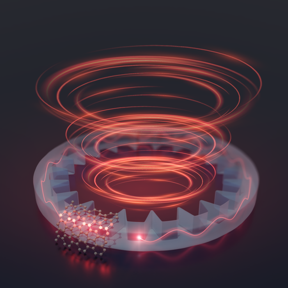 |
| The image shows a quantum emitter capable of emitting single photons integrated with a geared-shaped resonator. By fine-tuning the arrangement of the emitter and the gear-shaped resonator, it’s possible to leverage the interaction between the photon’s spin and its orbital angular momentum to create individual “twisty” photons on demand. CREDIT Stevens Institute of Technology |
Abstract:
Quantum computers and communication devices work by encoding information into individual or entangled photons, enabling data to be quantum securely transmitted and manipulated exponentially faster than is possible with conventional electronics. Now, quantum researchers at Stevens Institute of Technology have demonstrated a method for encoding vastly more information into a single photon, opening the door to even faster and more powerful quantum communication tools.
“Twisty” photons could turbocharge next-gen quantum communication: Team’s on-chip technology uses orbital angular momentum to encode more information into a single photon
Hoboken, NJ | Posted on September 23rd, 2022Typically, quantum communication systems “write” information onto a photon’s spin angular momentum. In this case, photons carry out either a right or left circular rotation, or form a quantum superposition of the two known as a two-dimensional qubit. It’s also possible to encode information onto a photon’s orbital angular momentum — the corkscrew path that light follows as it twists and torques forward, with each photon circling around the center of the beam. When the spin and angular momentum interlock, it forms a high-dimensional qudit -- enabling any of a theoretically infinite range of values to be encoded into and propagated by a single photon.
Qubits and qudits, also known as flying qubits and flying qudits, are used to propagate information stored in photons from one point to another. The main difference is that qudits can carry much more information over the same distance than qubits, providing the foundation for turbocharging next generation quantum communication.
In a cover story in the August 2022 issue of Optica, researchers led by Stefan Strauf, head of the NanoPhotonics Lab at Stevens, show that they can create and control individual flying qudits, or “twisty” photons, on demand — a breakthrough that could dramatically expand the capabilities of quantum communication tools. The work builds upon the team’s 2018 paper in Nature Nanotechnology.
“Normally the spin angular momentum and the orbital angular momentum are independent properties of a photon. Our device is the first to demonstrate simultaneous control of both properties via the controlled coupling between the two,” explained Yichen Ma, a graduate student in Strauf’s NanoPhotonics Lab, who led the research in collaboration with Liang Feng at the University of Pennsylvania, and Jim Hone at Columbia University.
“What makes it a big deal is that we’ve shown we can do this with single photons rather than classical light beams, which is the basic requirement for any kind of quantum communication application,” Ma said.
Encoding information into orbital angular momentum radically increases the information that can be transmitted, Ma explained. Leveraging “twisty” photons could boost the bandwidth of quantum communication tools, enabling them to transmit data far more quickly.
To create twisty photons, Strauf’s team used an atom-thick film of tungsten diselenide, an upcoming novel semiconductor material, to create a quantum emitter capable of emitting single photons.
Next, they coupled the quantum emitter in an internally reflective donut-shaped space called a ring resonator. By fine-tuning the arrangement of the emitter and the gear-shaped resonator, it’s possible to leverage the interaction between the photon’s spin and its orbital angular momentum to create individual “twisty” photons on demand. The key to enabling this spin-momentum-locking functionality relies in the gear-shaped patterning of the ring resonator, that when carefully engineered in the design, creates the twisty vortex beam of light that the device shoots out at the speed of light.
By integrating those capabilities into a single microchip measuring just 20 microns across — about a quarter of the width of a human hair — the team has created a twisty-photon emitter capable of interacting with other standardized components as part of a quantum communications system.
Some key challenges remain. While the team’s technology can control the direction in which a photon spirals — clockwise or anticlockwise — more work is needed to control the exact orbital angular momentum mode number. That’s the critical capability that will enable a theoretically infinite range of different values to be “written” into and later extracted from a single photon. Latest experiments in Strauf’s Nanophotonics Lab show promising results that this problem can be soon overcome, according to Ma.
Further work is also needed to create a device that can create twisted photons with rigorously consistent quantum properties, i.e., indistinguishable photons — a key requirement to enable the quantum internet. Such challenges affect everyone working in quantum photonics and could require new breakthroughs in material science to solve, Ma said.
“Plenty of challenges lie ahead,” he added. “But we’ve shown the potential for creating quantum light sources that are more versatile than anything that was previously possible.”
####
For more information, please click here
Contacts:
Thania Benios
Stevens Institute of Technology
Office: 917-930-5988
Copyright © Stevens Institute of Technology
If you have a comment, please Contact us.Issuers of news releases, not 7th Wave, Inc. or Nanotechnology Now, are solely responsible for the accuracy of the content.
Bookmark:


| Related Links |
| Related News Press |
News and information
 Quantum computer improves AI predictions April 17th, 2026
Flexible sensor gains sensitivity under pressure April 17th, 2026
A reusable chip for particulate matter sensing April 17th, 2026
Detecting vibrational quantum beating in the predissociation dynamics of SF6 using time-resolved photoelectron spectroscopy April 17th, 2026
Quantum communication
Next-generation quantum communication October 3rd, 2025
Nanophotonic platform boosts efficiency of nonlinear-optical quantum teleportation April 25th, 2025
Physicists unlock the secret of elusive quantum negative entanglement entropy using simple classical hardware August 16th, 2024
Govt.-Legislation/Regulation/Funding/Policy
Quantum computer improves AI predictions April 17th, 2026
Metasurfaces smooth light to boost magnetic sensing precision January 30th, 2026
New imaging approach transforms study of bacterial biofilms August 8th, 2025
Possible Futures
A fundamentally new therapeutic approach to cystic fibrosis: Nanobody repairs cellular defect April 17th, 2026
UC Irvine physicists discover method to reverse ‘quantum scrambling’ : The work addresses the problem of information loss in quantum computing system April 17th, 2026
Chip Technology
A reusable chip for particulate matter sensing April 17th, 2026
Metasurfaces smooth light to boost magnetic sensing precision January 30th, 2026
Optical computing/Photonic computing
ICFO researchers overcome long-standing bottleneck in single photon detection with twisted 2D materials August 8th, 2025
Programmable electron-induced color router array May 14th, 2025
Discoveries
Quantum computer improves AI predictions April 17th, 2026
Flexible sensor gains sensitivity under pressure April 17th, 2026
A reusable chip for particulate matter sensing April 17th, 2026
Detecting vibrational quantum beating in the predissociation dynamics of SF6 using time-resolved photoelectron spectroscopy April 17th, 2026
Announcements
A fundamentally new therapeutic approach to cystic fibrosis: Nanobody repairs cellular defect April 17th, 2026
UC Irvine physicists discover method to reverse ‘quantum scrambling’ : The work addresses the problem of information loss in quantum computing system April 17th, 2026
Interviews/Book Reviews/Essays/Reports/Podcasts/Journals/White papers/Posters
A fundamentally new therapeutic approach to cystic fibrosis: Nanobody repairs cellular defect April 17th, 2026
UC Irvine physicists discover method to reverse ‘quantum scrambling’ : The work addresses the problem of information loss in quantum computing system April 17th, 2026
Photonics/Optics/Lasers
Metasurfaces smooth light to boost magnetic sensing precision January 30th, 2026
From sensors to smart systems: the rise of AI-driven photonic noses January 30th, 2026
 |
||
 |
||
| The latest news from around the world, FREE | ||
 |
||
|
|
||
| Premium Products | ||
 |
||
|
Only the news you want to read!
Learn More |
||
 |
||
|
Full-service, expert consulting
Learn More |
||
|
|
||