Home > Press > Research improves upon conventional LED displays: With new technology, LEDs can be more cost-efficient and last longer
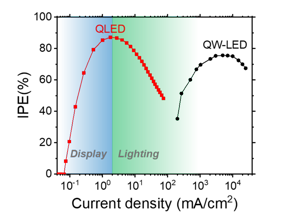 |
| This graph shows the improved conversion efficiency of QLEDs (IPE%) when compared to traditional LEDs (QW-LEDs). QLEDs can achieve a power conversion efficiency around 90%. CREDIT Nano Research, Tsinghua University Press |
Abstract:
LED lights, which stands for light-emitting-diodes, have become ubiquitous lighting solutions for homes and businesses, but when it comes to large, high-resolution displays, traditional LEDs have documented disadvantages. LED displays use a high voltage and a factor called the internal power conversion efficiency is low, which means the energy costs to run the displays are high, the displays do not last as long, and they can run too hot.
Research improves upon conventional LED displays: With new technology, LEDs can be more cost-efficient and last longer
Tsinghua, China | Posted on September 9th, 2022In a paper published in Nano Research on August 26, researchers outline how a technological advance called quantum dots could be the solution to some of these challenges. Quantum dots are tiny, man-made crystals that act as semiconductors. Because of their size, they have unique properties that can make them useful in display technology.
“Traditional LEDs have been successful in fields like display, lighting, and optical communications. However, the technique used to acquire high-quality semiconductor material and devices is highly energy- and cost-consumptive,” said assistant professor Xing Lin of the College of Information Science & Electronic Engineering at Zhejiang University. “Colloidal quantum dot provides a cost-effective way to construct high-performance LEDs using inexpensive solution processing techniques and chemical grade materials. Furthermore, as inorganic material, colloidal quantum dot surpasses emissive organic semiconductors in long-term operation stability.”
All LED displays are made up of multiple layers. One of the most important layers is the emissive layer, where the electric energy becomes colorful light. Researchers used a single layer of quantum dots for the emissive layer. Typically, the colloidal quantum dot emissive layer is a source of voltage loss since the conductivity of colloidal quantum dot solid is poor. By using mono-layer quantum dots as emissive layer, researchers theorize that they can reduce the voltage to the largest extend to power these displays.
Another feature of quantum dots that make them ideal for use in LEDs is that they can be made without any defects that would affect their efficiency. Quantum dots can be engineered without impurities and surface defects. “Quantum dot LEDs (QLEDs) can achieve near unity internal power conversion efficiency at current densities suitable for display and lighting applications. Traditional LEDs, based on epitaxially-grown semiconductors, exhibit serious efficiency roll-off in the same current density range. This difference originates from the defect-free nature of high-quality quantum dots,” said Lin.
The comparably low cost of producing emissive layers with quantum dots and the ability to improve the light extraction efficiency of QLEDs using optical engineering techniques, researchers suspect that QLEDs can be an efficient improvement over traditional LEDs for lighting, displays, and beyond. But there is still more research to be done and QLEDs, as they are now, have disadvantages that need to be overcome before they can be adopted widely.
“Our work demonstrates that thermal energy can be extracted to boost the electrical-to-optical power conversion efficiency,” said Lin. “However, the device performance at present stage is far from ideal in the sense of relatively high operating voltage and low current densities. These weaknesses can be overcome by seeking better charge transport material and engineering the interface between charge transport and quantum dot layers. The ultimate goal—achieving electroluminescence cooling devices—should be possible based on QLEDs.”
Other contributors include Xingliang Dai, Zikang Ye, Yufei Shu, Zixuan Song and Xiaogang Peng of the Department of Chemistry, Department of Material Science and Engineering and College of Optical Science and Engineering at Zhejiang University.
The National Natural Science Foundation of China (62035013) and the Key Research and Development Program of Zhejiang Province (2020C01001) supported this research.
####
About Tsinghua University Press
About Nano Research
Nano Research is a peer-reviewed, international and interdisciplinary research journal, publishes all aspects of nano science and technology, featured in rapid review and fast publishing, sponsored by Tsinghua University and the Chinese Chemical Society. It offers readers an attractive mix of authoritative and comprehensive reviews and original cutting-edge research papers. After 15 years of development, it has become one of the most influential academic journals in the nano field. In 2022 InCites Journal Citation Reports, Nano Research has an Impact Factor of 10.269 (9.136, 5 years), the total cites reached 29620, ranking first in China's international academic journals, and the number of highly cited papers reached 120, ranked among the top 2.8% of over 9000 academic journals.
About SciOpen
SciOpen is a professional open access resource for discovery of scientific and technical content published by the Tsinghua University Press and its publishing partners, providing the scholarly publishing community with innovative technology and market-leading capabilities. SciOpen provides end-to-end services across manuscript submission, peer review, content hosting, analytics, and identity management and expert advice to ensure each journal’s development by offering a range of options across all functions as Journal Layout, Production Services, Editorial Services, Marketing and Promotions, Online Functionality, etc. By digitalizing the publishing process, SciOpen widens the reach, deepens the impact, and accelerates the exchange of ideas.
For more information, please click here
Contacts:
Yao Meng
Tsinghua University Press
Office: 86-108-347-0574
Copyright © Tsinghua University Press
If you have a comment, please Contact us.Issuers of news releases, not 7th Wave, Inc. or Nanotechnology Now, are solely responsible for the accuracy of the content.
Bookmark:


| Related Links |
| Related News Press |
News and information
 Quantum computer improves AI predictions April 17th, 2026
Flexible sensor gains sensitivity under pressure April 17th, 2026
A reusable chip for particulate matter sensing April 17th, 2026
Detecting vibrational quantum beating in the predissociation dynamics of SF6 using time-resolved photoelectron spectroscopy April 17th, 2026
Display technology/LEDs/SS Lighting/OLEDs
Spinel-type sulfide semiconductors to operate the next-generation LEDs and solar cells For solar-cell absorbers and green-LED source October 3rd, 2025
Efficient and stable hybrid perovskite-organic light-emitting diodes with external quantum efficiency exceeding 40 per cent July 5th, 2024
Possible Futures
A fundamentally new therapeutic approach to cystic fibrosis: Nanobody repairs cellular defect April 17th, 2026
UC Irvine physicists discover method to reverse ‘quantum scrambling’ : The work addresses the problem of information loss in quantum computing system April 17th, 2026
Discoveries
Quantum computer improves AI predictions April 17th, 2026
Flexible sensor gains sensitivity under pressure April 17th, 2026
A reusable chip for particulate matter sensing April 17th, 2026
Detecting vibrational quantum beating in the predissociation dynamics of SF6 using time-resolved photoelectron spectroscopy April 17th, 2026
Announcements
A fundamentally new therapeutic approach to cystic fibrosis: Nanobody repairs cellular defect April 17th, 2026
UC Irvine physicists discover method to reverse ‘quantum scrambling’ : The work addresses the problem of information loss in quantum computing system April 17th, 2026
Interviews/Book Reviews/Essays/Reports/Podcasts/Journals/White papers/Posters
A fundamentally new therapeutic approach to cystic fibrosis: Nanobody repairs cellular defect April 17th, 2026
UC Irvine physicists discover method to reverse ‘quantum scrambling’ : The work addresses the problem of information loss in quantum computing system April 17th, 2026
Quantum Dots/Rods
A new kind of magnetism November 17th, 2023
IOP Publishing celebrates World Quantum Day with the announcement of a special quantum collection and the winners of two prestigious quantum awards April 14th, 2023
Qubits on strong stimulants: Researchers find ways to improve the storage time of quantum information in a spin rich material January 27th, 2023
NIST’s grid of quantum islands could reveal secrets for powerful technologies November 18th, 2022
 |
||
 |
||
| The latest news from around the world, FREE | ||
 |
||
|
|
||
| Premium Products | ||
 |
||
|
Only the news you want to read!
Learn More |
||
 |
||
|
Full-service, expert consulting
Learn More |
||
|
|
||