Home > Press > Bound by light: Glass nanoparticles show unexpected coupling when levitated with laser light
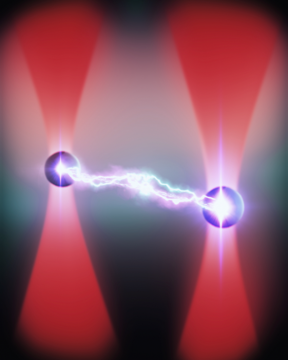 |
| Artistic illustration of two nanoparticles interacting through non-reciprocal light-induced forces CREDIT Equinox Graphics Ltd., University of Vienna |
Abstract:
A team of researchers at the University of Vienna, the Austrian Academy of Sciences and the University of Duisburg-Essen have found a new mechanism that fundamentally alters the interaction between optically levitated nanoparticles. Their experiment demonstrates previously unattainable levels of control over the coupling in arrays of particles, thereby creating a new platform to study complex physical phenomena. The results are published in this week’s issue of Science.
Bound by light: Glass nanoparticles show unexpected coupling when levitated with laser light
Vienna, Austria | Posted on August 26th, 2022Imagine dust particles randomly floating around in the room. When a laser is switched on the particles will experience forces of light and once a particle comes too close it will be trapped in the focus of the beam. This is the basis of Arthur Ashkin’s pioneering Nobel prize work of optical tweezers. When two or more particles are in the vicinity, light can be reflected back and forth between them to form standing waves of light, in which the particles self-align like a crystal of particles bound by light. This phenomenon, also called optical binding, has been known and studied for more than 30 years.
It came as quite a surprise to the researchers in Vienna when they saw a completely different behavior than was expected when studying forces between two glass nanoparticles. Not only could they change the strength and the sign of the binding force, but they could even see one particle, say the left, acting on the other, the right, without the right acting back on the left. What seems like a violation of Newton’s third law (everything that is being acted upon acts back with same strength but opposite sign) is so-called non-reciprocal behavior and occurs in situations in which a system can lose energy to its environment, in this case the laser. Something was obviously missing from our current theory of optical binding.
The secret trick behind this new behavior is "coherent scattering", a phenomenon that the Vienna researchers have already been investigating over the last years. When laser light hits a nanoparticle, the matter inside the particle becomes polarized and follows the oscillations of the light’s electromagnetic wave. As a consequence, all light that is scattered from the particle oscillates in phase with the incoming laser. Waves that are in phase can be made to interfere. Recently, the Vienna researchers used this interference effect provided by coherent scattering to cool for the first time a single nanoparticle at room temperature to its quantum ground state of motion.
When Uroš Delić, a senior researcher in the group of Markus Aspelmeyer at the University of Vienna and first author of the previous cooling work, started applying coherent scattering to two particles, he realized that additional interference effects occur. "Light that is scattered from one particle can interfere with the light that traps the other particle", Delić explains. "If the phase between these light fields can be tuned, so can the strength and character of the forces between the particles." For one set of phases, one recovers the well-known optical binding. For other phases, however, previously unobserved effects occur such as non-reciprocal forces. "It turns out that previous theories did neither take into account coherent scattering nor the fact that photons also get lost. When you add these two processes you get much richer interactions than have thought possible", says Benjamin Stickler, a team member from Germany working on the refined theoretical description: "…and past experiments were not sensitive to these effects either."
The Vienna team wanted to change that and set out to explore these new light-induced forces in an experiment. To achieve this, they used one laser to generate two optical beams, each one trapping a single glass nanoparticle of about 200 nm in size (about 1.000 times smaller than a typical grain of sand). In their experiment they were able to change not only the distance and intensity of the trap beams but also the relative phase between them. Each particle’s position oscillates at the frequency given by the trap and can be monitored with high precision in the experiment. Since every force on the trapped particle changes this frequency, it is possible to monitor the forces between them while phase and distance are being changed. To make sure that the forces are induced by light and not by the gas between the particles, the experiment was performed in vacuum. In that way they could confirm the presence of the new light-induced forces between the trapped particles. "The couplings that we see are more than 10 times larger than expected from conventional optical binding" says PhD student Jakob Rieser, the first author of the study. "And we see clear signatures from non-reciprocal forces when we change the laser phases, all as predicted from our new model."
The researchers believe that their insights will lead to new ways of studying complex phenomena in multiparticle systems. "The way to understand what is going on in genuinely complex systems is typically to study model systems with well-controlled interactions." says lead researcher Uroš Delić. "The really fascinating thing here is that we have found a completely new toolbox for controlling interactions in arrays of levitated particles." The researchers draw some of their inspiration also from atomic physics where, many years ago, the ability to control interactions between atoms in optical lattices basically started the field of quantum simulators. "Being able to apply this now on the level of solid-state systems could be a similar game changer."
####
For more information, please click here
Contacts:
Veronika Schallhart
University of Vienna
Office: +43-1-4277-175 30
Expert Contact
Dr. Uroš Delić
Quantum Optics, Quantum Nanophysics and Quantum Information, University of Vienna
Office: +43-1-4277-72532
Copyright © University of Vienna
If you have a comment, please Contact us.Issuers of news releases, not 7th Wave, Inc. or Nanotechnology Now, are solely responsible for the accuracy of the content.
Bookmark:


| Related Links |
| Related News Press |
News and information
 Quantum computer improves AI predictions April 17th, 2026
Flexible sensor gains sensitivity under pressure April 17th, 2026
A reusable chip for particulate matter sensing April 17th, 2026
Detecting vibrational quantum beating in the predissociation dynamics of SF6 using time-resolved photoelectron spectroscopy April 17th, 2026
Quantum Physics
Detecting vibrational quantum beating in the predissociation dynamics of SF6 using time-resolved photoelectron spectroscopy April 17th, 2026
Beyond silicon: Electronics at the scale of a single molecule January 30th, 2026
MXene nanomaterials enter a new dimension Multilayer nanomaterial: MXene flakes created at Drexel University show new promise as 1D scrolls January 30th, 2026
Physics
UC Irvine physicists discover method to reverse ‘quantum scrambling’ : The work addresses the problem of information loss in quantum computing system April 17th, 2026
Possible Futures
A fundamentally new therapeutic approach to cystic fibrosis: Nanobody repairs cellular defect April 17th, 2026
UC Irvine physicists discover method to reverse ‘quantum scrambling’ : The work addresses the problem of information loss in quantum computing system April 17th, 2026
Discoveries
Quantum computer improves AI predictions April 17th, 2026
Flexible sensor gains sensitivity under pressure April 17th, 2026
A reusable chip for particulate matter sensing April 17th, 2026
Detecting vibrational quantum beating in the predissociation dynamics of SF6 using time-resolved photoelectron spectroscopy April 17th, 2026
Announcements
A fundamentally new therapeutic approach to cystic fibrosis: Nanobody repairs cellular defect April 17th, 2026
UC Irvine physicists discover method to reverse ‘quantum scrambling’ : The work addresses the problem of information loss in quantum computing system April 17th, 2026
Interviews/Book Reviews/Essays/Reports/Podcasts/Journals/White papers/Posters
A fundamentally new therapeutic approach to cystic fibrosis: Nanobody repairs cellular defect April 17th, 2026
UC Irvine physicists discover method to reverse ‘quantum scrambling’ : The work addresses the problem of information loss in quantum computing system April 17th, 2026
Photonics/Optics/Lasers
Metasurfaces smooth light to boost magnetic sensing precision January 30th, 2026
From sensors to smart systems: the rise of AI-driven photonic noses January 30th, 2026
 |
||
 |
||
| The latest news from around the world, FREE | ||
 |
||
|
|
||
| Premium Products | ||
 |
||
|
Only the news you want to read!
Learn More |
||
 |
||
|
Full-service, expert consulting
Learn More |
||
|
|
||