Home > Press > At the water’s edge: Self-assembling 2D materials at a liquid–liquid interface: Scientists find a simple way to produce heterolayer coordination nanosheets, expanding the diversity of 2D materials
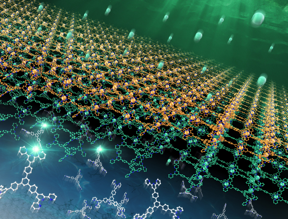 |
| This image depicts the formation of the second layer in a heterolayer coordination nanosheet. Cobalt ions pass through the preexisting first layer (composed of iron coordination centers and terpyridine ligands), which has formed at the liquid–liquid interface between water and dichloromethane. They then assemble into coordinated layers by combining with terpyridine ligands. CREDIT Hiroshi Nishihara from Tokyo University of Science |
Abstract:
The past few decades have witnessed a great amount of research in the field of two-dimensional (2D) materials. As the name implies, these thin film-like materials are composed of layers that are only a few atoms thick. Many of the chemical and physical properties of 2D materials can be fine-tuned, leading to promising applications in many fields, including optoelectronics, catalysis, renewable energy, and more.
At the water’s edge: Self-assembling 2D materials at a liquid–liquid interface: Scientists find a simple way to produce heterolayer coordination nanosheets, expanding the diversity of 2D materials
Tokyo, Japan | Posted on July 22nd, 2022Coordination nanosheets are one particularly interesting type of 2D material. The “coordination” refers to the effect of metallic ions in these molecules, which act as coordination centers. These centers can spontaneously create organized molecular dispositions that span multiple layers in 2D materials. This has attracted the attention of materials scientists due to their favorable properties. In fact, we have only begun to scratch the surface regarding what heterolayer coordination nanosheets – coordination nanosheets whose layers have different atomic composition – can offer.
In a recent study published first on June 13, 2022, and featured on the front cover of Chemistry—A European Journal, a team of scientists from Tokyo University of Science (TUS) and The University of Tokyo in Japan reported a remarkably simple way to synthesize heterolayer coordination nanosheets. Composed of the organic ligand, terpyridine, coordinating iron and cobalt, these nanosheets assemble themselves at the interface between two immiscible liquids in a peculiar way. The study, led by Prof. Hiroshi Nishihara from TUS, also included contributions from Mr. Joe Komeda, Dr. Kenji Takada, Dr. Hiroaki Maeda, and Dr. Naoya Fukui from TUS.
To synthesize the heterolayer coordination nanosheets, the team first created the liquid–liquid interface to enable their assembly. They dissolved tris(terpyridine) ligand in dichloromethane (CH2Cl2), an organic liquid that does not mix with water. They then poured a solution of water and ferrous tetrafluoroborate, an iron-containing chemical, on top of the CH2Cl2. After 24 hours, the first layer of the coordination nanosheet, bis(terpyridine)iron (or “Fe-tpy”), formed at the interface between both liquids.
Following this, they removed the iron-containing water and replaced it with cobalt-containing water. In the next few days, a bis(terpyridine)cobalt (or “Co-tpy”) layer formed right below the iron-containing one at the liquid–liquid interface.
The team made detailed observations of the heterolayer using various advanced techniques, such as scanning electron microscopy, X-ray photoelectron spectroscopy, atomic force microscopy, and scanning transmission electron microscopy. They found that the Co-tpy layer formed neatly below the Fe-tpy layer at the liquid–liquid interface. Moreover, they could control the thickness of the second layer depending on how long they left the synthesis process run its course.
Interestingly, the team also found that the ordering of the layers could be swapped by simply changing the order of the synthesis steps. In other words, if they first added a cobalt-containing solution and then replaced it with an iron-containing solution, the synthesized heterolayer would have cobalt coordination centers on the top layer and iron coordination centers on the bottom layer. “Our findings indicate that metal ions can go through the first layer from the aqueous phase to the CH2Cl2 phase to react with terpyridine ligands right at the boundary between the nanosheet and the CH2Cl2 phase,” explains Prof. Nishihara. “This is the first ever clarification of the growth direction of coordination nanosheets at a liquid/liquid interface.”
Additionally, the team investigated the reduction–oxidation properties of their coordination nanosheets as well as their electrical rectification characteristics. They found that the heterolayers behaved much like a diode in a way that is consistent with the electronic energy levels of Co-tpy and Fe-tpy. These insights, coupled with the easy synthesis procedure developed by the team, could help in the design of heterolayer nanosheets made of other materials and tailored for specific electronics applications. “Our synthetic method could be applicable to other coordination polymers synthesized at liquid–liquid interfaces,” highlights Prof. Nishihara. “Therefore, the results of this study will expand the structural and functional diversity of molecular 2D materials.”
With eyes set on the future, the team will keep investigating chemical phenomena occurring at liquid–liquid interfaces, elucidating the mechanisms of mass transport and chemical reactions. Their findings can help expand the design of 2D materials and, hopefully, lead to better performance of optoelectronic devices, such as solar cells.
####
About Tokyo University of Science
Tokyo University of Science (TUS) is a well-known and respected university, and the largest science-specialized private research university in Japan, with four campuses in central Tokyo and its suburbs and in Hokkaido. Established in 1881, the university has continually contributed to Japan's development in science through inculcating the love for science in researchers, technicians, and educators.
With a mission of “Creating science and technology for the harmonious development of nature, human beings, and society", TUS has undertaken a wide range of research from basic to applied science. TUS has embraced a multidisciplinary approach to research and undertaken intensive study in some of today's most vital fields. TUS is a meritocracy where the best in science is recognized and nurtured. It is the only private university in Japan that has produced a Nobel Prize winner and the only private university in Asia to produce Nobel Prize winners within the natural sciences field.
Website: https://www.tus.ac.jp/en/mediarelations/
About Professor Hiroshi Nishihara from Tokyo University of Science
Dr. Hiroshi Nishihara is a Professor of Chemistry at Tokyo University of Science in Japan. He is a distinguished professor, researcher, and pioneer in the field of electrochemistry and the synthesis of conductive metal complex polymers. His research is focused on the creation of new electro- and photo-functional materials comprising both transition metals and π-conjugated chains, as well as the invention of unidirectional electron transfer systems using molecular layer interfaces. He has published more than 467 papers with over 14911 citations to his credit.
Funding information
This study was financially supported by JST-CREST JPMJCR15F2, JSPS KAKENHI (grant no. JP19H05460), and the White Rock Foundation.
For more information, please click here
Contacts:
Hiroshi Matsuda
Tokyo University of Science
Copyright © Tokyo University of Science
If you have a comment, please Contact us.Issuers of news releases, not 7th Wave, Inc. or Nanotechnology Now, are solely responsible for the accuracy of the content.
Bookmark:


| Related Links |
| Related News Press |
News and information
 Quantum computer improves AI predictions April 17th, 2026
Flexible sensor gains sensitivity under pressure April 17th, 2026
A reusable chip for particulate matter sensing April 17th, 2026
Detecting vibrational quantum beating in the predissociation dynamics of SF6 using time-resolved photoelectron spectroscopy April 17th, 2026
2 Dimensional Materials
Flexible sensor gains sensitivity under pressure April 17th, 2026
MXene nanomaterials enter a new dimension Multilayer nanomaterial: MXene flakes created at Drexel University show new promise as 1D scrolls January 30th, 2026
Chemistry
Projecting light to dispense liquids: A new route to ultra-precise microdroplets January 30th, 2026
From sensors to smart systems: the rise of AI-driven photonic noses January 30th, 2026
"Nanoreactor" cage uses visible light for catalytic and ultra-selective cross-cycloadditions October 3rd, 2025
Possible Futures
A fundamentally new therapeutic approach to cystic fibrosis: Nanobody repairs cellular defect April 17th, 2026
UC Irvine physicists discover method to reverse ‘quantum scrambling’ : The work addresses the problem of information loss in quantum computing system April 17th, 2026
Chip Technology
A reusable chip for particulate matter sensing April 17th, 2026
Metasurfaces smooth light to boost magnetic sensing precision January 30th, 2026
Optical computing/Photonic computing
ICFO researchers overcome long-standing bottleneck in single photon detection with twisted 2D materials August 8th, 2025
Programmable electron-induced color router array May 14th, 2025
Materials/Metamaterials/Magnetoresistance
First real-time observation of two-dimensional melting process: Researchers at Mainz University unveil new insights into magnetic vortex structures August 8th, 2025
Researchers unveil a groundbreaking clay-based solution to capture carbon dioxide and combat climate change June 6th, 2025
A 1960s idea inspires NBI researchers to study hitherto inaccessible quantum states June 6th, 2025
Institute for Nanoscience hosts annual proposal planning meeting May 16th, 2025
Interviews/Book Reviews/Essays/Reports/Podcasts/Journals/White papers/Posters
A fundamentally new therapeutic approach to cystic fibrosis: Nanobody repairs cellular defect April 17th, 2026
UC Irvine physicists discover method to reverse ‘quantum scrambling’ : The work addresses the problem of information loss in quantum computing system April 17th, 2026
Energy
Sensors innovations for smart lithium-based batteries: advancements, opportunities, and potential challenges August 8th, 2025
Simple algorithm paired with standard imaging tool could predict failure in lithium metal batteries August 8th, 2025
Solar/Photovoltaic
Spinel-type sulfide semiconductors to operate the next-generation LEDs and solar cells For solar-cell absorbers and green-LED source October 3rd, 2025
KAIST researchers introduce new and improved, next-generation perovskite solar cell November 8th, 2024
Groundbreaking precision in single-molecule optoelectronics August 16th, 2024
Development of zinc oxide nanopagoda array photoelectrode: photoelectrochemical water-splitting hydrogen production January 12th, 2024
 |
||
 |
||
| The latest news from around the world, FREE | ||
 |
||
|
|
||
| Premium Products | ||
 |
||
|
Only the news you want to read!
Learn More |
||
 |
||
|
Full-service, expert consulting
Learn More |
||
|
|
||