Home > Press > Rensselaer researchers learn to control electron spin at room temperature to make devices more efficient and faster: Electron spin, rather than charge, holds the key
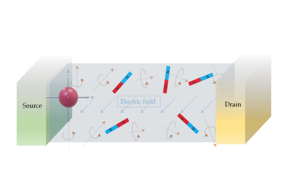 |
| In a Rashba-Dresselhaus spin transistor, the spin of electrons could be disrupted by spin-phonon coupling or non-ideal internal magnetic field distribution. CREDIT Jian Shi |
Abstract:
As our devices become smaller, faster, more energy efficient, and capable of holding larger amounts of data, spintronics may continue that trajectory. Whereas electronics is based on the flow of electrons, spintronics is based on the spin of electrons.
Rensselaer researchers learn to control electron spin at room temperature to make devices more efficient and faster: Electron spin, rather than charge, holds the key
Troy, NY | Posted on July 15th, 2022An electron has a spin degree of freedom, meaning that it not only holds a charge but also acts like a little magnet. In spintronics, a key task is to use an electric field to control electron spin and rotate the north pole of the magnet in any given direction.
The spintronic field effect transistor harnesses the so-called Rashba or Dresselhaus spin-orbit coupling effect, which suggests that one can control electron spin by electric field. Although the method holds promise for efficient and high-speed computing, certain challenges must be overcome before the technology reaches its true, miniature but powerful, and eco-friendly, potential.
For decades, scientists have been attempting to use electric fields to control spin at room temperature but achieving effective control has been elusive. In research recently published in Nature Photonics, a research team led by Jian Shi and Ravishankar Sundararaman of Rensselaer Polytechnic Institute and Yuan Ping of the University of California at Santa Cruz took a step forward in solving the dilemma.
“You want the Rashba or Dresselhaus magnetic field to be large to make the electron spin precess quickly,” said Dr. Shi, associate professor of materials science and engineering. “If it’s weak, the electron spin precesses slowly and it would take too much time to turn the spin transistor on or off. However, often a larger internal magnetic field, if not arranged well, leads to poor control of electron spin.”
The team demonstrated that a ferroelectric van der Waals layered perovskite crystal carrying unique crystal symmetry and strong spin-orbit coupling was a promising model material to understand the Rashba-Dresselhaus spin physics at room temperature. Its nonvolatile and reconfigurable spin-related room temperature optoelectronic properties may inspire the development of important design principles in enabling a room-temperature spin field effect transistor.
Simulations revealed that this material was particularly exciting, according to Dr. Sundararaman, associate professor of materials science and engineering. “The internal magnetic field is simultaneously large and perfectly distributed in a single direction, which allows the spins to rotate predictably and in perfect concert,” he said. “This is a key requirement to use spins for reliably transmitting information.”
“It’s a step forward toward the practical realization of a spintronic transistor,” Dr. Shi said.
The first authors of this article include graduate student Lifu Zhang and postdoctoral associate Jie Jiang from Dr. Shi’s group, as well as graduate student Christian Multunas from Dr. Sundararaman’s group.
This work was supported by the United States Army Research Office (Physical Properties of Materials program by Dr. Pani Varanasi), the Air Force Office of Scientific Research, and the National Science Foundation.
####
About Rensselaer Polytechnic Institute
Founded in 1824, Rensselaer Polytechnic Institute is America’s first technological research university. Rensselaer encompasses five schools, over 30 research centers, more than 140 academic programs including 25 new programs, and a dynamic community made up of over 6,800 students and 104,000 living alumni. Rensselaer faculty and alumni include upwards of 155 National Academy members, six members of the National Inventors Hall of Fame, six National Medal of Technology winners, five National Medal of Science winners, and a Nobel Prize winner in Physics. With nearly 200 years of experience advancing scientific and technological knowledge, Rensselaer remains focused on addressing global challenges with a spirit of ingenuity and collaboration. To learn more, please visit www.rpi.edu.
For more information, please click here
Contacts:
Katie Malatino
Sr. Communications Specialist
518-276-2146
Deanna Cohen
Director of Media Relations
518-233-4828
For general inquiries:
Visit the Rensselaer research and discovery blog: https://everydaymatters.rpi.edu/
Follow us on Twitter: @RPINews
Copyright © Rensselaer Polytechnic Institute
If you have a comment, please Contact us.Issuers of news releases, not 7th Wave, Inc. or Nanotechnology Now, are solely responsible for the accuracy of the content.
Bookmark:


| Related Links |
| Related News Press |
News and information
 Quantum computer improves AI predictions April 17th, 2026
Flexible sensor gains sensitivity under pressure April 17th, 2026
A reusable chip for particulate matter sensing April 17th, 2026
Detecting vibrational quantum beating in the predissociation dynamics of SF6 using time-resolved photoelectron spectroscopy April 17th, 2026
Perovskites
KAIST researchers introduce new and improved, next-generation perovskite solar cell November 8th, 2024
Efficient and stable hybrid perovskite-organic light-emitting diodes with external quantum efficiency exceeding 40 per cent July 5th, 2024
Govt.-Legislation/Regulation/Funding/Policy
Quantum computer improves AI predictions April 17th, 2026
Metasurfaces smooth light to boost magnetic sensing precision January 30th, 2026
New imaging approach transforms study of bacterial biofilms August 8th, 2025
Possible Futures
A fundamentally new therapeutic approach to cystic fibrosis: Nanobody repairs cellular defect April 17th, 2026
UC Irvine physicists discover method to reverse ‘quantum scrambling’ : The work addresses the problem of information loss in quantum computing system April 17th, 2026
Spintronics
Quantum materials: Electron spin measured for the first time June 9th, 2023
Chip Technology
A reusable chip for particulate matter sensing April 17th, 2026
Metasurfaces smooth light to boost magnetic sensing precision January 30th, 2026
Optical computing/Photonic computing
ICFO researchers overcome long-standing bottleneck in single photon detection with twisted 2D materials August 8th, 2025
Programmable electron-induced color router array May 14th, 2025
Discoveries
Quantum computer improves AI predictions April 17th, 2026
Flexible sensor gains sensitivity under pressure April 17th, 2026
A reusable chip for particulate matter sensing April 17th, 2026
Detecting vibrational quantum beating in the predissociation dynamics of SF6 using time-resolved photoelectron spectroscopy April 17th, 2026
Announcements
A fundamentally new therapeutic approach to cystic fibrosis: Nanobody repairs cellular defect April 17th, 2026
UC Irvine physicists discover method to reverse ‘quantum scrambling’ : The work addresses the problem of information loss in quantum computing system April 17th, 2026
Interviews/Book Reviews/Essays/Reports/Podcasts/Journals/White papers/Posters
A fundamentally new therapeutic approach to cystic fibrosis: Nanobody repairs cellular defect April 17th, 2026
UC Irvine physicists discover method to reverse ‘quantum scrambling’ : The work addresses the problem of information loss in quantum computing system April 17th, 2026
Military
Quantum engineers ‘squeeze’ laser frequency combs to make more sensitive gas sensors January 17th, 2025
Chainmail-like material could be the future of armor: First 2D mechanically interlocked polymer exhibits exceptional flexibility and strength January 17th, 2025
Single atoms show their true color July 5th, 2024
NRL charters Navy’s quantum inertial navigation path to reduce drift April 5th, 2024
 |
||
 |
||
| The latest news from around the world, FREE | ||
 |
||
|
|
||
| Premium Products | ||
 |
||
|
Only the news you want to read!
Learn More |
||
 |
||
|
Full-service, expert consulting
Learn More |
||
|
|
||