Home > Press > Deep-ultraviolet nonlinear optical crystals: Concept development and materials discovery
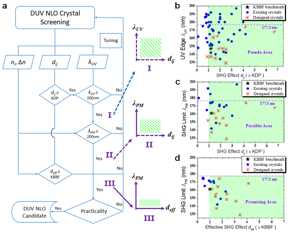 |
| (a) “peeling onion” screening flowchart for DUV NLO crystals. (b), (c), (d), key criteria coordinates (I, II, III) and corresponding structures of “pseudo”, “possible”, and “promising” DUV NLO crystals. CREDIT by Lei Kang, and Zheshuai Lin |
Abstract:
Nonlinear optics plays an important role in modern optics and laser technology. Nonlinear optical (NLO) technology is an important means to extend the wavelength of laser. NLO crystals are basic materials for realizing NLO technology. In the deep-ultraviolet (DUV) spectral region with wavelengths shorter than 200 nm, NLO crystals are the core devices for realizing high-power DUV laser output. The resulting DUV all-solid-state laser has important applications in cutting-edge technological fields such as medical, micromachining, lithography, photochemistry, spectroscopy, and microscopy. To date, KBe2BO3F2 (KBBF) crystal is the only DUV NLO crystal, providing a powerful tool to explore the material world. However, due to its layered habit, the growth of large-scale single KBBF crystals faces difficulties. In addition, the development of DUV science requires DUV NLO crystals with shorter output wavelengths and stronger NLO effects to meet the needs of higher precision and higher power lasers. Therefore, it is of great significance to continue to explore DUV NLO crystals to either replace KBBF in crystal growth abilities, or to surpass KBBF in NLO properties.
Deep-ultraviolet nonlinear optical crystals: Concept development and materials discovery
Changchun, China | Posted on July 8th, 2022In a new paper published in Light Science & Application, Lei Kang and Zheshuai Lin from Technical Institute of Physics and Chemistry, Chinese Academy of Sciences, China have clarified the key performance criteria and core conceptual basis of DUV NLO crystals by reviewing current experimental and theoretical progress. They also discussed the development of DUV NLO “structure-property correlations” based on first-principles methods and how it has sparked interest in related materials, as well as future exploration directions in the field of DUV NLO crystals.
The key performance criteria include second-harmonic generation (SHG) effect dij, effective SHG coefficient deff, UV transparent cut-off wavelength λUV and phase-matchable (PM) cut-off wavelength λPM. In the past two decades, although a large number of compounds have been synthesized and characterized, there are very few truly “promising” DUV NLO crystals. To achieve the “promising” criteria, we must grasp the two core concepts of “phase matching” and “effective SHG”. According to the “peeling onion” screening process shown in Figure 1, through the layer-by-layer screening of key performance criteria and the gradual introduction of core concepts, the theoretical performance of DUV NLO crystals can be effectively evaluated.
Numerous NLO materials are just transparent in the DUV region, but they cannot achieve effective DUV PM output; they are essentially “pseudo” DUV NLO crystals. A few crystals appear to meet the DUV NLO performance criteria, but their actual DUV coherent conversion capabilities are insufficient especially for SHG; they basically belong to “possible” DUV NLO crystals. Currently, only crystals capable of achieving effective DUV PM output with sufficient SHG conversion efficiency are called “promising” DUV NLO crystals. It should be emphasized that the materials exploration of DUV NLO crystals must rely on these strict concepts and self-consistent criteria. Without meeting the concepts, it is not strictly a DUV NLO crystal; without meeting the criteria, it cannot achieve a truly efficient DUV coherent output.
Prior to 2013, no materials were discovered that might exceed the DUV NLO properties of KBBF. It is a great challenge to continue to improve DUV NLO performance beyond KBBF. To address this challenge, several design strategies have been proposed to promote the performance improvement of DUV NLO crystals. By combining advanced first-principles modeling and simulations, a series of potential DUV PM SHG crystals were evaluated, designed, and predicted, some of which have been partially verified experimentally.
Tuning of the interlayer cations: KBBF, RBBF and CBBF have similar structures with comparable λUV and d22. However, their λPM are quite different due to different Δn. The λPM of RBBF is red-shifted by 13 nm than KBBF, and CBBF can no longer achieve effective DUV SHG output. This reason is due to so-called “NLO size-effect” induced by the interlayer cationic size (Figure 2a). Accordingly, rational tuning of the interlayer cationic size has become an effective strategy to improve the DUV NLO performance. If all the potential of the cations can be tapped, the DUV NLO performance may be further improved, thus breaking the KBBF limit. An extreme design strategy is to reduce the size of the interlayer cations to zero, i.e., to eliminate them, thereby maximizing the DUV NLO potential. Such theoretical design was first validated in the F-bridge-connected γ-Be2BO3F (Figure 2b). The first-principles results demonstrate that the shorter SHG output and the stronger SHG effect are indeed achieved. Another design strategy to eliminate the interlayer cations, i.e., via van der Waals (vdW) connection, has been proposed, and a series of possible DUV NLO structures have been accordingly predicted. Among them, an existing berborite (Be2BO5H3, Figure 2c) can theoretically achieve DUV NLO performance comparable to KBBF, and designed PB3O6F2 and SiCO3F2 could realize superior DUV NLO performance beyond KBBF.
Extending of the anionic groups: Conventional DUV NLO materials are layered fluorine-based borate anionic frameworks, since the layered frameworks favors large birefringence, and the fluorine-based borate anionic groups favor large bandgap. To this end, the materials exploration is extended (1) from borate to carbonate anionic groups, e.g., KAlCO3F2 and vdW Be2CO3F2 can exhibit shorter DUV SHG limits and larger SHG effects than KBBF (Figure 3a); (2) from fluorine-based to hydroxyl-based anionic groups, e.g., hydroxyborate SrB8O15H4 and hydroxycarbonate LiZnCO3OH exhibit possible DUV NLO properties (Figure 3b), and (3) from layered to chained anionic groups, e.g., poly(difluorophosphazene) (PNF2) is predicted with superior DUV NLO performance than KBBF (Figure 3c).
In short, the proposed first-principles approach can not only characterize the properties of DUV NLO crystals, but also elucidate the “structure-property correlation” laws, which provide insights for performance improvement and materials design. Although the first-principles calculations can provide an important reference for DUV NLO evaluations, the final performance determinations also require rigorous optical characterization of large-sized crystals rather than relying solely on theoretical results. High-quality large-sized single crystals are the fundamental and ultimate destination of NLO crystals. Reasonable performance evaluation is a crucial step for NLO crystals before large-sized crystal growth. Only by recognizing the theoretical applicability can the theoretical predictability be maximized. Using the first-principles methods in the design and prediction of DUV NLO crystals, the underlying “structure-property correlations” are proposed for current and future DUV NLO materials exploration, especially when exploration faces bottlenecks. This review provides an important reference for the evaluation of DUV NLO performance, and would have a positive impact on conceptual clarification and materials exploration in the field of DUV NLO crystals.
####
For more information, please click here
Contacts:
Media Contact
Yaobiao Li
Light Publishing Center, Changchun Institute of Optics, Fine Mechanics And Physics, CAS
Office: 86-431-861-76851
Expert Contact
Zheshuai Lin
Technical Institute of Physics and Chemistry, Chinese Academy of Sciences
Copyright © Light Publishing Center, Changchun Institute of Optics, Fine Mechanics And Physics, CAS
If you have a comment, please Contact us.Issuers of news releases, not 7th Wave, Inc. or Nanotechnology Now, are solely responsible for the accuracy of the content.
Bookmark:


| Related Links |
| Related News Press |
News and information
 Quantum computer improves AI predictions April 17th, 2026
Flexible sensor gains sensitivity under pressure April 17th, 2026
A reusable chip for particulate matter sensing April 17th, 2026
Detecting vibrational quantum beating in the predissociation dynamics of SF6 using time-resolved photoelectron spectroscopy April 17th, 2026
Possible Futures
A fundamentally new therapeutic approach to cystic fibrosis: Nanobody repairs cellular defect April 17th, 2026
UC Irvine physicists discover method to reverse ‘quantum scrambling’ : The work addresses the problem of information loss in quantum computing system April 17th, 2026
Optical computing/Photonic computing
ICFO researchers overcome long-standing bottleneck in single photon detection with twisted 2D materials August 8th, 2025
Programmable electron-induced color router array May 14th, 2025
Discoveries
Quantum computer improves AI predictions April 17th, 2026
Flexible sensor gains sensitivity under pressure April 17th, 2026
A reusable chip for particulate matter sensing April 17th, 2026
Detecting vibrational quantum beating in the predissociation dynamics of SF6 using time-resolved photoelectron spectroscopy April 17th, 2026
Announcements
A fundamentally new therapeutic approach to cystic fibrosis: Nanobody repairs cellular defect April 17th, 2026
UC Irvine physicists discover method to reverse ‘quantum scrambling’ : The work addresses the problem of information loss in quantum computing system April 17th, 2026
Interviews/Book Reviews/Essays/Reports/Podcasts/Journals/White papers/Posters
A fundamentally new therapeutic approach to cystic fibrosis: Nanobody repairs cellular defect April 17th, 2026
UC Irvine physicists discover method to reverse ‘quantum scrambling’ : The work addresses the problem of information loss in quantum computing system April 17th, 2026
Photonics/Optics/Lasers
Metasurfaces smooth light to boost magnetic sensing precision January 30th, 2026
From sensors to smart systems: the rise of AI-driven photonic noses January 30th, 2026
 |
||
 |
||
| The latest news from around the world, FREE | ||
 |
||
|
|
||
| Premium Products | ||
 |
||
|
Only the news you want to read!
Learn More |
||
 |
||
|
Full-service, expert consulting
Learn More |
||
|
|
||