Home > Press > From outside to inside: A rapid and precise total assessment method for cells: Researchers at Nara Institute of Science and Technology show that using four frequencies of applied voltage can improve the measurement of cell size and shape during impedance cytometry, enabling to en
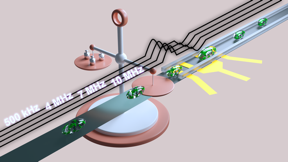 |
| Precise total assessment of the cells with impedance signals. CREDIT Tao Tang, Yaxiaer Yalikun |
Abstract:
Having a good eye for detail is an essential skill for many professions. In particular, biologists use special techniques and advanced technology to analyze individual cells with unprecedented precision. Impedance cytometry is one experimental method that can reveal specific characteristics of living single cells. This technique requires electrical penetration, in which high-frequency current can freely pass through the cell membrane, without damaging the cell. Now, researchers from Japan have determined optimal conditions to perform impedance cytometry. Their work may lead to rapid assessment of cells during culture in biological experiments.
From outside to inside: A rapid and precise total assessment method for cells: Researchers at Nara Institute of Science and Technology show that using four frequencies of applied voltage can improve the measurement of cell size and shape during impedance cytometry, enabling to en
Ikoma, Japan | Posted on June 24th, 2022An improved method for measuring the morphology and biomass of single cells using impedance cytometry has been introduced in a recently published study in Microsystems & Nanoengineering. Impedance cytometry involves applying high-frequency voltages to electrodes to measure complex impedance, which can provide information about the shape and effective volume of the cell. In the study, researchers led by Nara Institute of Science and Technology used different phases of voltage signals at four frequencies. They showed that applied voltages with frequencies of around 7 MHz are able to pass through the membrane of Euglena gracilis cells. Higher frequencies can monitor changes in biomass, while lower frequencies can track volume changes.
When a high-frequency electrical field penetrates the cell membrane, the uneven intracellular distribution tilts the impedance pulses to the left or right, which has been verified in simulation and experiments. “Ultimately, our method for determining the conductivity of the cell membrane relies on the degree of tilt caused by the electrical pulses,” says author Yoichiroh Hosokawa. The team also performed calibration studies using beads to better understand the underlying physical mechanisms of this effect.
“This research enables the easy determination of the electrical penetration of a cell membrane, and the proposed platform is applicable to multiparameter assessment of the organism’s state during cultivation,” says senior author Yaxiaer Yalikun. This platform may be easily integrated into microfluidic systems for the scalable monitoring of biological experiments.
The need for efficient and highly accurate analysis of living single cells may be met by this new impedance cytometry method developed by the research team led by Nara Institute of Science and Technology. Future applications could be extended to cells in mammals to monitor specific membrane changes in fields such as oncogenesis and cell aging.
####
For more information, please click here
Contacts:
Takahito Shikano
Nara Institute of Science and Technology
Copyright © Nara Institute of Science and Technology
If you have a comment, please Contact us.Issuers of news releases, not 7th Wave, Inc. or Nanotechnology Now, are solely responsible for the accuracy of the content.
Bookmark:


| Related Links |
 Information about the Bio-Process Engineering Laboratory can be found at the following website:
| Related News Press |
News and information
Quantum computer improves AI predictions April 17th, 2026
Flexible sensor gains sensitivity under pressure April 17th, 2026
A reusable chip for particulate matter sensing April 17th, 2026
Detecting vibrational quantum beating in the predissociation dynamics of SF6 using time-resolved photoelectron spectroscopy April 17th, 2026
Possible Futures
A fundamentally new therapeutic approach to cystic fibrosis: Nanobody repairs cellular defect April 17th, 2026
UC Irvine physicists discover method to reverse ‘quantum scrambling’ : The work addresses the problem of information loss in quantum computing system April 17th, 2026
Nanomedicine
A fundamentally new therapeutic approach to cystic fibrosis: Nanobody repairs cellular defect April 17th, 2026
New molecular technology targets tumors and simultaneously silences two ‘undruggable’ cancer genes August 8th, 2025
New imaging approach transforms study of bacterial biofilms August 8th, 2025
Electrifying results shed light on graphene foam as a potential material for lab grown cartilage June 6th, 2025
Discoveries
Quantum computer improves AI predictions April 17th, 2026
Flexible sensor gains sensitivity under pressure April 17th, 2026
A reusable chip for particulate matter sensing April 17th, 2026
Detecting vibrational quantum beating in the predissociation dynamics of SF6 using time-resolved photoelectron spectroscopy April 17th, 2026
Announcements
A fundamentally new therapeutic approach to cystic fibrosis: Nanobody repairs cellular defect April 17th, 2026
UC Irvine physicists discover method to reverse ‘quantum scrambling’ : The work addresses the problem of information loss in quantum computing system April 17th, 2026
Interviews/Book Reviews/Essays/Reports/Podcasts/Journals/White papers/Posters
A fundamentally new therapeutic approach to cystic fibrosis: Nanobody repairs cellular defect April 17th, 2026
UC Irvine physicists discover method to reverse ‘quantum scrambling’ : The work addresses the problem of information loss in quantum computing system April 17th, 2026
Nanobiotechnology
A fundamentally new therapeutic approach to cystic fibrosis: Nanobody repairs cellular defect April 17th, 2026
New molecular technology targets tumors and simultaneously silences two ‘undruggable’ cancer genes August 8th, 2025
New imaging approach transforms study of bacterial biofilms August 8th, 2025
Electrifying results shed light on graphene foam as a potential material for lab grown cartilage June 6th, 2025
 |
||
 |
||
| The latest news from around the world, FREE | ||
 |
||
|
|
||
| Premium Products | ||
 |
||
|
Only the news you want to read!
Learn More |
||
 |
||
|
Full-service, expert consulting
Learn More |
||
|
|
||