Home > Press > Electron-phonon coupling assisted universal red luminescence of o-phenylenediamine-based CDs
 |
| CREDIT by Boyang Wang, Zhihong Wei, Laizhi Sui, Jingkun Yu, Baowei Zhang, Xiaoyong Wang, Shengnan Feng, Haoqiang Song, Xue Yong, Yuxi Tian, Bai Yang, and Siyu Lu |
Abstract:
Carbon dots (CDs) are new carbon-based photoluminescence (PL) nanomaterials with a core-shell motif. Due to their fascinating advantages, such as chemical inertness, high quantum yields (QYs), high water solubility, thermal stability, and excellent biocompatibility, CDs have attracted extensive attention in various research applications, such as cancer diagnosis, phototherapy, and optoelectronic devices. However, the underlying PL phenomena of CDs remain a mystery due to the polydispersity of the products and the difficulty in ascertaining their atomic structures.
Electron-phonon coupling assisted universal red luminescence of o-phenylenediamine-based CDs
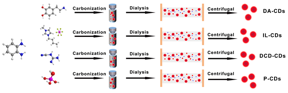
Changchun, China | Posted on June 10th, 2022In a new paper published in Light Science & Application, a team of scientists, led by Professor Siyu Lu and Yuxi Tian from the College of Chemistry, Zhengzhou University, and School of Chemistry and Chemical Engineering, Nanjing University, China, and co-workers have developed an innovative approach to investigate the formation process and fluorescence mechanism of o-phenylenediamine based red emission CDs. To this end, they designed six red emission CDs using different preparation methods, and all of them exhibited the same absorption and PL spectra after purification. The characterization of their structures by a series of tests shows that they have similar carbon core structures, while spectral characterization confirmed the different surface states of the CDs. Furthermore, transient absorption (TA) spectroscopy combined with single-particle PL spectroscopy technology confirmed that the red emission originated from the transition of different vibrational energy levels in the same PL center. Finally, theoretical calculations combined with thermogravimetric analysis confirmed the formation process of such CDs. Therefore, this work proposes a systematic way to analyze the emission mechanism of red emission CDs, which can be used as a guide for the analysis of the structure and mechanism of other types of CDs.
The presence of aromatic regions and some non-conjugated regions in CDs proves the hybrid structure, that is, these conjugated and non-conjugated structures exist in both the carbon core and a polymer shell. These scientists summarize that there is no clear boundary between the carbon core and the surface shell of CDs, but the “density” of the two parts is different. There are more conjugated structures in the carbon core and more polymer chains in the shell.
Further, these scientists confirmed their claims utilizing multiple characterizations: (1) The decay-dependent difference spectroscopy shows the same results of four samples, which proves that the photophysical processes are the same for all four CDs. The fitting results of the CDs were similar, and the carriers went through the same relaxation channel. (2) The single-particle PL spectra showed that all spectra of individual CDs were highly consistent with the ensemble spectrum, indicating that the multimodal emission of CDs originated from itself, rather than the superposition of multiple luminescent specie. (3) Temperature-dependent Raman spectroscopy directly prove that CDs are a new species, different from quantum dots and organic molecules, that possess the properties of both of these materials. (4) Density functional theory calculation shows in the hydrothermal process, oPD tends to aggregate and form planar structures. Then, the planar structures self-assemble to form spherical CDs.
"This article clarifies the general PL mechanism and formation process of oPD-based red emission CDs. This unified mechanism provides a new method for analyzing the structure-property relationship of CDs and thus paves the way for analyzing other types of CDs, thereby uncovering untapped opportunities". the scientists forecast.
####
For more information, please click here
Contacts:
Media Contact
Yaobiao Li
Light Publishing Center, Changchun Institute of Optics, Fine Mechanics And Physics, CAS
Office: 86-431-861-76851
Expert Contact
Siyu Lu
Zhengzhou University, China
Copyright © Light Publishing Center, Changchun Institute of Optics, Fine Mechanics And Physics, CAS
If you have a comment, please Contact us.Issuers of news releases, not 7th Wave, Inc. or Nanotechnology Now, are solely responsible for the accuracy of the content.
Bookmark:


| Related Links |
| Related News Press |
News and information
 Quantum computer improves AI predictions April 17th, 2026
Flexible sensor gains sensitivity under pressure April 17th, 2026
A reusable chip for particulate matter sensing April 17th, 2026
Detecting vibrational quantum beating in the predissociation dynamics of SF6 using time-resolved photoelectron spectroscopy April 17th, 2026
Cancer
New molecular technology targets tumors and simultaneously silences two ‘undruggable’ cancer genes August 8th, 2025
Ben-Gurion University of the Negev researchers several steps closer to harnessing patient's own T-cells to fight off cancer June 6th, 2025
Self-propelled protein-based nanomotors for enhanced cancer therapy by inducing ferroptosis June 6th, 2025
Possible Futures
A fundamentally new therapeutic approach to cystic fibrosis: Nanobody repairs cellular defect April 17th, 2026
UC Irvine physicists discover method to reverse ‘quantum scrambling’ : The work addresses the problem of information loss in quantum computing system April 17th, 2026
Nanomedicine
A fundamentally new therapeutic approach to cystic fibrosis: Nanobody repairs cellular defect April 17th, 2026
New molecular technology targets tumors and simultaneously silences two ‘undruggable’ cancer genes August 8th, 2025
New imaging approach transforms study of bacterial biofilms August 8th, 2025
Electrifying results shed light on graphene foam as a potential material for lab grown cartilage June 6th, 2025
Optical computing/Photonic computing
ICFO researchers overcome long-standing bottleneck in single photon detection with twisted 2D materials August 8th, 2025
Programmable electron-induced color router array May 14th, 2025
Discoveries
Quantum computer improves AI predictions April 17th, 2026
Flexible sensor gains sensitivity under pressure April 17th, 2026
A reusable chip for particulate matter sensing April 17th, 2026
Detecting vibrational quantum beating in the predissociation dynamics of SF6 using time-resolved photoelectron spectroscopy April 17th, 2026
Announcements
A fundamentally new therapeutic approach to cystic fibrosis: Nanobody repairs cellular defect April 17th, 2026
UC Irvine physicists discover method to reverse ‘quantum scrambling’ : The work addresses the problem of information loss in quantum computing system April 17th, 2026
Interviews/Book Reviews/Essays/Reports/Podcasts/Journals/White papers/Posters
A fundamentally new therapeutic approach to cystic fibrosis: Nanobody repairs cellular defect April 17th, 2026
UC Irvine physicists discover method to reverse ‘quantum scrambling’ : The work addresses the problem of information loss in quantum computing system April 17th, 2026
Nanobiotechnology
A fundamentally new therapeutic approach to cystic fibrosis: Nanobody repairs cellular defect April 17th, 2026
New molecular technology targets tumors and simultaneously silences two ‘undruggable’ cancer genes August 8th, 2025
New imaging approach transforms study of bacterial biofilms August 8th, 2025
Electrifying results shed light on graphene foam as a potential material for lab grown cartilage June 6th, 2025
 |
||
 |
||
| The latest news from around the world, FREE | ||
 |
||
|
|
||
| Premium Products | ||
 |
||
|
Only the news you want to read!
Learn More |
||
 |
||
|
Full-service, expert consulting
Learn More |
||
|
|
||