Home > Press > ‘Fruitcake’ structure observed in organic polymers
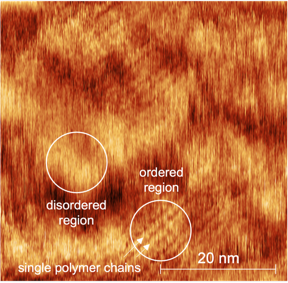 |
| Researchers have analysed the properties of an organic polymer with potential applications in flexible electronics and uncovered variations in hardness at the nanoscale, the first time such a fine structure has been observed in this type of material. CREDIT University of Cambridge |
Abstract:
Researchers have analysed the properties of an organic polymer with potential applications in flexible electronics and uncovered variations in hardness at the nanoscale, the first time such a fine structure has been observed in this type of material.
‘Fruitcake’ structure observed in organic polymers
Cambridge, UK | Posted on June 3rd, 2022The field of organic electronics has benefited from the discovery of new semiconducting polymers with molecular backbones that are resilient to twists and bends, meaning they can transport charge even if they are flexed into different shapes.
It had been assumed that these materials resemble a plate of spaghetti at the molecular scale, without any long-range order. However, an international team of researchers found that for at least one such material, there are tiny pockets of order within. These ordered pockets, just a few ten-billionths of a metre across, are stiffer than the rest of the material, giving it a ‘fruitcake’ structure with harder and softer regions.
The work was led by the University of Cambridge and Park Systems UK Limited, with KTH Stockholm in Sweden, the Universities of Namur and Mons in Belgium, and Wake Forest University in the USA. Their results, reported in the journal Nature Communications, could be used in the development of next-generation microelectronic and bioelectronic devices.
Studying and understanding the mechanical properties of these materials at the nanoscale – a field known as nanomechanics – could help scientists fine-tune those properties and make the materials suitable for a wider range of applications.
“We know that the fabric of nature on the nanoscale isn’t uniform, but finding uniformity and order where we didn’t expect to see it was a surprise,” said Dr Deepak Venkateshvaran from Cambridge’s Cavendish Laboratory, who led the research.
The researchers used an imaging technique called higher eigen mode imaging to take nanoscale pictures of the regions of order within a semiconducting polymer called indacenodithiophene-co-benzothiadiazole (C16-IDTBT). These pictures showed clearly how individual polymer chains line up next to each other in some regions of the polymer film. These regions of order are between 10 and 20 nanometres across.
“The sensitivity of these detection methods allowed us to map out the self-organisation of polymers down to the individual molecular strands,” said co-author Dr Leszek Spalek, also from the Cavendish Laboratory. “Higher eigen mode imaging is a valuable method for characterising nanomechanical properties of materials, given the relatively easy sample preparation that is required.”
Further measurements of the stiffness of the material on the nanoscale showed that the areas where the polymers self-organised into ordered regions were harder, while the disordered regions of the material were softer. The experiments were performed in ambient conditions as opposed to an ultra-high vacuum, which had been a requirement in earlier studies.
“Organic polymers are normally studied for their applications in large area, centimetre scale, flexible electronics,” said Venkateshvaran. “Nanomechanics can augment these studies by developing an understanding of their mechanical properties at ultra-small scales with unprecedented resolutions.
“Together, the fundamental knowledge gained from both types of studies could inspire a new generation of soft microelectronic and bioelectronic devices. These futuristic devices will combine the benefits of centimetre scale flexibility, micrometre scale homogeneity, and nanometre scale electrically controlled mechanical motion of polymer chains with superior biocompatibility.”
The research was funded in part by the Royal Society.
####
For more information, please click here
Contacts:
Sarah Collins
University of Cambridge
Office: 01223765542
Cell: 7525337458
Copyright © University of Cambridge
If you have a comment, please Contact us.Issuers of news releases, not 7th Wave, Inc. or Nanotechnology Now, are solely responsible for the accuracy of the content.
Bookmark:


| Related Links |
| Related News Press |
News and information
 Quantum computer improves AI predictions April 17th, 2026
Flexible sensor gains sensitivity under pressure April 17th, 2026
A reusable chip for particulate matter sensing April 17th, 2026
Detecting vibrational quantum beating in the predissociation dynamics of SF6 using time-resolved photoelectron spectroscopy April 17th, 2026
Flexible Electronics
Flexible sensor gains sensitivity under pressure April 17th, 2026
MXene nanomaterials enter a new dimension Multilayer nanomaterial: MXene flakes created at Drexel University show new promise as 1D scrolls January 30th, 2026
Flexible electronics integrated with paper-thin structure for use in space January 17th, 2025
Organic Electronics
Wearable electronics
Breakthrough brings body-heat powered wearable devices closer to reality December 13th, 2024
Possible Futures
A fundamentally new therapeutic approach to cystic fibrosis: Nanobody repairs cellular defect April 17th, 2026
UC Irvine physicists discover method to reverse ‘quantum scrambling’ : The work addresses the problem of information loss in quantum computing system April 17th, 2026
Chip Technology
A reusable chip for particulate matter sensing April 17th, 2026
Metasurfaces smooth light to boost magnetic sensing precision January 30th, 2026
Discoveries
Quantum computer improves AI predictions April 17th, 2026
Flexible sensor gains sensitivity under pressure April 17th, 2026
A reusable chip for particulate matter sensing April 17th, 2026
Detecting vibrational quantum beating in the predissociation dynamics of SF6 using time-resolved photoelectron spectroscopy April 17th, 2026
Announcements
A fundamentally new therapeutic approach to cystic fibrosis: Nanobody repairs cellular defect April 17th, 2026
UC Irvine physicists discover method to reverse ‘quantum scrambling’ : The work addresses the problem of information loss in quantum computing system April 17th, 2026
Interviews/Book Reviews/Essays/Reports/Podcasts/Journals/White papers/Posters
A fundamentally new therapeutic approach to cystic fibrosis: Nanobody repairs cellular defect April 17th, 2026
UC Irvine physicists discover method to reverse ‘quantum scrambling’ : The work addresses the problem of information loss in quantum computing system April 17th, 2026
 |
||
 |
||
| The latest news from around the world, FREE | ||
 |
||
|
|
||
| Premium Products | ||
 |
||
|
Only the news you want to read!
Learn More |
||
 |
||
|
Full-service, expert consulting
Learn More |
||
|
|
||