Home > Press > Bacteria-killing drills get an upgrade Visible light triggers: Rice’s molecular machines to treat infections
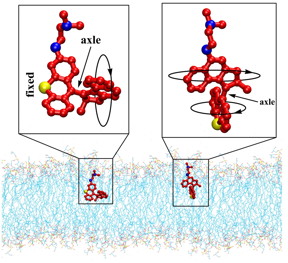 |
| The schematics show two variants of light-activated molecular machines developed at Rice University that drill into and destroy antibiotic-resistant bacteria. The machines could be useful to fight infectious skin diseases. (Credit: Tour Research Group/Rice University) |
Abstract:
Molecular machines that kill infectious bacteria have been taught to see their mission in a new light.
Bacteria-killing drills get an upgrade Visible light triggers: Rice’s molecular machines to treat infections
Houston, TX | Posted on June 1st, 2022The latest iteration of nanoscale drills developed at Rice University are activated by visible light rather than ultraviolet (UV), as in earlier versions. These have also proven effective at killing bacteria through tests on real infections.
Six variants of molecular machines were successfully tested by Rice chemist James Tour and his team. All of them punched holes in the membranes of gram-negative and gram-positive bacteria in as little as two minutes. Resistance was futile for bacteria that have no natural defenses against mechanical invaders. That means they are unlikely to develop resistance, potentially offering a strategy to defeat bacteria that have become immune to standard antibacterial treatments over time.
“I tell students that when they are my age, antibiotic-resistant bacteria are going to make COVID look like a walk in the park,” Tour said. “Antibiotics won’t be able to keep 10 million people a year from dying of bacterial infections. But this really stops them.”
The breakthrough study led by Tour and Rice alumni Ana Santos and Dongdong Liu appears in Science Advances.
Because extended exposure to UV can be damaging to humans, the Rice lab has been refining its molecules for years. The new version gets its energy from still-blueish light at 405 nanometers, spinning the molecules’ rotors at 2 to 3 million times per second.
It’s been suggested by other researchers that light at that wavelength has mild antibacterial properties of its own, but the addition of molecular machines supercharges it, said Tour, who suggested bacterial infections like those suffered by burn victims and people with gangrene will be early targets.
The machines are based on Nobel Prize-winning work by Bernard Feringa, who developed the first molecule with a rotor in 1999 and got the rotor to spin reliably in one direction. Tour and his team introduced their advanced drills in a 2017 Nature paper.
The Rice lab’s first tests of the new molecules on burn wound infection models confirmed their ability to quickly kill bacteria, including methicillin-resistant Staphylococcus aureus, a common cause of skin and soft tissue infections that was responsible for more than 100,000 deaths in 2019.
The team achieved visible light activation by adding a nitrogen group. “The molecules were further modified with different amines in either the stator (stationary) or the rotor portion of the molecule to promote the association between the protonated amines of the machines and the negatively charged bacterial membrane,” said Liu, now a scientist at Arcus Biosciences in California.
The researchers also found the machines effectively break up biofilms and persister cells, which become dormant to avoid antibacterial drugs.
“Even if an antibiotic kills most of a colony, there are often a few persister cells that for some reason don’t die,” Tour said. “But that doesn’t matter to the drills.”
As with earlier versions, the new machines also promise to revive antibacterial drugs considered ineffective. “Drilling through the microorganisms’ membranes allows otherwise ineffective drugs to enter cells and overcome the bug’s intrinsic or acquired resistance to antibiotics,” said Santos, who’s on the third year of the postdoctoral global fellowship that brought her to Rice for two years and is continuing at the Health Research Institute of the Balearic Islands in Palma, Spain.
The lab is working toward better targeting of bacteria to minimize damage to mammalian cells by linking bacteria-specific peptide tags to the drills to direct them toward pathogens of interest. “But even without that, the peptide can be applied to a site of bacterial concentration, like in a burn wound area,” Santos said.
Co-authors are Rice alumni Anna Reed and John Li, senior Aaron Wyderka, graduate students Alexis van Venrooy and Jacob Beckham, researcher Victor Li, postdoctoral alumni Mikita Misiura and Olga Samoylova, research scientist Ciceron Ayala-Orozco, lecturer Lawrence Alemany and Anatoly Kolomeisky, a professor of chemistry; Antonio Oliver of the Health Research Institute of the Balearic Islands and the Son Espases University Hospital, Palma, Spain; and George Tegos of Tower Health, Reading, Pennsylvania.
Tour is the T.T. and W.F. Chao Professor of Chemistry and a professor of materials science and nanoengineering.
The European Union’s Horizon 2020 research and innovation program (843116), the Discovery Institute and the Robert A. Welch Foundation (C-2017-20190330) supported the research.
####
About Rice University
Located on a 300-acre forested campus in Houston, Rice University is consistently ranked among the nation’s top 20 universities by U.S. News & World Report. Rice has highly respected schools of Architecture, Business, Continuing Studies, Engineering, Humanities, Music, Natural Sciences and Social Sciences and is home to the Baker Institute for Public Policy. With 4,052 undergraduates and 3,484 graduate students, Rice’s undergraduate student-to-faculty ratio is just under 6-to-1. Its residential college system builds close-knit communities and lifelong friendships, just one reason why Rice is ranked No. 1 for lots of race/class interaction and No. 1 for quality of life by the Princeton Review. Rice is also rated as a best value among private universities by Kiplinger’s Personal Finance.
Follow Rice News and Media Relations via Twitter @RiceUNews.
For more information, please click here
Contacts:
Jeff Falk
713-348-6775
Mike Williams
713-348-6728
Copyright © Rice University
If you have a comment, please Contact us.Issuers of news releases, not 7th Wave, Inc. or Nanotechnology Now, are solely responsible for the accuracy of the content.
Bookmark:


| Related Links |
| Related News Press |
News and information
 Quantum computer improves AI predictions April 17th, 2026
Flexible sensor gains sensitivity under pressure April 17th, 2026
A reusable chip for particulate matter sensing April 17th, 2026
Detecting vibrational quantum beating in the predissociation dynamics of SF6 using time-resolved photoelectron spectroscopy April 17th, 2026
Govt.-Legislation/Regulation/Funding/Policy
Quantum computer improves AI predictions April 17th, 2026
Metasurfaces smooth light to boost magnetic sensing precision January 30th, 2026
New imaging approach transforms study of bacterial biofilms August 8th, 2025
Possible Futures
A fundamentally new therapeutic approach to cystic fibrosis: Nanobody repairs cellular defect April 17th, 2026
UC Irvine physicists discover method to reverse ‘quantum scrambling’ : The work addresses the problem of information loss in quantum computing system April 17th, 2026
Nanomedicine
A fundamentally new therapeutic approach to cystic fibrosis: Nanobody repairs cellular defect April 17th, 2026
New molecular technology targets tumors and simultaneously silences two ‘undruggable’ cancer genes August 8th, 2025
New imaging approach transforms study of bacterial biofilms August 8th, 2025
Electrifying results shed light on graphene foam as a potential material for lab grown cartilage June 6th, 2025
Discoveries
Quantum computer improves AI predictions April 17th, 2026
Flexible sensor gains sensitivity under pressure April 17th, 2026
A reusable chip for particulate matter sensing April 17th, 2026
Detecting vibrational quantum beating in the predissociation dynamics of SF6 using time-resolved photoelectron spectroscopy April 17th, 2026
Announcements
A fundamentally new therapeutic approach to cystic fibrosis: Nanobody repairs cellular defect April 17th, 2026
UC Irvine physicists discover method to reverse ‘quantum scrambling’ : The work addresses the problem of information loss in quantum computing system April 17th, 2026
Interviews/Book Reviews/Essays/Reports/Podcasts/Journals/White papers/Posters
A fundamentally new therapeutic approach to cystic fibrosis: Nanobody repairs cellular defect April 17th, 2026
UC Irvine physicists discover method to reverse ‘quantum scrambling’ : The work addresses the problem of information loss in quantum computing system April 17th, 2026
Grants/Sponsored Research/Awards/Scholarships/Gifts/Contests/Honors/Records
Quantum computer improves AI predictions April 17th, 2026
Detecting vibrational quantum beating in the predissociation dynamics of SF6 using time-resolved photoelectron spectroscopy April 17th, 2026
Metasurfaces smooth light to boost magnetic sensing precision January 30th, 2026
Nanobiotechnology
A fundamentally new therapeutic approach to cystic fibrosis: Nanobody repairs cellular defect April 17th, 2026
New molecular technology targets tumors and simultaneously silences two ‘undruggable’ cancer genes August 8th, 2025
New imaging approach transforms study of bacterial biofilms August 8th, 2025
Electrifying results shed light on graphene foam as a potential material for lab grown cartilage June 6th, 2025
Research partnerships
Lab to industry: InSe wafer-scale breakthrough for future electronics August 8th, 2025
HKU physicists uncover hidden order in the quantum world through deconfined quantum critical points April 25th, 2025
 |
||
 |
||
| The latest news from around the world, FREE | ||
 |
||
|
|
||
| Premium Products | ||
 |
||
|
Only the news you want to read!
Learn More |
||
 |
||
|
Full-service, expert consulting
Learn More |
||
|
|
||