Home > Press > Nanoscale chemically ordered-disordered domains in Fe3Pt alloys and their three-dimensional interface and lattice strain
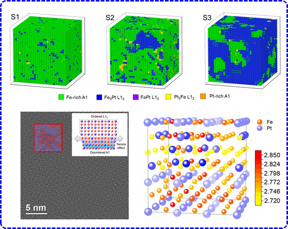 |
| The three-dimensional distribution of the Fe3Pt alloys prepared in this study with different degrees of chemical ordering is plotted in the figure (top). The size of ordered/disordered nanodomains and the lattice strain observed by high-resolution transmission electron microscopy is shown schematically in the lower left, and the magnetic moment modulation around the ordered/disordered interfaces is shown in the lower right. CREDIT ©Science China Press |
Abstract:
In solid-state matters, chemical ordering is often closely associated with their fantastic physical properties and specific chemical reaction mechanisms. Through the redistribution of atoms and chemical bonds, the modulation of chemical ordering can lead to effective lattice tuning and provide intrinsic lattice stress. However, the direct probing of the three-dimensional structure of chemically ordered/disordered interfaces remains a great challenge. Recently, the National Science Review published online the research results of Prof. Xianran Xing's group at the Institute of Solid State Chemistry, University of Science and Technology Beijing, which reveals the atomic distribution and lattice matching relationship of nano-scale ordered/disordered domains in Fe3Pt alloys with the help of the Pair Distribution Function (PDF) method. Through the lattice adjustment around the interfaces of nanodomains, the effective regulation of the magnetic properties and negative thermal expansion of lattice was obtained.
Nanoscale chemically ordered-disordered domains in Fe3Pt alloys and their three-dimensional interface and lattice strain
Beijing, China | Posted on May 27th, 2022The present experimental and theoretical results from the research team provide convincing structural insights into the identification of the local structure of nanodomains in solids and the lattice matching around the interfaces, providing a structural basis for understanding chemical ordering at the atomic scale and developing new lattice design strategies.
####
For more information, please click here
Contacts:
Media Contact
Bei Yan
Science China Press
Office: 86-10-64015905
Expert Contacts
Qiang Li
Beijing Advanced Innovation Center for Materials Genome Engineering, Institute of Solid State Chemistry, University of Science and Technology Beijing
Xianran Xing
Beijing Advanced Innovation Center for Materials Genome Engineering, Institute of Solid State Chemistry, University of Science and Technology Beijing
Copyright © Science China Press
If you have a comment, please Contact us.Issuers of news releases, not 7th Wave, Inc. or Nanotechnology Now, are solely responsible for the accuracy of the content.
Bookmark:


| Related Links |
| Related News Press |
News and information
 Quantum computer improves AI predictions April 17th, 2026
Flexible sensor gains sensitivity under pressure April 17th, 2026
A reusable chip for particulate matter sensing April 17th, 2026
Detecting vibrational quantum beating in the predissociation dynamics of SF6 using time-resolved photoelectron spectroscopy April 17th, 2026
Chemistry
Projecting light to dispense liquids: A new route to ultra-precise microdroplets January 30th, 2026
From sensors to smart systems: the rise of AI-driven photonic noses January 30th, 2026
"Nanoreactor" cage uses visible light for catalytic and ultra-selective cross-cycloadditions October 3rd, 2025
Cambridge chemists discover simple way to build bigger molecules – one carbon at a time June 6th, 2025
Possible Futures
A fundamentally new therapeutic approach to cystic fibrosis: Nanobody repairs cellular defect April 17th, 2026
UC Irvine physicists discover method to reverse ‘quantum scrambling’ : The work addresses the problem of information loss in quantum computing system April 17th, 2026
Discoveries
Quantum computer improves AI predictions April 17th, 2026
Flexible sensor gains sensitivity under pressure April 17th, 2026
A reusable chip for particulate matter sensing April 17th, 2026
Detecting vibrational quantum beating in the predissociation dynamics of SF6 using time-resolved photoelectron spectroscopy April 17th, 2026
Announcements
A fundamentally new therapeutic approach to cystic fibrosis: Nanobody repairs cellular defect April 17th, 2026
UC Irvine physicists discover method to reverse ‘quantum scrambling’ : The work addresses the problem of information loss in quantum computing system April 17th, 2026
Interviews/Book Reviews/Essays/Reports/Podcasts/Journals/White papers/Posters
A fundamentally new therapeutic approach to cystic fibrosis: Nanobody repairs cellular defect April 17th, 2026
UC Irvine physicists discover method to reverse ‘quantum scrambling’ : The work addresses the problem of information loss in quantum computing system April 17th, 2026
 |
||
 |
||
| The latest news from around the world, FREE | ||
 |
||
|
|
||
| Premium Products | ||
 |
||
|
Only the news you want to read!
Learn More |
||
 |
||
|
Full-service, expert consulting
Learn More |
||
|
|
||