Home > Press > New nanomechanical oscillators with record-low loss
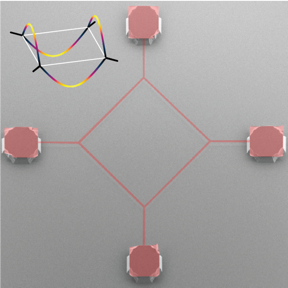 |
| Scanning electron micrograph of a polygon resonator. The inset shows the shape of the perimeter mode. CREDIT Mohammad J. Bereyhi (EPFL) |
Abstract:
The vibrational modes of nanomechanical resonators are analogous to different notes of a guitar string and have similar properties such as frequency (pitch) and lifetime. The lifetime is characterized by the quality factor, which is the number of times that the resonator oscillates until its energy is reduced by 70%. The quality factor is crucial for the modern applications of mechanical resonators as it determines the level of thermal noise, which is a limit for sensing weak forces and observation of quantum effects.
New nanomechanical oscillators with record-low loss
Lausanne, Switzerland | Posted on May 13th, 2022Now, scientists at EPFL led by Professor Tobias J. Kippenberg show that a regular polygon suspended at its vertices supports vibrational modes along the perimeter with extremely high quality factors. This is a consequence of the geometrical symmetry of regular polygons, combined with the elastic properties of structures under tension. This approach to loss-engineering has an important advantage over previous techniques: realizing high quality factors in devices with much smaller footprints.
“The new perimeter modes not only beat the record for the highest quality factor, but are almost 20 times more compact than devices with similar performance,” says Nils Engelsen, the study’s senior author. “The compactness comes with real practical benefits. In our laboratory, we try to measure and control mechanical vibrations at the quantum level using light, which requires suspension of mechanical resonators less than one micrometer from a structure which guides light. This feat is much simpler with compact devices.”
The uncomplicated design of the polygon resonators allows the authors to take one step further and make a chain of connected polygon resonators. This chain of coupled oscillators can behave strikingly different from a single resonator. The authors study the particular dynamics of this chain which arises from the way the resonators are connected.
Precision force sensing is an important application of nanomechanical resonators. By measuring the position fluctuations of a polygon resonator using an optical interferometer, the authors demonstrate that these resonators can measure force fluctuations as low as 1 attonewton. This level of sensitivity approaches that of state-of-the-art atomic force microscopes.
“We hope that the demonstrated force sensitivity of the polygons combined with their compactness and simplicity will inspire their use in actual force microscopes”, says Mohammad Bereyhi, who led the study. “So far, improvements in mechanical quality factors have come at the cost of increased size and increased design complexity, making state-of-the-art devices very difficult to fabricate. With perimeter modes it’s a different story. I believe that the simplicity of this new design greatly expands its potential to find new and promising applications.”
####
For more information, please click here
Contacts:
Nik Papageorgiou
Ecole Polytechnique Fédérale de Lausanne
Office: 41-216-932-105
Expert Contact
Tobias J. Kippenberg
EPFL
Office: +41 21 693 44 28
Copyright © Ecole Polytechnique Fédérale de Lausanne
If you have a comment, please Contact us.Issuers of news releases, not 7th Wave, Inc. or Nanotechnology Now, are solely responsible for the accuracy of the content.
Bookmark:


| Related Links |
| Related News Press |
News and information
 Quantum computer improves AI predictions April 17th, 2026
Flexible sensor gains sensitivity under pressure April 17th, 2026
A reusable chip for particulate matter sensing April 17th, 2026
Detecting vibrational quantum beating in the predissociation dynamics of SF6 using time-resolved photoelectron spectroscopy April 17th, 2026
Quantum Physics
Detecting vibrational quantum beating in the predissociation dynamics of SF6 using time-resolved photoelectron spectroscopy April 17th, 2026
Possible Futures
A fundamentally new therapeutic approach to cystic fibrosis: Nanobody repairs cellular defect April 17th, 2026
UC Irvine physicists discover method to reverse ‘quantum scrambling’ : The work addresses the problem of information loss in quantum computing system April 17th, 2026
Sensors
Flexible sensor gains sensitivity under pressure April 17th, 2026
Tiny nanosheets, big leap: A new sensor detects ethanol at ultra-low levels January 30th, 2026
From sensors to smart systems: the rise of AI-driven photonic noses January 30th, 2026
Sensors innovations for smart lithium-based batteries: advancements, opportunities, and potential challenges August 8th, 2025
Discoveries
Quantum computer improves AI predictions April 17th, 2026
Flexible sensor gains sensitivity under pressure April 17th, 2026
A reusable chip for particulate matter sensing April 17th, 2026
Detecting vibrational quantum beating in the predissociation dynamics of SF6 using time-resolved photoelectron spectroscopy April 17th, 2026
Announcements
A fundamentally new therapeutic approach to cystic fibrosis: Nanobody repairs cellular defect April 17th, 2026
UC Irvine physicists discover method to reverse ‘quantum scrambling’ : The work addresses the problem of information loss in quantum computing system April 17th, 2026
Interviews/Book Reviews/Essays/Reports/Podcasts/Journals/White papers/Posters
A fundamentally new therapeutic approach to cystic fibrosis: Nanobody repairs cellular defect April 17th, 2026
UC Irvine physicists discover method to reverse ‘quantum scrambling’ : The work addresses the problem of information loss in quantum computing system April 17th, 2026
 |
||
 |
||
| The latest news from around the world, FREE | ||
 |
||
|
|
||
| Premium Products | ||
 |
||
|
Only the news you want to read!
Learn More |
||
 |
||
|
Full-service, expert consulting
Learn More |
||
|
|
||