Home > Press > The future of desalination? A fast, efficient, selective membrane for purifying saltwater
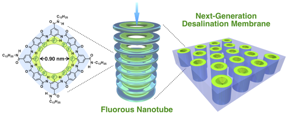 |
| Reducing the energy and thus financial cost, as well as improving the simplicity of water desalination, could help communities around the world with poor access to safe drinking water. CREDIT © 2022 Itoh et al. |
Abstract:
Water scarcity is a growing problem around the world. Desalination of seawater is an established method to produce drinkable water but comes with huge energy costs. For the first time, researchers use fluorine-based nanostructures to successfully filter salt from water. Compared to current desalination methods, these fluorous nanochannels work faster, require less pressure and less energy, and are a more effective filter.
The future of desalination? A fast, efficient, selective membrane for purifying saltwater
Tokyo, Japan | Posted on May 13th, 2022If you’ve ever cooked with a nonstick Teflon-coated frying pan, then you’ve probably seen the way that wet ingredients slide around it easily. This happens because the key component of Teflon is fluorine, a lightweight element that is naturally water repelling, or hydrophobic. Teflon can also be used to line pipes to improve the flow of water. Such behavior caught the attention of Associate Professor Yoshimitsu Itoh from the Department of Chemistry and Biotechnology at the University of Tokyo and his team. It inspired them to explore how pipes or channels made from fluorine might operate on a very different scale, the nanoscale.
“We were curious to see how effective a fluorous nanochannel might be at selectively filtering different compounds, in particular, water and salt. And, after running some complex computer simulations, we decided it was worth the time and effort to create a working sample,” said Itoh. “There are two main ways to desalinate water currently: thermally, using heat to evaporate seawater so it condenses as pure water, or by reverse osmosis, which uses pressure to force water through a membrane that blocks salt. Both methods require a lot of energy, but our tests suggest fluorous nanochannels require little energy, and have other benefits too.”
The team created test filtration membranes by chemically synthesizing nanoscopic fluorine rings, which were stacked and embedded in an otherwise impermeable lipid layer, similar to the organic molecules that make up cell walls. They created several test samples with nanorings between about 1 and 2 nanometers. For reference, a human hair is almost 100,000 nanometers wide. To test the effectiveness of their membranes, Itoh and the team measured the presence of chlorine ions, one of the major components of salt — the other being sodium — on either side of the test membrane.
“It was very exciting to see the results firsthand. The smaller of our test channels perfectly rejected incoming salt molecules, and the larger channels too were still an improvement over other desalination techniques and even cutting-edge carbon nanotube filters,” said Itoh. “The real surprise to me was how fast the process occurred. Our sample worked around several thousand times faster than typical industrial devices, and around 2,400 times faster than experimental carbon nanotube-based desalination devices.”
As fluorine is electrically negative, it repels negative ions such as the chlorine found in salt. But an added bonus of this negativity is that it also breaks down what are known as water clusters, essentially loosely bound groups of water molecules, so that they pass through the channels quicker. The team’s fluorine-based water desalination membranes are more effective, faster, require less energy to operate and are made to be very simple to use as well, so what’s the catch?
“At present, the way we synthesize our materials is relatively energy-intensive itself; however, this is something we hope to improve upon in upcoming research. And, given the longevity of the membranes and their low operational costs, the overall energy costs will be much lower than with current methods,” said Itoh. “Other steps we wish to take are of course scaling this up. Our test samples were single nanochannels, but with the help of other specialists, we hope to create a membrane around 1 meter across in several years. In parallel with these manufacturing concerns, we’re also exploring whether similar membranes could be used to reduce carbon dioxide or other undesirable waste products released by industry.”
Funding: This work was financially supported by a JSPS Grant-in-Aid for Scientific Research (S) 7 (18H05260) on “Innovative Functional Materials based on Multi-Scale Interfacial Molecular 8 Science” for T.A. Y.I. is grateful for a JSPS Grant-in-Aid for Scientific Research (B) (21H01903) 9 and JST, PRESTO Grant Number JPMJPR21Q1.
####
About University of Tokyo
The University of Tokyo is Japan's leading university and one of the world's top research universities. The vast research output of some 6,000 researchers is published in the world's top journals across the arts and sciences. Our vibrant student body of around 15,000 undergraduate and 15,000 graduate students includes over 4,000 international students. Find out more at www.u-tokyo.ac.jp/en/ or follow us on Twitter at @UTokyo_News_en.
For more information, please click here
Contacts:
Joseph Krisher
University of Tokyo
Office: 81-358-411-045
Expert Contact
Associate Professor Yoshimitsu Itoh
The University of Tokyo
Press contact:
Mr Rohan Mehra
Public Relations Group, The University of Tokyo
7-3-1 Hongo, Bunkyo-ku, Tokyo 113-8656, Japan
email:
Copyright © University of Tokyo
If you have a comment, please Contact us.Issuers of news releases, not 7th Wave, Inc. or Nanotechnology Now, are solely responsible for the accuracy of the content.
Bookmark:


| Related Links |
| Related News Press |
News and information
 Quantum computer improves AI predictions April 17th, 2026
Flexible sensor gains sensitivity under pressure April 17th, 2026
A reusable chip for particulate matter sensing April 17th, 2026
Detecting vibrational quantum beating in the predissociation dynamics of SF6 using time-resolved photoelectron spectroscopy April 17th, 2026
Govt.-Legislation/Regulation/Funding/Policy
Quantum computer improves AI predictions April 17th, 2026
Metasurfaces smooth light to boost magnetic sensing precision January 30th, 2026
New imaging approach transforms study of bacterial biofilms August 8th, 2025
Possible Futures
A fundamentally new therapeutic approach to cystic fibrosis: Nanobody repairs cellular defect April 17th, 2026
UC Irvine physicists discover method to reverse ‘quantum scrambling’ : The work addresses the problem of information loss in quantum computing system April 17th, 2026
Discoveries
Quantum computer improves AI predictions April 17th, 2026
Flexible sensor gains sensitivity under pressure April 17th, 2026
A reusable chip for particulate matter sensing April 17th, 2026
Detecting vibrational quantum beating in the predissociation dynamics of SF6 using time-resolved photoelectron spectroscopy April 17th, 2026
Announcements
A fundamentally new therapeutic approach to cystic fibrosis: Nanobody repairs cellular defect April 17th, 2026
UC Irvine physicists discover method to reverse ‘quantum scrambling’ : The work addresses the problem of information loss in quantum computing system April 17th, 2026
Interviews/Book Reviews/Essays/Reports/Podcasts/Journals/White papers/Posters
A fundamentally new therapeutic approach to cystic fibrosis: Nanobody repairs cellular defect April 17th, 2026
UC Irvine physicists discover method to reverse ‘quantum scrambling’ : The work addresses the problem of information loss in quantum computing system April 17th, 2026
Water
Taking salt out of the water equation October 7th, 2022
Grants/Sponsored Research/Awards/Scholarships/Gifts/Contests/Honors/Records
Quantum computer improves AI predictions April 17th, 2026
Detecting vibrational quantum beating in the predissociation dynamics of SF6 using time-resolved photoelectron spectroscopy April 17th, 2026
Metasurfaces smooth light to boost magnetic sensing precision January 30th, 2026
 |
||
 |
||
| The latest news from around the world, FREE | ||
 |
||
|
|
||
| Premium Products | ||
 |
||
|
Only the news you want to read!
Learn More |
||
 |
||
|
Full-service, expert consulting
Learn More |
||
|
|
||