Home > Press > Three dimensional Mn-doped NixSy/Ni2P and Mn-doped Ni2O3/Ni2P nanosheets as efficient electrocatalysts for alkaline overall water splitting
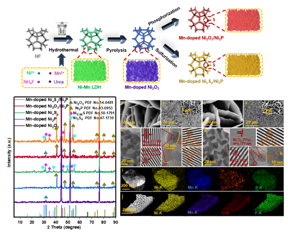 |
| Mn-doped Ni2O3/Ni2P and Mn-doped NixSy/Ni2P are successfully fabricated through hydrothermal reaction and subsequently phosphorization and sulfurization. The characterization results also show that the existence of heterostructures and the corresponding composition of as-fabricated electrocatalysts. CREDIT ©Science China Press |
Abstract:
Hydrogen has attracted extensive attention from academia and industry as an energy source due to its intrinsic environmental compatibility, abundance, and high energy density (120 MJ kg−1). Electrocatalytic water splitting is an environmentally friendly route to produce hydrogen, especially when the electricity is from renewable sources that minimize carbon dioxide emissions throughout the process. The oxygen evolution reaction (OER) on the anode and hydrogen evolution reaction (HER) on the cathode are two half-reactions in electrocatalytic water splitting. Pt- and Ru/Ir-based compounds are the best-known high-performance noble metal electrocatalysts for HER and OER, respectively. However, the scarcity and high cost of such noble metals hamper their application in water electrolysis. Therefore, with global prospects, it is essential to develop earth-abundant non-noble metal electrocatalysts for next-generation water splitting technologies. Recently, Ni-based electrocatalysts have been confirmed to be effective for boosting electrocatalytic overall water splitting, but their performances are not high enough for large-scale hydrogen production.
Three dimensional Mn-doped NixSy/Ni2P and Mn-doped Ni2O3/Ni2P nanosheets as efficient electrocatalysts for alkaline overall water splitting
Guangzhou, China | Posted on April 8th, 2022Shi’s team successfully fabricated Mn-doped Ni2O3/Ni2P and Mn-doped NixSy/Ni2P through facile hydrothermal reaction and subsequently phosphorization and sulfurization method.
The X-ray diffraction (XRD) peaks of Mn-doped NixSy/Ni2P and Mn-doped Ni2O3/Ni2P indicate that Mn-doped NixSy/Ni2P is composed of NixSy and Ni2P, while Mn-doped Ni2O3/Ni2P consists of Ni2O3 and Ni2P. Besides, the scanning electron microscopy (SEM) and transmission electron microscopy (TEM) images both show the nanosheets microstructure of Mn-doped Ni2O3/Ni2P and Mn-doped NixSy/Ni2P. Nevertheless, the heterostructures of Ni2O3/Ni2P and NixSy/Ni2P are confirmed by the high-resolution TEM images.
Benefiting from the electronic modulation and abundant active sites, Mn-doped Ni2O3/Ni2P exhibited superior HER activity with a current density of −10 mA cm−2 at a low overpotential of 104 mV. Meanwhile, Mn-doped NixSy/Ni2P achieved a current density of 100 mA cm−2 at a low overpotential of 290 mV for OER and showed a nearly constant potential at 50 mA cm−2 for 160 h. Interestingly, the electrolytic cell constructed by these two electrocatalysts required a cell voltage of only 1.65 V to afford 10 mA cm−2 with superior stability at 50 mA cm−2 for 120 h.
In conclusion, by combining three strategies, Mn doping, heterostructure engineering, and applying 3D-nanosheet arrays, Mn-doped Ni2O3/Ni2P and Mn-doped NixSy/Ni2P are successfully fabricated by a facile hydrothermal reaction followed by phosphorization, and in the case of Mn-doped NixSy/Ni2P, sulfurization. High intrinsic activities are enabled by electronic modulation of the heterostructures and Mn doping, while abundant active sites are guaranteed by enlarged active surface areas from the 3D-nanosheet arrays. The combination cumulatively enhances the electrocatalytic activities toward HER, OER, and overall water splitting.
####
For more information, please click here
Contacts:
Bei Yan
Science China Press
Office: 86-10-64015905
Expert Contact
Zhicong Shi
Institute of Batteries, School of Materials and Energy, Guangdong University of Technology, Guangzhou, China.
Copyright © Science China Press
If you have a comment, please Contact us.Issuers of news releases, not 7th Wave, Inc. or Nanotechnology Now, are solely responsible for the accuracy of the content.
Bookmark:


| Related Links |
| Related News Press |
News and information
 Quantum computer improves AI predictions April 17th, 2026
Flexible sensor gains sensitivity under pressure April 17th, 2026
A reusable chip for particulate matter sensing April 17th, 2026
Detecting vibrational quantum beating in the predissociation dynamics of SF6 using time-resolved photoelectron spectroscopy April 17th, 2026
Possible Futures
A fundamentally new therapeutic approach to cystic fibrosis: Nanobody repairs cellular defect April 17th, 2026
UC Irvine physicists discover method to reverse ‘quantum scrambling’ : The work addresses the problem of information loss in quantum computing system April 17th, 2026
Discoveries
Quantum computer improves AI predictions April 17th, 2026
Flexible sensor gains sensitivity under pressure April 17th, 2026
A reusable chip for particulate matter sensing April 17th, 2026
Detecting vibrational quantum beating in the predissociation dynamics of SF6 using time-resolved photoelectron spectroscopy April 17th, 2026
Announcements
A fundamentally new therapeutic approach to cystic fibrosis: Nanobody repairs cellular defect April 17th, 2026
UC Irvine physicists discover method to reverse ‘quantum scrambling’ : The work addresses the problem of information loss in quantum computing system April 17th, 2026
Interviews/Book Reviews/Essays/Reports/Podcasts/Journals/White papers/Posters
A fundamentally new therapeutic approach to cystic fibrosis: Nanobody repairs cellular defect April 17th, 2026
UC Irvine physicists discover method to reverse ‘quantum scrambling’ : The work addresses the problem of information loss in quantum computing system April 17th, 2026
Energy
Sensors innovations for smart lithium-based batteries: advancements, opportunities, and potential challenges August 8th, 2025
Simple algorithm paired with standard imaging tool could predict failure in lithium metal batteries August 8th, 2025
Water
Taking salt out of the water equation October 7th, 2022
 |
||
 |
||
| The latest news from around the world, FREE | ||
 |
||
|
|
||
| Premium Products | ||
 |
||
|
Only the news you want to read!
Learn More |
||
 |
||
|
Full-service, expert consulting
Learn More |
||
|
|
||