Home > Press > Nano therapy for micro-preemies protects lungs, brain in lab study
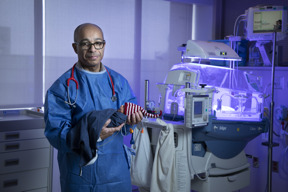 |
| Dr. Bernard Thébaud holds a very premature baby in the Neonatal Intensive Care Unit at The Ottawa Hospital. CREDIT The Ottawa Hospital |
Abstract:
Very premature babies need extra oxygen and mechanical intervention to breathe, but this damages their lungs, causing a chronic lung disease called bronchopulmonary dysplasia (BPD). These babies have smaller and weaker lungs that can’t send as much oxygen to their growing brains. The lack of oxygen during brain development can lead to learning disabilities, or problems walking, hearing and seeing.
Nano therapy for micro-preemies protects lungs, brain in lab study
Ottawa, Canada | Posted on April 1st, 2022There is no cure for BPD, but Dr. Bernard Thébaud and his team are hoping to change that. The team previously found that cells from the umbilical cord, called mesenchymal stromal cells or MSCs, could prevent BPD in newborn rats.
Now, a study in mice led by former team members Drs. Marissa Lithopoulos and Lannae Strueby and published in the American Journal of Respiratory and Critical Care Medicine shows that tiny particles released by these MSCs called extra-cellular vesicles are just as good at preventing BPD. Known as MSC-EVs or nanotherapies, these nano-sized particles have similar effects to MSCs but are easier to manufacture, store, and dose. Unlike MSCs, they can cross the blood-brain barrier, meaning they can travel into the brain after being injected into the blood stream. The researchers saw evidence that some MSC-EVs did reach the brain in this study, though most travelled to the lungs.
Not only did MSC-EVs prevent lung injury in this study, they also prevented brain injury. This was the first study to show that BPD impairs some of the key functions of brain stem cells. Brain stem cells can become all the different cells in the brain, and play an important role in brain development.
This study comes as Dr. Thébaud and his research team prepare to launch a phase I clinical trial to test the feasibility and safety of using MSCs to treat premature babies with BPD. They hope to evaluate MSC-EVs in future clinical trials.
“A therapy that improves lung and brain health would immensely benefit preterm babies with this chronic lung disease.” -Dr. Bernard Thébaud, neonatologist and senior scientist at The Ottawa Hospital and CHEO and professor at the University of Ottawa.
####
For more information, please click here
Contacts:
Amelia Buchanan
The Ottawa Hospital
Cell: 613-297-8315
Copyright © The Ottawa Hospital
If you have a comment, please Contact us.Issuers of news releases, not 7th Wave, Inc. or Nanotechnology Now, are solely responsible for the accuracy of the content.
Bookmark:


| Related Links |
| Related News Press |
News and information
 Quantum computer improves AI predictions April 17th, 2026
Flexible sensor gains sensitivity under pressure April 17th, 2026
A reusable chip for particulate matter sensing April 17th, 2026
Detecting vibrational quantum beating in the predissociation dynamics of SF6 using time-resolved photoelectron spectroscopy April 17th, 2026
Possible Futures
A fundamentally new therapeutic approach to cystic fibrosis: Nanobody repairs cellular defect April 17th, 2026
UC Irvine physicists discover method to reverse ‘quantum scrambling’ : The work addresses the problem of information loss in quantum computing system April 17th, 2026
Nanomedicine
A fundamentally new therapeutic approach to cystic fibrosis: Nanobody repairs cellular defect April 17th, 2026
New molecular technology targets tumors and simultaneously silences two ‘undruggable’ cancer genes August 8th, 2025
New imaging approach transforms study of bacterial biofilms August 8th, 2025
Electrifying results shed light on graphene foam as a potential material for lab grown cartilage June 6th, 2025
Discoveries
Quantum computer improves AI predictions April 17th, 2026
Flexible sensor gains sensitivity under pressure April 17th, 2026
A reusable chip for particulate matter sensing April 17th, 2026
Detecting vibrational quantum beating in the predissociation dynamics of SF6 using time-resolved photoelectron spectroscopy April 17th, 2026
Announcements
A fundamentally new therapeutic approach to cystic fibrosis: Nanobody repairs cellular defect April 17th, 2026
UC Irvine physicists discover method to reverse ‘quantum scrambling’ : The work addresses the problem of information loss in quantum computing system April 17th, 2026
Interviews/Book Reviews/Essays/Reports/Podcasts/Journals/White papers/Posters
A fundamentally new therapeutic approach to cystic fibrosis: Nanobody repairs cellular defect April 17th, 2026
UC Irvine physicists discover method to reverse ‘quantum scrambling’ : The work addresses the problem of information loss in quantum computing system April 17th, 2026
Nanobiotechnology
A fundamentally new therapeutic approach to cystic fibrosis: Nanobody repairs cellular defect April 17th, 2026
New molecular technology targets tumors and simultaneously silences two ‘undruggable’ cancer genes August 8th, 2025
New imaging approach transforms study of bacterial biofilms August 8th, 2025
Electrifying results shed light on graphene foam as a potential material for lab grown cartilage June 6th, 2025
 |
||
 |
||
| The latest news from around the world, FREE | ||
 |
||
|
|
||
| Premium Products | ||
 |
||
|
Only the news you want to read!
Learn More |
||
 |
||
|
Full-service, expert consulting
Learn More |
||
|
|
||