Home > Press > Self-standing mesoporous Si film can power lithium-ion batteries Peer-Reviewed Publication
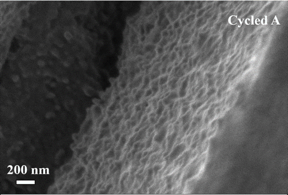 |
| SEM image of the cross-section of the optimal Si film electrode after cycling. CREDIT The Authors. |
Abstract:
Battery researchers at the University of Eastern Finland have developed a self-standing mesoporous silicon (Si) film anode for lithium-ion batteries. This film electrode does not need carbon additives and binders to connect particles like typical slurry-based electrodes, but it still exhibits excellent battery performance. The success of this electrode design provides an efficient strategy for achieving high energy density lithium-ion batteries.
Self-standing mesoporous Si film can power lithium-ion batteries Peer-Reviewed Publication
Kuopio, Finland | Posted on April 1st, 2022The development of high performance lithium-ion batteries has been highly desirable due to their wide applications in portable electronics and in electric and hybrid vehicles. Silicon is the most promising anode material for next-generation lithium-ion batteries due to its high theoretical specific capacity and safe electrochemical potential. However, Si anode suffers from large volume expansion and contraction during cycling that causes electrical contact loss between silicon and other battery components, eventually leading to battery failure.
Battery researchers from all over the world have been dedicating their efforts to improving Si electrode performance, including researchers at the University of Eastern Finland. Using the electrochemical etching method, they developed a self-standing mesoporous Si film anode for lithium-ion batteries. The idea is that the pores of mesoporous silicon can accommodate the volume expansion during cycling, thus leading to stable battery cycling. They systematically investigated the effects of pore characteristics on electrode performance using correlation analysis and uncovered their relationship.
Detailed pore analysis and electrochemical characterization of the Si films were performed to study their correlation. Correlation analysis showed that both reversible specific capacity and initial Coulombic efficiency (ICE) have a strong negative correlation with the porosity and surface area, while the cycling performance is dictated by the film thickness over the pore characteristics. The only positive correlation was found between the long-term cycling stability and the pore diameter. The best Si film anode delivers an ICE of 81.2% and stable cycling for over 450 cycles with a limited specific capacity of 1200 mAh g−1 in half cells.
The study indicates the direction of the porous silicon material for high-performance lithium-ion bateries. More importantly, it provides the researchers in the battery material research, especially Si anode, with a better understanding of the factors involved in evaluating the electrode performance and developing more cost-effective evaluation strategies for battery research.
The research was funded by the Academy of Finland (project number 325495).
####
For more information, please click here
Contacts:
Maj Vuorre
University of Eastern Finland
Office: 358-504-303-880
Expert Contact
Vesa-Pekka Lehto
University of Eastern Finland
Cell: +358403552470
Copyright © University of Eastern Finland
If you have a comment, please Contact us.Issuers of news releases, not 7th Wave, Inc. or Nanotechnology Now, are solely responsible for the accuracy of the content.
Bookmark:


| Related Links |
| Related News Press |
News and information
 Quantum computer improves AI predictions April 17th, 2026
Flexible sensor gains sensitivity under pressure April 17th, 2026
A reusable chip for particulate matter sensing April 17th, 2026
Detecting vibrational quantum beating in the predissociation dynamics of SF6 using time-resolved photoelectron spectroscopy April 17th, 2026
Possible Futures
A fundamentally new therapeutic approach to cystic fibrosis: Nanobody repairs cellular defect April 17th, 2026
UC Irvine physicists discover method to reverse ‘quantum scrambling’ : The work addresses the problem of information loss in quantum computing system April 17th, 2026
Discoveries
Quantum computer improves AI predictions April 17th, 2026
Flexible sensor gains sensitivity under pressure April 17th, 2026
A reusable chip for particulate matter sensing April 17th, 2026
Detecting vibrational quantum beating in the predissociation dynamics of SF6 using time-resolved photoelectron spectroscopy April 17th, 2026
Announcements
A fundamentally new therapeutic approach to cystic fibrosis: Nanobody repairs cellular defect April 17th, 2026
UC Irvine physicists discover method to reverse ‘quantum scrambling’ : The work addresses the problem of information loss in quantum computing system April 17th, 2026
Interviews/Book Reviews/Essays/Reports/Podcasts/Journals/White papers/Posters
A fundamentally new therapeutic approach to cystic fibrosis: Nanobody repairs cellular defect April 17th, 2026
UC Irvine physicists discover method to reverse ‘quantum scrambling’ : The work addresses the problem of information loss in quantum computing system April 17th, 2026
Battery Technology/Capacitors/Generators/Piezoelectrics/Thermoelectrics/Energy storage
Decoding hydrogen‑bond network of electrolyte for cryogenic durable aqueous zinc‑ion batteries January 30th, 2026
COF scaffold membrane with gate‑lane nanostructure for efficient Li+/Mg2+ separation January 30th, 2026
MXene nanomaterials enter a new dimension Multilayer nanomaterial: MXene flakes created at Drexel University show new promise as 1D scrolls January 30th, 2026
Grants/Sponsored Research/Awards/Scholarships/Gifts/Contests/Honors/Records
Quantum computer improves AI predictions April 17th, 2026
Detecting vibrational quantum beating in the predissociation dynamics of SF6 using time-resolved photoelectron spectroscopy April 17th, 2026
Metasurfaces smooth light to boost magnetic sensing precision January 30th, 2026
 |
||
 |
||
| The latest news from around the world, FREE | ||
 |
||
|
|
||
| Premium Products | ||
 |
||
|
Only the news you want to read!
Learn More |
||
 |
||
|
Full-service, expert consulting
Learn More |
||
|
|
||