Home > Press > Graphene crystals grow better under copper cover
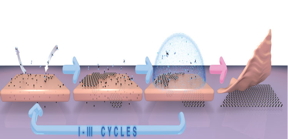 |
| A schematic illustration of the single-crystal graphene sheets grown on an insulating substrate. The method could enhance next-generation nanomaterial-based devices. © Springer Nature; Reproduced with permission from Junzhu Li et al (2022). |
Abstract:
An approach that produces single-crystal graphene sheets on large-scale electrically insulating supports could help with the development of next-generation nanomaterial-based devices, such as very light and thin touchscreens, wearable electronics and solar cells.
Graphene crystals grow better under copper cover
Thuwal, Saudi Arabia | Posted on April 1st, 2022Most graphene-based electronic devices require insulating supports. Yet, high-quality graphene films destined for industrial use typically are grown on a metal substrate, such as copper foil, before being transferred to an insulating support for device fabrication. This transfer step can introduce impurities that affect how well the device performs. Efforts to grow graphene on insulating supports have not been able to produce the required high-quality single crystals.
“If graphene can be grown on an insulating substrate with a clean interface, certain devices might function better,” says Ph.D. student Bo Tian, who co-led the study under Xixiang Zhang’s supervision. “This also opens the door to new types of graphene-based nanodevices,” he explains.
Zhang, Tian and coworkers from Asia and Europe tweaked the chemical vapor deposition method, which relies on the copper-catalyzed decomposition of methane into carbon precursors, to generate smooth single-crystal graphene monolayers on wafer-scale single-crystal substrates called c-plane sapphire.
The researchers converted polycrystalline copper foil into its single-crystal counterpart Cu(111) on the sapphire surface and introduced active carbon atoms from the metal substrate-catalyzed decomposition of methane on the resulting film. The carbon atoms diffused through the metallic film toward the copper–sapphire interface, which acted as a template, and formed well-oriented graphene islands that, after several growth cycles, merged to yield a sheet.
In addition to weak surface interactions, the copper film and sapphire displayed similar crystal lattice symmetry to that of graphene, Tian says, which explains the high crystallinity of the graphene monolayer.
The researchers etched away any graphene that had accumulated on top of the copper film using a hydrogen–argon plasma to facilitate carbon diffusion. They immersed the samples in liquid nitrogen before heating them rapidly to 500 degrees Celsius, making the copper film easy to peel off while keeping the graphene monolayer intact.
Field-effect transistors manufactured on the sapphire-grown single-crystal graphene monolayer exhibited excellent performance with higher carrier mobilities. The superior electronic performance of the graphene grown on sapphire results from its higher crystallinity and fewer folds on the surface, Tian explains.
“Our team is now trying to grow other two-dimensional materials on the insulator-supported graphene to build functionalized large-scale heterostructures,” Tian says. These heterostructures held together by van der Waals interactions are expected to be useful in future nanodevices.
####
For more information, please click here
Contacts:
Michael Cusack
King Abdullah University of Science & Technology (KAUST)
Office: 009660128083040
Expert Contact
Xixiang Zhang
King Abdullah University of Science and Technology (KAUST)
Copyright © King Abdullah University of Science & Technology (KAUST)
If you have a comment, please Contact us.Issuers of news releases, not 7th Wave, Inc. or Nanotechnology Now, are solely responsible for the accuracy of the content.
Bookmark:


| Related Links |
| Related News Press |
News and information
 Quantum computer improves AI predictions April 17th, 2026
Flexible sensor gains sensitivity under pressure April 17th, 2026
A reusable chip for particulate matter sensing April 17th, 2026
Detecting vibrational quantum beating in the predissociation dynamics of SF6 using time-resolved photoelectron spectroscopy April 17th, 2026
2 Dimensional Materials
Flexible sensor gains sensitivity under pressure April 17th, 2026
ICFO researchers overcome long-standing bottleneck in single photon detection with twisted 2D materials August 8th, 2025
First real-time observation of two-dimensional melting process: Researchers at Mainz University unveil new insights into magnetic vortex structures August 8th, 2025
Lab to industry: InSe wafer-scale breakthrough for future electronics August 8th, 2025
Display technology/LEDs/SS Lighting/OLEDs
Spinel-type sulfide semiconductors to operate the next-generation LEDs and solar cells For solar-cell absorbers and green-LED source October 3rd, 2025
Graphene/ Graphite
Electrifying results shed light on graphene foam as a potential material for lab grown cartilage June 6th, 2025
Wearable electronics
Breakthrough brings body-heat powered wearable devices closer to reality December 13th, 2024
Possible Futures
A fundamentally new therapeutic approach to cystic fibrosis: Nanobody repairs cellular defect April 17th, 2026
UC Irvine physicists discover method to reverse ‘quantum scrambling’ : The work addresses the problem of information loss in quantum computing system April 17th, 2026
Discoveries
Quantum computer improves AI predictions April 17th, 2026
Flexible sensor gains sensitivity under pressure April 17th, 2026
A reusable chip for particulate matter sensing April 17th, 2026
Detecting vibrational quantum beating in the predissociation dynamics of SF6 using time-resolved photoelectron spectroscopy April 17th, 2026
Announcements
A fundamentally new therapeutic approach to cystic fibrosis: Nanobody repairs cellular defect April 17th, 2026
UC Irvine physicists discover method to reverse ‘quantum scrambling’ : The work addresses the problem of information loss in quantum computing system April 17th, 2026
Interviews/Book Reviews/Essays/Reports/Podcasts/Journals/White papers/Posters
A fundamentally new therapeutic approach to cystic fibrosis: Nanobody repairs cellular defect April 17th, 2026
UC Irvine physicists discover method to reverse ‘quantum scrambling’ : The work addresses the problem of information loss in quantum computing system April 17th, 2026
Solar/Photovoltaic
Spinel-type sulfide semiconductors to operate the next-generation LEDs and solar cells For solar-cell absorbers and green-LED source October 3rd, 2025
KAIST researchers introduce new and improved, next-generation perovskite solar cell November 8th, 2024
Groundbreaking precision in single-molecule optoelectronics August 16th, 2024
Development of zinc oxide nanopagoda array photoelectrode: photoelectrochemical water-splitting hydrogen production January 12th, 2024
 |
||
 |
||
| The latest news from around the world, FREE | ||
 |
||
|
|
||
| Premium Products | ||
 |
||
|
Only the news you want to read!
Learn More |
||
 |
||
|
Full-service, expert consulting
Learn More |
||
|
|
||