Home > Press > Quantum ‘shock absorbers’ allow perovskite to exhibit superfluorescence at room temperature
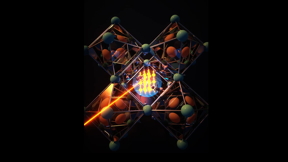 |
| Image by Ella Maru Studio |
Abstract:
Abstract:
The formation of coherent macroscopic states and the manipulation of their entanglement using external stimuli is essential for emerging quantum applications1-3. However, the observation of collective quantum coherent phenomena such as Bose-Einstein condensation, superconductivity, superfluidity, and superradiance has been limited to extremely low temperatures in order to suppress dephasing due to random thermal agitations. Here, we report room-temperature superfluorescence in hybrid perovskite PEA:CsPbBr3. This surprising discovery shows the existence of an extremely strong immunity to electronic dephasing due to thermal processes at elevated temperatures in this system. To explain the observation of room-temperature superfluorescence, we propose that the formation of large polarons in hybrid perovskites provides a “quantum analog of vibrational isolation” to the electronic excitation and protects it against dephasing even at room temperature. Understanding the origin of this sustained quantum coherence and the superfluorescence phase transition at high temperatures can provide guidance to design systems for emerging quantum information technologies and to realize similar macroscopic quantum phenomena in tailored materials.
Quantum ‘shock absorbers’ allow perovskite to exhibit superfluorescence at room temperature
Durham, NC | Posted on April 1st, 2022Semiconducting perovskites that exhibit superfluorescence at room temperature do so due to built-in thermal “shock absorbers” which protect dipoles within the material from thermal interference. A new study from North Carolina State University explores the mechanism involved in this macroscopic quantum phase transition and explains how and why materials like perovskites exhibit macroscopic quantum coherence at high temperatures.
Picture a school of fish swimming in unison or the synchronized flashing of fireflies – examples of collective behavior in nature. When similar collective behavior happens in the quantum world – a phenomenon known as macroscopic quantum phase transition – it leads to exotic processes such as superconductivity, superfluidity, or superfluorescenece. In all of these processes a group of quantum particles forms a macroscopically coherent system that acts like a giant quantum particle.
Superfluorescence is a macroscopic quantum phase transition in which a population of tiny light emitting units known as dipoles form a giant quantum dipole and simultaneously radiate a burst of photons. Similar to superconductivity and superfluidity, superfluorescence normally requires cryogenic temperatures to be observed, because the dipoles move out of phase too quickly to form a collectively coherent state.
Recently, a team led by Kenan Gundogdu, professor of physics at NC State and corresponding author of a paper describing the work, had observed superfluorescence at room temperature in hybrid perovskites.
“Our initial observations indicated that something was protecting these atoms from thermal disturbances at higher temperatures,” Gundogdu says.
The team analyzed the structure and optical properties of a common lead-halide hybrid perovskite. They noticed the formation of polarons in these materials – quasiparticles made of bound lattice motion and electrons. Lattice motion refers to a group of atoms that are collectively oscillating. When an electron binds to these oscillating atoms, a polaron forms.
“Our analysis showed that formation of large polarons creates a thermal vibrational noise filter mechanism that we call, ‘Quantum Analog of Vibration Isolation,’ or QAVI,” Gundogdu says.
According to Franky So, Walter and Ida Freeman Distinguished Professor of Materials Science and Engineering at NC State, “In layman’s terms, QAVI is a shock absorber. Once the dipoles are protected by the shock absorbers, they can synchronize and exhibit superfluorescence.” So is co-author of the research.
According to the researchers, QAVI is an intrinsic property that exists in certain materials, like hybrid perovskites. However, understanding how this mechanism works could lead to quantum devices that could operate at room temperature.
“Understanding this mechanism not only solves a major physics puzzle, it may help us identify, select and also tailor materials with properties that allow extended quantum coherence and macroscopic quantum phase transitions” Gundogdu says.
The research appears in Nature Photonics and is supported by the National Science Foundation (grant 1729383) and NC State’s Research and Innovation Seed Funding. NC State graduate students Melike Biliroglu and Gamze Findik are co-first authors.
####
For more information, please click here
Contacts:
Tracey Peake
North Carolina State University
Office: 919-515-6142
Copyright © North Carolina State University
If you have a comment, please Contact us.Issuers of news releases, not 7th Wave, Inc. or Nanotechnology Now, are solely responsible for the accuracy of the content.
Bookmark:


| Related Links |
 “Room Temperature Superfluorescence in Hybrid Perovskites and Its Origins”
| Related News Press |
News and information
Quantum computer improves AI predictions April 17th, 2026
Flexible sensor gains sensitivity under pressure April 17th, 2026
A reusable chip for particulate matter sensing April 17th, 2026
Detecting vibrational quantum beating in the predissociation dynamics of SF6 using time-resolved photoelectron spectroscopy April 17th, 2026
Superconductivity
MXene nanomaterials enter a new dimension Multilayer nanomaterial: MXene flakes created at Drexel University show new promise as 1D scrolls January 30th, 2026
Lattice-driven charge density wave fluctuations far above the transition temperature in Kagome superconductor April 25th, 2025
Perovskites
KAIST researchers introduce new and improved, next-generation perovskite solar cell November 8th, 2024
Possible Futures
A fundamentally new therapeutic approach to cystic fibrosis: Nanobody repairs cellular defect April 17th, 2026
UC Irvine physicists discover method to reverse ‘quantum scrambling’ : The work addresses the problem of information loss in quantum computing system April 17th, 2026
Discoveries
Quantum computer improves AI predictions April 17th, 2026
Flexible sensor gains sensitivity under pressure April 17th, 2026
A reusable chip for particulate matter sensing April 17th, 2026
Detecting vibrational quantum beating in the predissociation dynamics of SF6 using time-resolved photoelectron spectroscopy April 17th, 2026
Announcements
A fundamentally new therapeutic approach to cystic fibrosis: Nanobody repairs cellular defect April 17th, 2026
UC Irvine physicists discover method to reverse ‘quantum scrambling’ : The work addresses the problem of information loss in quantum computing system April 17th, 2026
Interviews/Book Reviews/Essays/Reports/Podcasts/Journals/White papers/Posters
A fundamentally new therapeutic approach to cystic fibrosis: Nanobody repairs cellular defect April 17th, 2026
UC Irvine physicists discover method to reverse ‘quantum scrambling’ : The work addresses the problem of information loss in quantum computing system April 17th, 2026
 |
||
 |
||
| The latest news from around the world, FREE | ||
 |
||
|
|
||
| Premium Products | ||
 |
||
|
Only the news you want to read!
Learn More |
||
 |
||
|
Full-service, expert consulting
Learn More |
||
|
|
||