Home > Press > Peering into precise ultrafast dynamics in matter
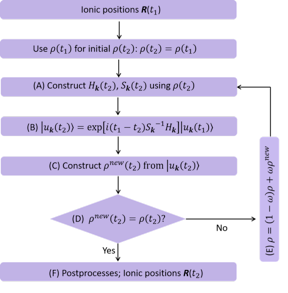 |
| Flowchart of rt-TDDFT approach for evolution of coupled electronic and ionic systems. Here, we assume that the two subsystems have the same evolution time step CREDIT Ultrafast Science |
Abstract:
A team of researchers from Beijing led by Prof. Dr. Sheng Meng has succeeded in developing predictive first-principles approaches for investigating precise ultrafast processes in matter. The method, named TDAP (time-dependent ab initio propagation), aims at providing robust dynamic simulations of light-induced, highly nonlinear phenomena which are at the atomic and molecular level and occur within a few femtosecond (10-15 sec) or even attosecond (10-18 sec). Fundamental interactions among different degrees of freedom can now be understood more precisely, purely based on quantum mechanical principles, according to the researchers. The results of the research have been published in the scientific journal Ultrafast Science and are expected to foster a variety of further developments in related scientific fields.
Peering into precise ultrafast dynamics in matter
Beijing, China | Posted on March 25th, 2022The team has spent a decade of years working on extending first-principels theoretical methods into modelling dynamical responses of quantum materials to external fields (e.g., electric, magnetic and laser fields), which are of great interest in these days, but the detailed information remains rather limited. Especially, the generation and synthesis of intense ultrashort light pulses with a controlled electric field and associated phases provide a promising route to dynamically decouple and manipulate the microscopic interactions with an unprecedented time resolution. Therefore, the laser-induced nonequilibrium phenomena have attracted enumerated attention from a broad range of scientific fields.
The theoretical treatment of the time-dependent nonadiabatic phenomena induced by laser is a formidable challenge at many levels, ranging from the description of the excited states to the time propagation of the corresponding physical properties. In TDAP, time-domain quantum evolution of electronic states with the classical approximations of nuclear motions is treated concurrently, which has enabled real-time tracking of coupled electron-nuclear dynamics without having to resort to the perturbation theory. The use of numerical atomic orbital has provided flexibility and credibility to do high-accuracy, large-scale simulations in a wide range of quantum systems with a moderate computational cost.
The method has been applied to the exploration of strong field physics and decoding vast information underneath the experimentally detected signals. By comparing the theoretical and experimental results, the approaches have been demonstrated effective and efficient in treating ultrafast quantum dynamical processes involving complex interactions among photons, electrons and phonons under laser excitation conditions. The development of this method helps understand the excited state dynamics in the fields of photocatalysis, photovoltaic and optoelectronic device design, attosecond pulse synthesis and applications, etc.
####
For more information, please click here
Contacts:
Jiangbo She
Ultrafast Science
Copyright © Ultrafast Science
If you have a comment, please Contact us.Issuers of news releases, not 7th Wave, Inc. or Nanotechnology Now, are solely responsible for the accuracy of the content.
Bookmark:


| Related Links |
| Related News Press |
News and information
 Quantum computer improves AI predictions April 17th, 2026
Flexible sensor gains sensitivity under pressure April 17th, 2026
A reusable chip for particulate matter sensing April 17th, 2026
Detecting vibrational quantum beating in the predissociation dynamics of SF6 using time-resolved photoelectron spectroscopy April 17th, 2026
Chemistry
Projecting light to dispense liquids: A new route to ultra-precise microdroplets January 30th, 2026
From sensors to smart systems: the rise of AI-driven photonic noses January 30th, 2026
"Nanoreactor" cage uses visible light for catalytic and ultra-selective cross-cycloadditions October 3rd, 2025
Cambridge chemists discover simple way to build bigger molecules – one carbon at a time June 6th, 2025
Possible Futures
A fundamentally new therapeutic approach to cystic fibrosis: Nanobody repairs cellular defect April 17th, 2026
UC Irvine physicists discover method to reverse ‘quantum scrambling’ : The work addresses the problem of information loss in quantum computing system April 17th, 2026
Optical computing/Photonic computing
ICFO researchers overcome long-standing bottleneck in single photon detection with twisted 2D materials August 8th, 2025
Programmable electron-induced color router array May 14th, 2025
Discoveries
Quantum computer improves AI predictions April 17th, 2026
Flexible sensor gains sensitivity under pressure April 17th, 2026
A reusable chip for particulate matter sensing April 17th, 2026
Detecting vibrational quantum beating in the predissociation dynamics of SF6 using time-resolved photoelectron spectroscopy April 17th, 2026
Announcements
A fundamentally new therapeutic approach to cystic fibrosis: Nanobody repairs cellular defect April 17th, 2026
UC Irvine physicists discover method to reverse ‘quantum scrambling’ : The work addresses the problem of information loss in quantum computing system April 17th, 2026
Interviews/Book Reviews/Essays/Reports/Podcasts/Journals/White papers/Posters
A fundamentally new therapeutic approach to cystic fibrosis: Nanobody repairs cellular defect April 17th, 2026
UC Irvine physicists discover method to reverse ‘quantum scrambling’ : The work addresses the problem of information loss in quantum computing system April 17th, 2026
Photonics/Optics/Lasers
Metasurfaces smooth light to boost magnetic sensing precision January 30th, 2026
From sensors to smart systems: the rise of AI-driven photonic noses January 30th, 2026
Solar/Photovoltaic
Spinel-type sulfide semiconductors to operate the next-generation LEDs and solar cells For solar-cell absorbers and green-LED source October 3rd, 2025
KAIST researchers introduce new and improved, next-generation perovskite solar cell November 8th, 2024
Groundbreaking precision in single-molecule optoelectronics August 16th, 2024
Development of zinc oxide nanopagoda array photoelectrode: photoelectrochemical water-splitting hydrogen production January 12th, 2024
 |
||
 |
||
| The latest news from around the world, FREE | ||
 |
||
|
|
||
| Premium Products | ||
 |
||
|
Only the news you want to read!
Learn More |
||
 |
||
|
Full-service, expert consulting
Learn More |
||
|
|
||