Home > Press > Turning any camera into a polarization camera: Metasurface attachment can be used with almost any optical system, from machine vision cameras to telescopes
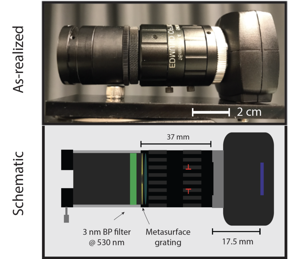 |
| The grating is mounted just in front of the front face of a chosen objective lens in a tube that also houses a bandpass filter and a field stop. This is shown implemented (top), as a schematic (bottom). CREDIT (Credit: Capasso Lab/Harvard SEAS) |
Abstract:
Polarization, the direction in which light vibrates, provides a lot of information about the objects with which it interacts, from aerosols in the atmosphere to the magnetic field of stars. However, because this quality of light is invisible to human eyes, researchers and engineers have relied on specialized, expensive, and bulky cameras to capture it. Until now.
Turning any camera into a polarization camera: Metasurface attachment can be used with almost any optical system, from machine vision cameras to telescopes
Cambridge, MA | Posted on March 18th, 2022Researchers from the Harvard John A. Paulson School of Engineering and Applied Sciences (SEAS) have developed a metasurface attachment that can turn just about any camera or imaging system, even off-the-shelf systems, into polarization cameras. The attachment uses a metasurface of subwavelength nanopillars to direct light based on its polarization and compiles an image that captures polarization at every pixel.
The research is published in Optics Express.
“The addition of polarization sensitivity to practically any camera will reveal details and features that ordinary cameras can’t see, benefiting a wide range of applications from face recognition and self-driving cars to remote sensing and machine vision, “said Federico Capasso, the Robert L. Wallace Professor of Applied Physics and Vinton Hayes Senior Research Fellow in Electrical Engineering at SEAS and senior author of the study.
In 2019, Capasso and his team developed a compact, portable camera that used a metasurface to image polarization in a single shot. In this research, the team explored how to generalize the concept of a polarization camera.
“After building the specialized polarization camera, we wanted to go more in depth and investigate the design rules and trade-offs that govern pairing a special polarization component with a conventional camera system,” said Noah Rubin, a graduate student at SEAS and co-first author of the study.
To demonstrate those design rules, the researchers attached the polarization metasurface to an off-the-shelf machine vision camera, simply screwing it on in front of the objective lens, in a small tube that also housed a color filter and field stop. From there, all they needed to do was point and click to get polarization information.
The nanopillars direct light based on polarization, which forms four images, each showing a different aspect of the polarization. The images are then put together, giving a full snapshot of polarization at every pixel.
The attachment could be used to improve machine vision in vehicles or in biometric sensors for security applications.
“This metasurface attachment is incredibly versatile,” said Paul Chevalier, a postdoctoral research fellow at SEAS and co-first author of the study. “It is a component that could live in a variety of optical systems, from room-size telescopes to tiny spy cameras, expanding the application space for polarization cameras.”
The research was co-authored by Michael Juhl, Michele Tamagnone and Russell Chipman. It was supported by the Earth Science Technology Office (ESTO) of the National Aeronautics and Space Administration (NASA) and by the U.S. Air Force Office of Scientific Research under grant no. FA9550-18-P-0024. It was performed in part at the Center for Nanoscale Systems (CNS), a member of the National Nanotechnology Coordinated Infrastructure (NNCI), which is supported by the National Science Foundation under NSF award no. 1541959.
####
For more information, please click here
Contacts:
Leah Burrows
Harvard John A. Paulson School of Engineering and Applied Sciences
Office: 617-496-1351
Copyright © Harvard John A. Paulson School of Engineering and Applied Sciences
If you have a comment, please Contact us.Issuers of news releases, not 7th Wave, Inc. or Nanotechnology Now, are solely responsible for the accuracy of the content.
Bookmark:


| Related Links |
| Related News Press |
News and information
 Quantum computer improves AI predictions April 17th, 2026
Flexible sensor gains sensitivity under pressure April 17th, 2026
A reusable chip for particulate matter sensing April 17th, 2026
Detecting vibrational quantum beating in the predissociation dynamics of SF6 using time-resolved photoelectron spectroscopy April 17th, 2026
Imaging
Simple algorithm paired with standard imaging tool could predict failure in lithium metal batteries August 8th, 2025
Law enforcement/Anti-Counterfeiting/Security/Loss prevention
Chainmail-like material could be the future of armor: First 2D mechanically interlocked polymer exhibits exceptional flexibility and strength January 17th, 2025
With VECSELs towards the quantum internet Fraunhofer: IAF achieves record output power with VECSEL for quantum frequency converters April 5th, 2024
Researchers’ approach may protect quantum computers from attacks March 8th, 2024
Govt.-Legislation/Regulation/Funding/Policy
Quantum computer improves AI predictions April 17th, 2026
Metasurfaces smooth light to boost magnetic sensing precision January 30th, 2026
New imaging approach transforms study of bacterial biofilms August 8th, 2025
Possible Futures
A fundamentally new therapeutic approach to cystic fibrosis: Nanobody repairs cellular defect April 17th, 2026
UC Irvine physicists discover method to reverse ‘quantum scrambling’ : The work addresses the problem of information loss in quantum computing system April 17th, 2026
Discoveries
Quantum computer improves AI predictions April 17th, 2026
Flexible sensor gains sensitivity under pressure April 17th, 2026
A reusable chip for particulate matter sensing April 17th, 2026
Detecting vibrational quantum beating in the predissociation dynamics of SF6 using time-resolved photoelectron spectroscopy April 17th, 2026
Announcements
A fundamentally new therapeutic approach to cystic fibrosis: Nanobody repairs cellular defect April 17th, 2026
UC Irvine physicists discover method to reverse ‘quantum scrambling’ : The work addresses the problem of information loss in quantum computing system April 17th, 2026
Interviews/Book Reviews/Essays/Reports/Podcasts/Journals/White papers/Posters
A fundamentally new therapeutic approach to cystic fibrosis: Nanobody repairs cellular defect April 17th, 2026
UC Irvine physicists discover method to reverse ‘quantum scrambling’ : The work addresses the problem of information loss in quantum computing system April 17th, 2026
Military
Quantum engineers ‘squeeze’ laser frequency combs to make more sensitive gas sensors January 17th, 2025
Chainmail-like material could be the future of armor: First 2D mechanically interlocked polymer exhibits exceptional flexibility and strength January 17th, 2025
Single atoms show their true color July 5th, 2024
NRL charters Navy’s quantum inertial navigation path to reduce drift April 5th, 2024
Aerospace/Space
Decoding hydrogen‑bond network of electrolyte for cryogenic durable aqueous zinc‑ion batteries January 30th, 2026
ICFO researchers overcome long-standing bottleneck in single photon detection with twisted 2D materials August 8th, 2025
Onion-like nanoparticles found in aircraft exhaust May 14th, 2025
 |
||
 |
||
| The latest news from around the world, FREE | ||
 |
||
|
|
||
| Premium Products | ||
 |
||
|
Only the news you want to read!
Learn More |
||
 |
||
|
Full-service, expert consulting
Learn More |
||
|
|
||