Home > Press > Controlling how fast graphene cools down An international study, published in ACS Nano, has demonstrated an unprecedented level of control of the optical properties of graphene. The work has promising applications in different technological fields ranging from photonics to teleco
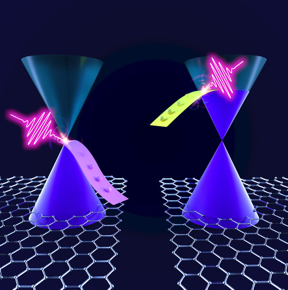 |
| Graphene charge carriers lying on different energetic levels represented by the Dirac cones, which, depending on the number of charge carriers, are occupied up to the neutrality point (blue level on the left cone) or well into the conduction band (blue level on the right cone). In the two cases, the photoexcited charge carriers relax with faster (left side) or slower (right side) dynamics. CREDIT Politecnico di Milano - CNR |
Abstract:
Graphene is the thinnest material ever produced, with the thickness of a single atomic layer, thinner than a billionth of a meter, it is able to efficiently absorb light from the visible to the infrared through the photoexcitation of its charge carriers. After light absorption, its photoexcited charge carriers cool down to the initial equilibrium state in a few picoseconds, corresponding to a millionth of a millionth of a second. The remarkable speed of this relaxation process makes graphene particularly promising for a number of technological applications, including light detectors, sources and modulators.
Controlling how fast graphene cools down An international study, published in ACS Nano, has demonstrated an unprecedented level of control of the optical properties of graphene. The work has promising applications in different technological fields ranging from photonics to teleco
Milano, Italy | Posted on March 4th, 2022A recent study published in ACS Nano has shown that the relaxation time of graphene charge carriers can be significantly modified by applying an external electrical field. The research was conceived within an international collaboration between the CNR-IFN, Politecnico di Milano, the University of Pisa, the Graphene Center of Cambridge (UK) and ICN2 of Barcelona (Spain).
“The change in the relaxation time of charge carriers in graphene that we have observed, demonstrates an unprecedented level of control on the optical response of a crystal and allows to obtain a large variety of behaviors using a single material” says Eva Pogna, researched from CNR-IFN, first author of the work.
This work paves the way to the development of devices that exploit the control of the relaxation time of charge carriers to support novel functionalities. For example, if graphene is used as saturable absorber in a laser cavity to generate ultrashort light pulses, by changing the relaxation time of the charge carriers, we can control the duration of the output pulses.
“The specific device that we have used to study graphene, proved to be crucial to observe the strong tunability of its optical properties with the external electric field, allowing to change the number of charge carriers over a broad range by exploiting ionic liquid gating, which is a state-of-the-art technology introduced to study superconductors” explains Andrea Ferrari, director of the Graphene Center in Cambridge.
The graphene-based device has been studied by ultrafast spectroscopy, which allowed to monitor the variation of the relaxation time of the charge carriers.
“This work represents the latest step of a long-standing research collaboration devoted to the study of the ultrafast carrier dynamics in graphene, aimed at exploring the great potential of this fascinating material” as added by Klaas-Jan Tielrooij, leader of the Ultrafast Dynamics in Nanoscale Systems group at ICN2.
“This discovery is of large interest for a number of technological applications, ranging from photonics, for pulsed laser sources or optical limiters that prevent optical components damaging, to telecommunication, for ultrafast detectors and modulators” concludes Giulio Cerullo, professor of the Physics Department of Politecnico di Milano.
####
For more information, please click here
Contacts:
Emanuele Sanzone
Politecnico di Milano
Office: 0223992443
Cell: +39 331.6480248
Copyright © Politecnico di Milano
If you have a comment, please Contact us.Issuers of news releases, not 7th Wave, Inc. or Nanotechnology Now, are solely responsible for the accuracy of the content.
Bookmark:


| Related Links |
| Related News Press |
News and information
 Quantum computer improves AI predictions April 17th, 2026
Flexible sensor gains sensitivity under pressure April 17th, 2026
A reusable chip for particulate matter sensing April 17th, 2026
Detecting vibrational quantum beating in the predissociation dynamics of SF6 using time-resolved photoelectron spectroscopy April 17th, 2026
Graphene/ Graphite
Electrifying results shed light on graphene foam as a potential material for lab grown cartilage June 6th, 2025
Breakthrough in proton barrier films using pore-free graphene oxide: Kumamoto University researchers achieve new milestone in advanced coating technologies September 13th, 2024
Possible Futures
A fundamentally new therapeutic approach to cystic fibrosis: Nanobody repairs cellular defect April 17th, 2026
UC Irvine physicists discover method to reverse ‘quantum scrambling’ : The work addresses the problem of information loss in quantum computing system April 17th, 2026
Discoveries
Quantum computer improves AI predictions April 17th, 2026
Flexible sensor gains sensitivity under pressure April 17th, 2026
A reusable chip for particulate matter sensing April 17th, 2026
Detecting vibrational quantum beating in the predissociation dynamics of SF6 using time-resolved photoelectron spectroscopy April 17th, 2026
Announcements
A fundamentally new therapeutic approach to cystic fibrosis: Nanobody repairs cellular defect April 17th, 2026
UC Irvine physicists discover method to reverse ‘quantum scrambling’ : The work addresses the problem of information loss in quantum computing system April 17th, 2026
Interviews/Book Reviews/Essays/Reports/Podcasts/Journals/White papers/Posters
A fundamentally new therapeutic approach to cystic fibrosis: Nanobody repairs cellular defect April 17th, 2026
UC Irvine physicists discover method to reverse ‘quantum scrambling’ : The work addresses the problem of information loss in quantum computing system April 17th, 2026
Photonics/Optics/Lasers
Metasurfaces smooth light to boost magnetic sensing precision January 30th, 2026
From sensors to smart systems: the rise of AI-driven photonic noses January 30th, 2026
 |
||
 |
||
| The latest news from around the world, FREE | ||
 |
||
|
|
||
| Premium Products | ||
 |
||
|
Only the news you want to read!
Learn More |
||
 |
||
|
Full-service, expert consulting
Learn More |
||
|
|
||