Home > Press > Superb switching uniformity of RRAM with localized nanofilaments of wafer-scale Si subulate array
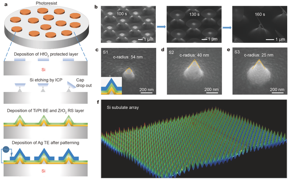 |
| Fig. 1. (a) Schematics of the SSA fabrication process. (b) SEM images of the SSA during the ICP etching process. (c–e) SEM images of the subulate RRAM devices with different c-radii. (f) 3D profile of uniform SSA from a typical region of the substrate. CREDIT ©Science China Press |
Abstract:
This study is led by Ying Zhang (doctoral student, Institute of Microelectronics, Chinese Academy of Sciences) and Dr. Xiaolong Zhao (postdoctor, School of Microelectronics, University of Science and Technology of China). Si subulate array (SSA) substrates with different curvature radii fabricated by a low-cost, CMOS-compatible, nanoscale-controllable, and wafer-scale process were utilized to configure highly uniform RRAM devices. The fabrication process of the Ag/ZrO2/Pt subulate device was shown in Fig. 1. The SSA substrate was prepared via inductively coupled plasma (ICP) etching the planar Si substrate. The smallest curvature radius (c-radius) was achieved with a critical ICP etching time. The c-radius of the tip region (TR) can be further controlled by prolonging the etching time. Subsequently, Pt/ZrO2/Ag RRAM devices were prepared on the SSA substrates (one tip per cell).
Superb switching uniformity of RRAM with localized nanofilaments of wafer-scale Si subulate array
Beijing, China | Posted on March 4th, 2022Compared with the control device with a planar Si substrate, the RRAM devices with subulate substrates exhibit significantly improved cycle-to-cycle and device-to-device uniformity (Fig. 2 and 3). Decreasing the c-radius significantly improves the device performance, including the resistive window, retention characteristics, and uniformity of switching voltages (VSET and VRESET) and resistance.
To determine the effects of the SSA strategy on conductive filament (CF) formation, the Pt/ZrO2/Ag subulate device after the SET process was investigated by transmission electron microscopy and energy dispersive spectroscopy characterization. CFs were demonstrated to be generated in the TR of the subulate device, where the electric field is enhanced by the tip with a small c-radius.
The SSA substrates enhance the local electric field, control a few CFs formed in the TR of each device, and further optimize the device switching performance. The low-cost SSA fabrication process is fully compatible with standard CMOS process for largescale integration. The proposed SSA provides a low-cost, uniform, CMOS-compatible, and nanoscale-controllable optimization strategy for the large-scale integration of highly uniform RRAM devices.
####
For more information, please click here
Contacts:
Bei Yan
Science China Press
Office: 86-10-64015905
Expert Contact
Xiaolong Zhao
School of Microelectronics, University of Science and Technology of China
Copyright © Science China Press
If you have a comment, please Contact us.Issuers of news releases, not 7th Wave, Inc. or Nanotechnology Now, are solely responsible for the accuracy of the content.
Bookmark:


| Related Links |
| Related News Press |
News and information
 Quantum computer improves AI predictions April 17th, 2026
Flexible sensor gains sensitivity under pressure April 17th, 2026
A reusable chip for particulate matter sensing April 17th, 2026
Detecting vibrational quantum beating in the predissociation dynamics of SF6 using time-resolved photoelectron spectroscopy April 17th, 2026
Possible Futures
A fundamentally new therapeutic approach to cystic fibrosis: Nanobody repairs cellular defect April 17th, 2026
UC Irvine physicists discover method to reverse ‘quantum scrambling’ : The work addresses the problem of information loss in quantum computing system April 17th, 2026
Chip Technology
A reusable chip for particulate matter sensing April 17th, 2026
Metasurfaces smooth light to boost magnetic sensing precision January 30th, 2026
Discoveries
Quantum computer improves AI predictions April 17th, 2026
Flexible sensor gains sensitivity under pressure April 17th, 2026
A reusable chip for particulate matter sensing April 17th, 2026
Detecting vibrational quantum beating in the predissociation dynamics of SF6 using time-resolved photoelectron spectroscopy April 17th, 2026
Announcements
A fundamentally new therapeutic approach to cystic fibrosis: Nanobody repairs cellular defect April 17th, 2026
UC Irvine physicists discover method to reverse ‘quantum scrambling’ : The work addresses the problem of information loss in quantum computing system April 17th, 2026
Interviews/Book Reviews/Essays/Reports/Podcasts/Journals/White papers/Posters
A fundamentally new therapeutic approach to cystic fibrosis: Nanobody repairs cellular defect April 17th, 2026
UC Irvine physicists discover method to reverse ‘quantum scrambling’ : The work addresses the problem of information loss in quantum computing system April 17th, 2026
 |
||
 |
||
| The latest news from around the world, FREE | ||
 |
||
|
|
||
| Premium Products | ||
 |
||
|
Only the news you want to read!
Learn More |
||
 |
||
|
Full-service, expert consulting
Learn More |
||
|
|
||