Home > Press > Development of semiconductor microchip that can detect prostate cancer markers with ultra-high sensitivity: Working toward the realization of IoT biosensors
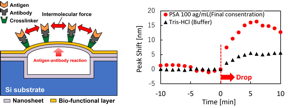 |
| The semiconductor sensor that detects antigen molecules by capturing them on the surface of a nanosheet film. The peak shift amount represents the output value of the sensor proportional to the amount of deformation of the film during marker adsorption. CREDIT COPYRIGHT (C) TOYOHASHI UNIVERSITY OF TECHNOLOGY. ALL RIGHTS RESERVED. |
Abstract:
Associate Professor Kazuhiro Takahashi and Tomoya Maeda (a second-year Master's student) and other members of the Department of Electrical and Electronic Information Engineering at Toyohashi University of Technology have developed a semiconductor sensor capable of detecting ultra-low concentrations of tumor markers, on chips made using semiconductor micromachine technology. The research team succeeded in detecting only prostate cancer antigens by adsorbing disease-derived marker molecules contained in blood and other bodily fluids into the surface of a flexibly deforming nanosheet, using the principle of converting the force caused by the interaction between the adsorbed molecules into the amount of deformation of the nanosheet. Testing chips, formed in sizes of several millimeters across using semiconductor technologies, are expected to be used as IoT biosensors for home-based testing.
Development of semiconductor microchip that can detect prostate cancer markers with ultra-high sensitivity: Working toward the realization of IoT biosensors
Toyohashi, Japan | Posted on March 4th, 2022Details
Measuring devices that perform disease tests simply and quickly from small amounts of blood, urine, saliva, and other bodily fluids are extremely important for accurate diagnosis and verifying the effectiveness of therapeutic treatments. Substances that change in concentration according to specific diseases contained in such bodily fluids are called biomarkers. As one example, it has been reported that patients with severe cases of COVID-19 have different concentrations of multiple biomarkers in their blood than those with mild cases of the disease, and it is expected that this can be used to predict severity by examining those markers. One of the most widely used marker tests is the PSA test. PSA is a marker that increases in the blood as a result of prostate cancer. Marker screening of saliva is also carried out as a less invasive form of cancer risk testing. The marker testing equipment that has been put to practical use so far is a detection method that reads color changes using a labeling agent. Because it takes time and effort to perform labeling, many of the devices used are relatively large, and the use of this method was limited to testing at large hospitals. Accordingly, if portable IoT biosensors are actualized, it is expected to expand testing opportunities and contribute to the advancement of telemedicine.
The research team is researching a micro-scale testing chip that uses flexibly deforming nanosheets formed using semiconductor micromachine technology to determine the presence or absence of disease. The principle of the method is that antibodies which catch the marker (antigen) molecules to be detected are fixed onto the nanosheet in advance, and the deformation of the thin film—caused by the force of the adsorbed antigens electrically repelling each other—is read. In this sensor—which was designed to deform sensitively in response to the adsorption of biomolecules—however, there was a problem in that the film deteriorated as a result of fixing antibodies to it. In the past, the biological functional layer on the surface was produced by spin coating and ultraviolet irradiation, but ultraviolet irradiation was considered to be one of the factors that degraded nanosheet films. The research team changed the materials used from the conventional method, and instead adopted a method of depositing the functional layer by chemical vapor deposition. As a result, a thinner, more uniform and less degraded sensor chip was created.
Using the biosensors developed on this occasion, the team conducted an experiment detecting prostate cancer biomarkers, and succeeded in detecting 100 attograms* (equivalent to three attomolars in terms of molar concentration) contained in one milliliter of fluid. This lower limit detection concentration is comparable to that of large testing devices using labeling agents, and can be hoped to be applied in ultra-sensitive testing with portable-scale testing devices. Furthermore, since it is possible to detect how nanosheets deform by adsorption of molecules in real time, it is possible to detect disease-derived molecules faster than in comparison with testing equipment using labeling agents.
*Atto: an SI unit prefix denoting 10-18 (quintillionth)
Future Outlook
The research team now plans to demonstrate that biomarkers can be detected on semiconductor sensors that integrate analytical integrated circuitry, with a view to practical applications in portable testing equipment. In addition, replacing probe molecules applied to the surface of nanosheets will enable the creation of numerous types of comprehensive disease diagnosis tests, which are expected to lead to the early-stage detection of more diseases in the future. By implementing IoT biosensors in society, the team aims to help create a society where everyone will be able to take tests easily, and undergo medical examinations by physicians remotely.
Reference
Tomoya Maeda, Ryoto Kanamori, Yong-Joon Choi, Miki Taki, Toshihiko Noda, Kazuaki Sawada, and Kazuhiro Takahashi, “Bio-Interface on Freestanding Nanosheet of Microelectromechanical System Optical Interferometric Immunosensor for Label-Free Attomolar Prostate Cancer Marker Detection”, Sensors, 2022, 22(4), 1356, DOI: 10.3390/s22041356
This research is supported by the Grants-in-Aid for Scientific Research (B) (17H03251, 20H02204), operated by the Ministry of Education, Culture, Sports, Science and Technology (MEXT), and the Precursory Research for Embryonic Science and Technology (PRESTO), Innovative nano-electronics through interdisciplinary collaboration among material, device and system layers (JPMJPR1526) operated by the Japan Science and Technology Agency (JST).
####
For more information, please click here
Contacts:
Yuko Ito
Toyohashi University of Technology (TUT)
Copyright © Toyohashi University of Technology (TUT)
If you have a comment, please Contact us.Issuers of news releases, not 7th Wave, Inc. or Nanotechnology Now, are solely responsible for the accuracy of the content.
Bookmark:


| Related Links |
| Related News Press |
News and information
 Quantum computer improves AI predictions April 17th, 2026
Flexible sensor gains sensitivity under pressure April 17th, 2026
A reusable chip for particulate matter sensing April 17th, 2026
Detecting vibrational quantum beating in the predissociation dynamics of SF6 using time-resolved photoelectron spectroscopy April 17th, 2026
Cancer
New molecular technology targets tumors and simultaneously silences two ‘undruggable’ cancer genes August 8th, 2025
Ben-Gurion University of the Negev researchers several steps closer to harnessing patient's own T-cells to fight off cancer June 6th, 2025
Self-propelled protein-based nanomotors for enhanced cancer therapy by inducing ferroptosis June 6th, 2025
Possible Futures
A fundamentally new therapeutic approach to cystic fibrosis: Nanobody repairs cellular defect April 17th, 2026
UC Irvine physicists discover method to reverse ‘quantum scrambling’ : The work addresses the problem of information loss in quantum computing system April 17th, 2026
Chip Technology
A reusable chip for particulate matter sensing April 17th, 2026
Metasurfaces smooth light to boost magnetic sensing precision January 30th, 2026
Nanomedicine
A fundamentally new therapeutic approach to cystic fibrosis: Nanobody repairs cellular defect April 17th, 2026
New molecular technology targets tumors and simultaneously silences two ‘undruggable’ cancer genes August 8th, 2025
New imaging approach transforms study of bacterial biofilms August 8th, 2025
Electrifying results shed light on graphene foam as a potential material for lab grown cartilage June 6th, 2025
Discoveries
Quantum computer improves AI predictions April 17th, 2026
Flexible sensor gains sensitivity under pressure April 17th, 2026
A reusable chip for particulate matter sensing April 17th, 2026
Detecting vibrational quantum beating in the predissociation dynamics of SF6 using time-resolved photoelectron spectroscopy April 17th, 2026
Announcements
A fundamentally new therapeutic approach to cystic fibrosis: Nanobody repairs cellular defect April 17th, 2026
UC Irvine physicists discover method to reverse ‘quantum scrambling’ : The work addresses the problem of information loss in quantum computing system April 17th, 2026
Interviews/Book Reviews/Essays/Reports/Podcasts/Journals/White papers/Posters
A fundamentally new therapeutic approach to cystic fibrosis: Nanobody repairs cellular defect April 17th, 2026
UC Irvine physicists discover method to reverse ‘quantum scrambling’ : The work addresses the problem of information loss in quantum computing system April 17th, 2026
Nanobiotechnology
A fundamentally new therapeutic approach to cystic fibrosis: Nanobody repairs cellular defect April 17th, 2026
New molecular technology targets tumors and simultaneously silences two ‘undruggable’ cancer genes August 8th, 2025
New imaging approach transforms study of bacterial biofilms August 8th, 2025
Electrifying results shed light on graphene foam as a potential material for lab grown cartilage June 6th, 2025
 |
||
 |
||
| The latest news from around the world, FREE | ||
 |
||
|
|
||
| Premium Products | ||
 |
||
|
Only the news you want to read!
Learn More |
||
 |
||
|
Full-service, expert consulting
Learn More |
||
|
|
||