Home > Press > Measuring pulse waves with a hair-thin patch
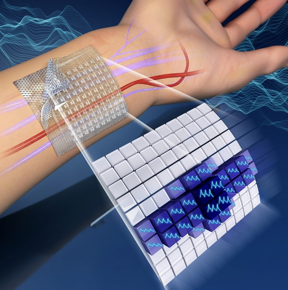 |
| Pulse signal map created by ultrathin wearable sensors with 100 sensing pixels. CREDIT POSTECH |
Abstract:
A pulse wave is a wave in which the blood flow – that originates from the heartbeat – is transmitted to the body. It is an important biosignal that indicates cardiovascular health. Analyzing the pulse wave signal can diagnose cardiac conditions including high blood pressure, arteriosclerosis and more. However, conventional pulse wave measuring devices are cumbersome as they require wearing the blood-pressure measuring cuff or stiff tong-shaped sensor and can mostly be performed at hospitals.
Measuring pulse waves with a hair-thin patch
Pohang, South Korea | Posted on March 4th, 2022Recently, a POSTECH research team led by Professor Sungjune Jung (Department of Convergence IT Engineering and Department of Materials Science and Engineering), Dr. Sanghoon Baek (Department of Convergence IT Engineering), and Professor Sung-Min Park (Department of Convergence IT Engineering, Department of Mechanical Engineering, and Department of Electrical Engineering) in collaboration with Professor Hyunhyub Ko of UNIST (School of Energy and Chemical Engineering) has developed a wearable sensor patch thinner than a hair strand that can measure pulse wave signals with high precision.
What is notable about this research is that the patch was printed using inkjet printing that we are familiar with. This printing technology is also well known as a next-generation semiconductor manufacturing method that can dramatically reduce cost. Using this technology, wearable electronic devices can be made by simply printing conductive ink on a very thin substrate.
First, the research team fabricated a pressure sensor that mimics skin’s tactility and used it to enable physical pulse waves to be detected by the patch just as they are detected by the fingers. The researchers also used a patch-type device with 100 sensor pixels to obtain a two-dimensional (2D) pressure map on the wrist. Conventional wearable pulse wave sensors are designed to measure signals only at a single location, making it difficult to accurately place them on the artery, leading to less precise measurements.
Through experiments, the researchers successfully created a 2D pressure map to accurately obtain the pulse wave signals and analyzed their strengths to locate the invisible arterial blood vessels. Moreover, the researchers developed sensor patches of various sizes by taking age, gender, and body sizes into consideration. Such personalized design was possible by the simple inkjet printing technology.
“This study is significant in that it has demonstrated possible applications of inkjet printing to next-generation customizable wearable devices,” remarked Professor Sungjune Jung of POSTECH.
“The newly developed technology allows for at-home diagnosis of diseases that are usually performed only at hospitals,” explained Professor Sung-Min Park of POSTECH. He added, “it can be used for medical applications such as pre-diagnosis of cardiovascular diseases and arterial catheter injections in daily life.”
Recently published in the international journal ACS Nano, this study was conducted with the support from the Technology Innovation Program funded by the Ministry of Trade, Industry & Energy of Korea (MOTIE) and from the LG Display-POSTECH Incubation program.
####
For more information, please click here
Contacts:
Jinyoung Huh
Pohang University of Science & Technology (POSTECH)
Office: 82-54-279-2415
Copyright © Pohang University of Science & Technology (POSTECH)
If you have a comment, please Contact us.Issuers of news releases, not 7th Wave, Inc. or Nanotechnology Now, are solely responsible for the accuracy of the content.
Bookmark:


| Related Links |
| Related News Press |
News and information
 Researchers develop molecular qubits that communicate at telecom frequencies October 3rd, 2025
Next-generation quantum communication October 3rd, 2025
"Nanoreactor" cage uses visible light for catalytic and ultra-selective cross-cycloadditions October 3rd, 2025
Govt.-Legislation/Regulation/Funding/Policy
New imaging approach transforms study of bacterial biofilms August 8th, 2025
Electrifying results shed light on graphene foam as a potential material for lab grown cartilage June 6th, 2025
Institute for Nanoscience hosts annual proposal planning meeting May 16th, 2025
Possible Futures
Spinel-type sulfide semiconductors to operate the next-generation LEDs and solar cells For solar-cell absorbers and green-LED source October 3rd, 2025
Nanomedicine
New molecular technology targets tumors and simultaneously silences two ‘undruggable’ cancer genes August 8th, 2025
New imaging approach transforms study of bacterial biofilms August 8th, 2025
Cambridge chemists discover simple way to build bigger molecules – one carbon at a time June 6th, 2025
Electrifying results shed light on graphene foam as a potential material for lab grown cartilage June 6th, 2025
Discoveries
Researchers develop molecular qubits that communicate at telecom frequencies October 3rd, 2025
Next-generation quantum communication October 3rd, 2025
"Nanoreactor" cage uses visible light for catalytic and ultra-selective cross-cycloadditions October 3rd, 2025
Announcements
Rice membrane extracts lithium from brines with greater speed, less waste October 3rd, 2025
Researchers develop molecular qubits that communicate at telecom frequencies October 3rd, 2025
Next-generation quantum communication October 3rd, 2025
"Nanoreactor" cage uses visible light for catalytic and ultra-selective cross-cycloadditions October 3rd, 2025
Interviews/Book Reviews/Essays/Reports/Podcasts/Journals/White papers/Posters
Spinel-type sulfide semiconductors to operate the next-generation LEDs and solar cells For solar-cell absorbers and green-LED source October 3rd, 2025
Rice membrane extracts lithium from brines with greater speed, less waste October 3rd, 2025
Nanobiotechnology
New molecular technology targets tumors and simultaneously silences two ‘undruggable’ cancer genes August 8th, 2025
New imaging approach transforms study of bacterial biofilms August 8th, 2025
Ben-Gurion University of the Negev researchers several steps closer to harnessing patient's own T-cells to fight off cancer June 6th, 2025
Electrifying results shed light on graphene foam as a potential material for lab grown cartilage June 6th, 2025
 |
||
 |
||
| The latest news from around the world, FREE | ||
 |
||
|
|
||
| Premium Products | ||
 |
||
|
Only the news you want to read!
Learn More |
||
 |
||
|
Full-service, expert consulting
Learn More |
||
|
|
||