Home > Press > “Workhorse” of photovoltaics combined with perovskite in tandem for the first time
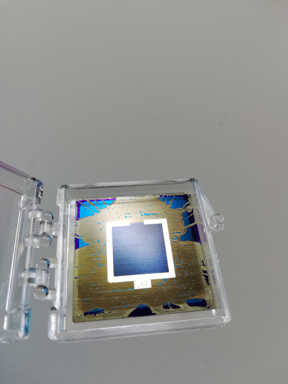 |
| A standard silicon solar cell is combined with a perovskite top cell. This tandem solar cell could reach high efficiencies. CREDIT Silvia Mariotti / HZB |
Abstract:
Tandem cells made of silicon and perovskite are able to convert the broad energy spectrum of sunlight into electrical energy more efficiently than the respective single cells. Now, for the first time, two teams from HZB and ISFH Hameln have succeeded in combining a perovskite top cell with a so-called PERC/POLO silicon cell to form a tandem device. This is an important achievement, since PERC silicon cells on p-type silicon are the "workhorse" of photovoltaics, with a market share of about 50% of all solar cells produced worldwide. They are largely optimised, long-term stable and temperature stable. Therefore, it is particularly interesting for the commercialisation of a perovskite-silicon tandem technology to develop a "perovskite tandem upgrade" for PERC cells. The cooperation took place within the framework of the joint project P3T, which is funded by the Federal Ministry of Economics and coordinated by HZB.
“Workhorse” of photovoltaics combined with perovskite in tandem for the first time
Berlin, Germany | Posted on February 25th, 2022The team at ISFH used an industry-compatible PERC process for the backside contact of the silicon bottom cells. On the front side of the wafer, another industrialisable technology was used, the so-called POLO contact, which was adapted here for the small-area proof of concept cells.
Perovskite expertise at HZB
The following process steps took place at HZB: A tin-doped indium oxide recombination layer was applied as a contact between the two subcells. On top of this, a perovskite cell was processed with a layer sequence similar to that in the current world record tandem cell on n-type silicon heterojunction cells, made by HZB. The first perovskite PERC/POLO tandem cells produced in this way achieve an efficiency of 21.3% on an active cell area of about 1 cm². This efficiency is thus still below the efficiency of optimised PERC cells in this feasibility study. "However, initial experimental results and optical simulations indicate that we can significantly improve the performance through process and layer optimisation," explains Dr. Lars Korte, the corresponding author of the study.
PCE estimated at 29,5 %
The experts estimate the Power Conversion Efficiency (PCE) of these perovskite/silicon tandem solar cells with PERC-like sub-cell technology at 29.5 %. The next steps for further efficiency increases are already clear: Dr. Silvia Mariotti from the HZB team had identified the coverage of the silicon surface by the perovskite as potential for improvement: "For this purpose, one could adapt the surface of the silicon wafers and thus quickly increase the efficiency to about 25%," says Mariotti. This is then already significantly higher than the efficiency of PERC single cells.
####
For more information, please click here
Contacts:
Antonia Roetger
Helmholtz-Zentrum Berlin für Materialien und Energie
Office: 0049-308-062-43733
Copyright © Helmholtz-Zentrum Berlin für Materialien und Energie
If you have a comment, please Contact us.Issuers of news releases, not 7th Wave, Inc. or Nanotechnology Now, are solely responsible for the accuracy of the content.
Bookmark:


| Related Links |
| Related News Press |
News and information
 Quantum computer improves AI predictions April 17th, 2026
Flexible sensor gains sensitivity under pressure April 17th, 2026
A reusable chip for particulate matter sensing April 17th, 2026
Detecting vibrational quantum beating in the predissociation dynamics of SF6 using time-resolved photoelectron spectroscopy April 17th, 2026
Perovskites
KAIST researchers introduce new and improved, next-generation perovskite solar cell November 8th, 2024
Efficient and stable hybrid perovskite-organic light-emitting diodes with external quantum efficiency exceeding 40 per cent July 5th, 2024
Possible Futures
A fundamentally new therapeutic approach to cystic fibrosis: Nanobody repairs cellular defect April 17th, 2026
UC Irvine physicists discover method to reverse ‘quantum scrambling’ : The work addresses the problem of information loss in quantum computing system April 17th, 2026
Discoveries
Quantum computer improves AI predictions April 17th, 2026
Flexible sensor gains sensitivity under pressure April 17th, 2026
A reusable chip for particulate matter sensing April 17th, 2026
Detecting vibrational quantum beating in the predissociation dynamics of SF6 using time-resolved photoelectron spectroscopy April 17th, 2026
Announcements
A fundamentally new therapeutic approach to cystic fibrosis: Nanobody repairs cellular defect April 17th, 2026
UC Irvine physicists discover method to reverse ‘quantum scrambling’ : The work addresses the problem of information loss in quantum computing system April 17th, 2026
Interviews/Book Reviews/Essays/Reports/Podcasts/Journals/White papers/Posters
A fundamentally new therapeutic approach to cystic fibrosis: Nanobody repairs cellular defect April 17th, 2026
UC Irvine physicists discover method to reverse ‘quantum scrambling’ : The work addresses the problem of information loss in quantum computing system April 17th, 2026
Energy
Sensors innovations for smart lithium-based batteries: advancements, opportunities, and potential challenges August 8th, 2025
Simple algorithm paired with standard imaging tool could predict failure in lithium metal batteries August 8th, 2025
Solar/Photovoltaic
Spinel-type sulfide semiconductors to operate the next-generation LEDs and solar cells For solar-cell absorbers and green-LED source October 3rd, 2025
KAIST researchers introduce new and improved, next-generation perovskite solar cell November 8th, 2024
Groundbreaking precision in single-molecule optoelectronics August 16th, 2024
Development of zinc oxide nanopagoda array photoelectrode: photoelectrochemical water-splitting hydrogen production January 12th, 2024
 |
||
 |
||
| The latest news from around the world, FREE | ||
 |
||
|
|
||
| Premium Products | ||
 |
||
|
Only the news you want to read!
Learn More |
||
 |
||
|
Full-service, expert consulting
Learn More |
||
|
|
||